Saturday, 12 February 2011

Cambodian Government Approves Controversial Titanium Mine

via CAAI

The Cambodian government has approved a titanium mine which will lead to the deforestation of over 50,000 acres of rain forest.

PHNOM PENH, Cambodia/WASHINGTON, DC, Feb. 11, 2011 – Prime Minister Hun Sen has approved a land concession to United Khmer Group, a private mining company. The prime minister’s approval came ahead of a meeting on Friday, February 11 at the Council for the Development of Cambodia that was meant to discuss the proposed mining project. United Khmer Group had exploration rights to search for titanium in 20,400 hectares of densely forested land in the Southern Cardamom Mountains.

The decision to approve the mine threatens to devastate one of the last remaining elephant corridors on the continent, put more than 70 endangered and vulnerable species at risk, and degrade one of the world’s largest remaining carbon sink reserves. Months after local villagers initially discovered construction workers bulldozing access roads in June 2010, the Cambodian government’s decision will allow the mining company to exploit the land.

Suwanna Gauntlett, Wildlife Alliance CEO, led the fight against the mine, representing the views of local communities and other environmental groups. Local villagers recognized the mine as a threat to the growing ecotourism industry, agricultural initiatives, forests, and a habitat for one of Cambodia’s largest wild elephant populations.

“This is Cambodia’s natural heritage, its national heritage, and it could all be eliminated by 20,400 hectares of strip mining,” Gauntlett says.

The United Khmer Group projects revenues of more than $1.3 billion a year, numbers that far outpace the market rate for titanium. To date, a comprehensive study to determine the size and concentration levels of the titanium ore deposit has not been conducted.

“Without scientific research to prove the economic viability of the proposed mine,” Gauntlett says, “bulldozing the rainforest is simply destructive and does not even make good business sense.”

Wildlife Alliance calls on United Khmer Group to work closely with communities, the Forestry Administration and environmental groups to minimize the mine's impact on local residents, waterways, and wildlife. Further, we request UKG submit a comprehensive Environmental Impact Assessment and strictly abide by the regulations laid out in Cambodia’s laws on forestry and mining.

“We recognize that development is essential to Cambodia’s future, but that development must be conducted in a coordinated matter that respects conservation initiatives,” says Suwanna Gauntlett. “We ask that all industrial developers work closely with conservation partners in the Southern Cardamom Mountains to minimize environmental damages associated with economic development. Together we can find solutions to maximize the earning potential of local people while diminishing the harm to wildlife and habitats, local rivers, and downstream fisheries.”

Wildlife Alliance is a non-profit organization based in Cambodia and Washington, D.C., working directly with communities and governments to improve forest management and institute good governance to comprehensively address the devastation of ecosystems and combat the illegal wildlife trade. We actively empower local communities by promoting diversified agriculture, community-based ecotourism, and reforestation. Visit Wildlife Alliance on the Web at: http://www.wildlifealliance.org/.

Contacts:
In Phnom Penh — John Maloy, Chief Communications Officer
+855 78 809 70
jmaloyonline.com.kh

In Washington, D.C. — Andrea Kaufmann, Director of Communications and Marketing
+1 202 368 1746
kaufmannwildlifealliance.org

Cambodia's orphan tourism

via CAAI

With more than 600,000 orphans in Cambodia, we look at the booming business behind the country's orphanages.

101 East Last Modified: 10 Feb 2011 13:27 GMT


Cambodia's beautiful temples and dark history attracts tourists from across the world.

But many of today's holidaymakers want to do more than sightseeing, with a growing number volunteering their time, energy and skills for free.

From schools to orphanages, they hope their efforts will have a positive impact on the country. But critics claim that such good intentions are having a negative impact, with some orphanages creating a booming business trading on guilt.

There are reports of orphanages using children with parents to pose as orphans, of wealthy tourists depriving local workers from getting much-needed jobs, and of orphans forming emotional attachments to volunteers and facing more trauma when they leave.

On this edition of 101 East, we ask if volunteer tourism does more harm than good for the people of Cambodia.

Villagers Suffering From Thai-Cambodia Border Fighting, Urge Peace

Daniel Schearf, VOA Khmer
Si Sa Ket, Thailand Friday, 11 February 2011

via CAAI

Photo: VOA – D. Schearf
Border clashes have left thousands of villagers homeless from Thai-Cambodia border area.

"Fortunately, the children were not in the buildings and nobody was injured.

Border clashes between Thailand and Cambodia have stopped for now and their political leaders are set to hold talks Monday at the United Nations. The fighting near a disputed border area was the worst in years, killing several on both sides and sending thousands fleeing for safety. Villagers have yet to return home and many in Thailand urge the government to resolve the dispute so life can return to normal.

Thousands of villagers fled the Thai-Cambodia border after their militaries exchanged artillery and machine gun fire a week ago.

Many Cambodian villagers took refuge in Siem Reap, while Thais moved to camps several kilometers away from the border.

Sodsri Phahom returned to her home in Phum Srol district briefly, for her husband's funeral. She says when the shells hit she and her niece ran for the trees while her husband took cover in a ditch. He was decapitated by shrapnel. Now she has to care for the farm and their five children on her own.

She says they are in deep trouble because they are poor. She says since her husband died they have no money left. She blames the Thai government for not being able to keep peace with Cambodia.

A week after fighting broke out, villages along the border remain empty and schools closed. Many houses here were damaged or destroyed.

Workers at Phum Srol Wittaya school sweep up outside a one-story building. The classroom walls and ceilings are blown out and the children's desks are covered with debris.

The main school building next to it has a massive hole in the roof. Fortunately, the children were not in the buildings and nobody was injured.

School Director Pramoon Sawangpon says classes are scheduled to resume Monday though he is not comfortable with the idea.

He says personally, right now, he cannot conclude whether to stop or continue classes because they are still waiting. He says he is not sure that it will be safe because fighting can happen any time.

The clashes erupted near disputed territory surrounding a 900-year-old Hindu Khmer temple known as Preah Vihear in Cambodia and Phra Viharn in Thailand.

Both sides blame the other for starting the fighting. Armed volunteers helped evacuate 3,000 people and remain behind to guard homes.

Defense leader Boonkerd Tae Tong says they have always had good relations with Cambodians, who he calls part of their community. He blames politics for the dispute particularly because two rival Thai groups, known as the red shirts and the yellow shirts, have used the border issue to gain support.

He says it probably started in 2008 when yellow and red shirt groups came here. He says since then, along the border, they are never happy with either trade or livelihoods. He says they have border tensions continuously.

Civilians and journalists are not allowed to enter the temple area and the border remains tense with militaries on both sides preparing for any further confrontation.

Foreign Minister Leaves for Security Council Talks

Chun Sakada, VOA Khmer
Phnom Penh Friday, 11 February 2011

via CAAI

Photo: AP
A Cambodian army soldier sits at damaged Cambodia's 11th century Hindu Preah Vihear temple.

Foreign Minister Hor Namhong on Friday left Cambodia for New York, where he is scheduled to address UN Security Council officials over deadly border fighting with Thailand last week.

Prime Minister Hun Sen has called on the Security Council to intervene in what has become a protracted, sometimes violent border standoff.

The latest clash, which was the most intense, involved artillery and tank exchanges and left at least 10 people dead.


Hor Namhong is scheduled to address the Security Council along with his Thai and Indonesian counterparts on Monday.

Indonesia, which is the current head of Asean, is attempting to mediate the ongoing dispute, which centers around a small stretch of land next to Preah Vihear temple, a Unesco World Heritage site that was damaged in fighting over the weekend.

Teachers With Two Jobs Hurting Education: Advocate

Sok Khemara, VOA Khmer

Washington, DC Friday, 11 February 2011

via CAAI

Photo: AP
Cambodian school children sit under the shade of tree as they listen to teacher at Trapaing Loeuk primary school in Kampong Speu province.

“If education is weak, it impacts all sectors.”

Low salaries for teachers means that nearly all of them have to take second jobs, which threatens the quality of Cambodia’s education, a leading teachers activist said Thursday.

Rong Chhun, who is the president of the Cambodian Independent Teachers Association, told “Hello VOA” that a poor teacher corps was harmful to the development of Cambodia overall.

“When they have another job, they do not have time to research or properly instruct, and there is no concentration in transferring their knowledge to students,” he said. “If education is weak, it impacts all sectors.”

Cambodia has more than 100,000 teachers nationwide, but their budgeted salary is only $40 to $60 per month. This leads almost “95 percent” of them to take other jobs, Rong Chhun said.

Teachers have complained alongside other workers that the price of goods and services in Cambodia continues to rise, but that salaries have not kept pace.

Cheam Yiep, a lawmaker for the ruling Cambodian People’s Party and head of the National Assembly’s finance committee, said the government tries to raise salaries by as much as 20 percent per year. However, he acknowledged that low salaries and continued inflation have made it a struggle for many teachers.

Rong Chhun said the government should pay teachers up to $240 per month and encouraged more educators to join his association in a bid to raise salaries.

Thailand, Cambodia Border Fight Moves to UN

Ron Corben
Bangkok February 11, 2011

via CAAI

A Cambodian soldier polishes his boots at the 11th-century Preah Vihear temple on the border between Thailand and Cambodia, February 8, 2011

Thailand and Cambodia plan to present their positions next week to the United Nations Security Council over recent fighting on their border.

A ceasefire held Friday along the Cambodian-Thai border, though the armies of both governments remain on alert.

Latest fight

A week ago, fighting erupted near a 900-year-old Hindu Khmer temple on the border. Several died before fighting halted Tuesday, and thousands on both sides were forced to flee their homes.

On Monday, Cambodia’s Foreign Minister Hor Namhong and Thailand’s Kasit Piromya appear before the United Nations Security Council to set out their respective positions. Each country blames the other for starting the battle.

In 1962, the International Court of Justice ruled the temple was in Cambodia, but a main access route is on the Thai side. The two sides have disputed the exact border in places around the temple, known as Preah Vihear in Cambodia and Phra Viharn in Thailand.

Possible rights violations

Sunai Pasuk, a representative for Human Rights Watch in Thailand, says the U.N. will provide a forum for debate over the clashes, and could help determine human rights violations.

"But the basis for conflict resolution is still within bilateral process," noted Sunai. "A presentation at the U.N. Security Council will be an opportunity to both Thailand and Cambodia to [outline] further allegations of human rights violations to international laws as the use of cluster ammunitions can only be resolved with independent observation of the affected area."

Both countries have accused the other of using banned cluster bombs in the fighting.

ASEAN presence at meeting

Indonesian Foreign Minister Marty Natelegawa, whose country is currently chairman of the Association of Southeast Asian Nations, also will attend the U.N. meeting. ASEAN officials have offered to mediate negotiations between Bangkok and Phnom Penh.

In Thailand, Prime Minister Abhisit Vejjajiva says the temple should be de-listed as a United Nations Scientific and Educations Organization World Heritage site.

Mr. Abhisit says doing so and scrapping a proposed Cambodian management plan would defuse the border conflict. However, Cambodia is expected to oppose the idea.

Interior pressure

The border dispute first flared up in 2008, after Cambodia received World Heritage status for Preah Vihear. Thai nationalists, many of whom say the temple belongs to Thailand, protested, and both governments reinforced troops along the border.

The Thai government is facing pressure from the nationalists, who demand that Bangkok revoke a memorandum of understanding with Cambodia on resolving border disputes. Nationalist groups want their government to push for Cambodians off disputed lands. The government has rejected these calls.

UNESCO Director-General to send Special Envoy to Bangkok and Phnom Penh

via CAAI

WEBWIRE – Friday, February 11, 2011

UNESCO Director-General Irina Bokova regretted the continuing tension between Cambodia and Thailand over the issue of the Temple of Preah Vihear. “The world’s cultural heritage should never be a cause for conflict,” she said.

She announced that she would shortly send a Special Envoy on a mission of good offices to Bangkok and Phnom Penh, following appropriate consultations with both capitals.

The Director-General also stated that any assessment mission to the Preah Vihear site could only take place once calm has been restored to the area.

Meanwhile, UNESCO is in close touch with senior officials of both countries.

The temple was inscribed on the World Heritage List in 2008. Dedicated to Shiva, is composed of a series of sanctuaries linked by a system of pavements and staircases over an 800-metre-long axis; it dates back to the first half of the 11th century AD. The site is exceptional for the quality of its carved stone ornamentation and its architecture, adapted to the natural environment and the religious function of the temple.

Dragonfly embraces gay drop-in centre


Meghan Lewis has opened a drop-in centre at Dragonfly House for gay and transgender people. Photo by: CRAIG MILES

via CAAI

Friday, 11 February 2011 15:00 Craig Miles

THE need for a safe place for gay and transgender people in Siem Reap as well as a lack of information has prompted the opening of a drop-in centre this month.

Dragonfly House manager Meghan Lewis said there were services for individual groups, such as gay men or lesbians, but no services which brought the groups together to discuss health issues.

She said there were several problems the gay and bisexual community faced in Siem Reap, including lack of access to information about sexual health and a lack of health services in general.

She said some transgender people felt uncomfortable going to the doctor, adding: “The GPs discriminate and a lot of people find that the doctors just laugh at them. For example, if transgender people present themselves as a male, they will feel uncomfortable. There is a lack of understanding from the GPs.”

She said another problem in Siem Reap was with police harassment.

“There was an incident last month where four transgender people were arrested and had their condoms taken from them. They look different and are arrested for reasons that can’t be explained.”

The Dragonfly House will initially be open from 9am to 5pm, and Lewis said the long-term goal was to have it open all the time and also to hopefully run a small café.

She said the centre would run workshops on different themes, such as rights, religion and sexuality.

“We will also provide some fun events, dancing classes and exercise classes. We will provide the space so that if someone has a talent or skill, they can share it.”

The idea of drop-in centres in Cambodia started after a study by the Khmer HIV/AIDS NGO Alliance, assessing the needs and possible implementation of drop-in centres in Battambang, Siem Reap and Sihanoukville, was published in 2006.

To contact Dragonfly House, please email Meghan on mlewis@khana.org.khThis e-mail address is being protected from spambots. You need JavaScript enabled to view it , or phone 0636 689 900.

AKP - The Agence Kampuchea Press


via CAAI

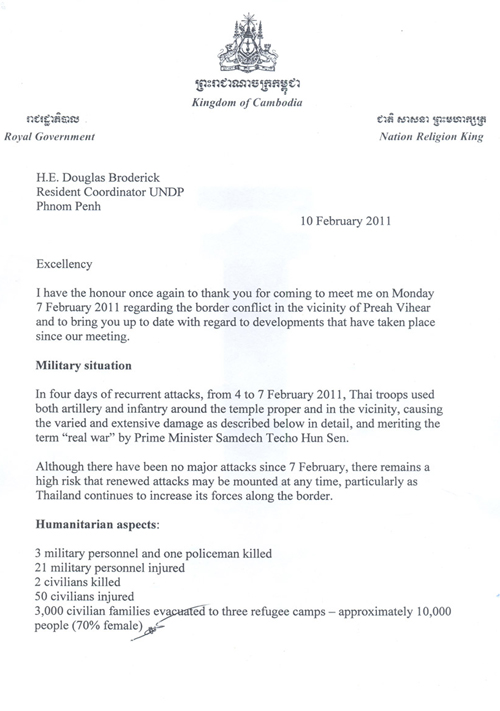
DPM Sok An’s Letter to UNDP Resident Coordinator

Phnom Penh, February 11, 2011 AKP – Cambodian Deputy Prime Minister and Minister in charge of the Office of the Council of Ministers H.E. Sok An has sent a letter to Resident Coordinator of the United Nations Development Program (UNDP), H.E. Douglas Broderick to inform him of new developments of the Cambodia-Thailand border conflict.

The letter dated Feb. 10 reads as follows:

______

NGOs Support Royal Government

Phnom Penh, February 11, 2011 AKP – Associations, NGOs and Unions of Cambodia issued on Feb. 10 a statement to support the Royal Government of Cambodia for requesting the president of the United Nations Security Council to call an urgent meeting so as to stop Thailand’s aggression on Cambodia.

Below is the full statement:  


______


PM Meets Japanese Ambassador in charge of International Counterterrorism Cooperation

Phnom Penh, February 11, 2011 AKP – Cambodian Prime Minister Samdech Akka Moha Sena Padei Techo Hun Sen received here yesterday visiting Japanese Ambassador in charge of international counterterrorism cooperation, Mr. Takaaki Mojima.

In the meeting, Mr. Takaaki Mojima said the purpose of his visit to Cambodia was to participate in the ASEAN-Japan Dialogue on Anti-Terrorism.

He said Japan will do its best to cooperate with Cambodia for the success of the meeting, Ieng Sophalet, assistant to the Cambodian premier told reporters upon the talk.

For his part, Samdech Techo Hun Sen proposed to upgrade the meeting, from the Japan-ASEAN dialogue partnership to the Japan-ASEAN cooperation partnership.

Cambodia is ready to cooperate with Japan and in the ASEAN-Japan framework as well as with other partners in combating terrorism, he said.

Samdech Techo Hun Sen also expressed his belief that Japan will contribute to help Cambodia in fighting against terrorism.

Cambodia has been hosting the two-day (Feb. 10-11) ASEAN-Japan Dialogue on Anti-Terrorism, which began in 2005. –AKP

By SOKMOM Nimul

______

PM: Agriculture Is the Biggest Priority for Cambodia

Phnom Penh, February 11, 2011 AKP – Agriculture is the biggest priority for Cambodia. If we neglect it, it will be the big mistake for leadership policy, said Cambodian Prime Minister Samdech Akka Moha Sena Padei Techo Hun Sen.

At a graduation ceremony held here on Thursday at the Royal University of Agriculture, the Cambodian premier recalled the success in the agricultural domain, stressing that Cambodia has changed from a country that lacked rice to a country that has the surplus rice for export.

“Our choice is to do our best so that a hectare of land, which fed five people, could feed from 10 to 20 people or more,” said Samdech Techo Hun Sen, adding that irrigation system is the first challenge to be solved.

On the occasion, the prime minister highly appreciated the Royal University of Agriculture and the Prek Leap National School of Agriculture for their efforts in training human resources. –AKP

Article in Khmer by CHEY Phum Pul
Article in English by SOKMOM Nimul

______

H.E. Sok An Meets New Australian Ambassador

Phnom Penh, February 11, 2011 AKP – Deputy Prime Minister H.E. Sok An, minister in charge of the Council of Ministers Office told new Australian Ambassador to Cambodia Ms. Penelope Ann Richards on Feb. 9 that the bilateral talks between Cambodia and Thailand are not successful.

Only the presence of the UN’s military observers as a neutral team could remove the accusation against each other, he said, while meeting with the Australian ambassador.

Cambodia will welcome the presence of UN’s Australian military observer on Preah Vihear Temple area if Australia offers to help solve the border conflict, he said.

The cause of the tense situation between the two countries is that Thailand used its own unilateral map which is not recognized internationally, he said.

He elaborated on the fighting between Cambodian and Thai troops in four days, saying Thai soldiers used heavy weapons, mainly cluster munitions, being fired on Cambodian land, which made the loss of the people’s lives and property and damaged the world heritage property.

Thailand violated the 1954 international convention on the heritage protection in the event of armed conflict and the Convention on Cluster Munitions, he said.

He told the Australian diplomat that Cambodia asked UNESCO to send experts to evaluate the damage of Preah Vihear Temple caused by the fighting of Thai troops and also called for UN buffer force to be put in place.

For her part, Ms. Penelope Ann Richards pledged to do her utmost to boost the ties of friendship and cooperation between the two nations.

She also said Australia asked the two countries to exercise utmost restraint and to continue to solve the border conflict by the peaceful means. –AKP

By THOU Peou

Cambodian refugees receive donation gift

Cambodian refugees wait to receive donation gift at a refugee camp of Ta Keung village, about 70 kilometers (43 miles) south of Cambodia's 11th centuryHindu Preah Vihear temple near the disputed border between Cambodia and Thailand, in Preah Vihear province, Cambodia, Friday, Feb. 11, 2011. The battle over a hilly patch of land in this remote countryside is rooted in a decades-old border dispute that has fueled nationalist passions and been driven by domestic politics and conspiracy theories on both sides. (AP Photo/Heng Sinith)  

Cambodian refugees wait to receive donation gift from the royal palace officers at a refugee camp of Ta Keung village, about 70 kilometers (43 miles) southof Cambodia's 11th century Hindu Preah Vihear temple near the disputed border between Cambodia and Thailand, in Preah Vihear province, Cambodia, Friday, Feb. 11, 2011. The battle over a hilly patch of land in this remote countryside is rooted in a decades-old border dispute that has fueled nationalist passions and been driven by domestic politics and conspiracy theories on both sides. (AP Photo/Heng Sinith)  

A Cambodian refugee rests at a tent in a refugee camp of Ta Keung village, about 70 kilometers (43 miles) south of Cambodia's 11th century Hindu PreahVihear temple near the disputed border between Cambodia and Thailand, in Preah Vihear province, Cambodia, Friday, Feb. 11, 2011. The battle over a hilly patch of land in this remote countryside is rooted in a decades-old border dispute that has fueled nationalist passions and been driven by domestic politics and conspiracy theories on both sides. (AP Photo/Heng Sinith)  

A Cambodian refugee, left, receives donation gift from the royal palace officers at a refugee camp of Ta Keung village, about 70 kilometers (43 miles)south of Cambodia's 11th century Hindu Preah Vihear temple near the disputed border between Cambodia and Thailand, in Preah Vihear province, Cambodia, Friday, Feb. 11, 2011. The battle over a hilly patch of land in this remote countryside is rooted in a decades-old border dispute that has fueled nationalist passions and been driven by domestic politics and conspiracy theories on both sides. (AP Photo/Heng Sinith)
 
Cambodian refugees wait to receive donation gift from the Royal Palace officers at a refugee camp of Ta Keung village, about 70 kilometers (43 miles) southof Cambodia's 11th century Hindu Preah Vihear temple near the deputed border between Cambodia Thailand, in Preah Vihear province, Cambodia, Friday, Feb. 11, 2011. The battle over a hilly patch of land in this remote countryside is rooted in a decades-old border dispute that has fueled nationalist passions and been driven by domestic politics and conspiracy theories on both sides. (AP Photo/Heng Sinith)  

Cambodian boy, bottom, receives treatment as his mother holds a serum bottle at a refugee camp of Ta Keung village, about 70 kilometers (43 miles) southof Cambodia's 11th century Hindu Preah Vihear temple near the deputed border between Cambodia Thailand, in Preah Vihear province, Cambodia, Friday, Feb. 11, 2011. The battle over a hilly patch of land in this remote countryside is rooted in a decades-old border dispute that has fueled nationalist passions and been driven by domestic politics and conspiracy theories on both sides. (AP Photo/Heng Sinith)  

A Cambodian boy, bottom, receives treatment from serum bottle beside his mother at a refugee camp of Ta Keung village, about 70 kilometers (43 miles) southof Cambodia's 11th century Hindu Preah Vihear temple near the deputed border between Cambodia and Thailand, in Preah Vihear province, Cambodia, Friday, Feb. 11, 2011. The battle over a hilly patch of land in this remote countryside is rooted in a decades-old border dispute that has fueled nationalist passions and been driven by domestic politics and conspiracy theories on both sides. (AP Photo/Heng Sinith)

A Cambodian boy, center, sleeps beside his mother as he receives medical treatment at a refugee camp of Ta Keung village, about 70 kilometers (43 miles)south of Cambodia's 11th century Hindu Preah Vihear temple near the deputed border between Cambodia Thailand, in Preah Vihear province, Cambodia, Friday, Feb. 11, 2011. The battle over a hilly patch of land in this remote countryside is rooted in a decades-old border dispute that has fueled nationalist passions and been driven by domestic politics and conspiracy theories on both sides. (AP Photo/Heng Sinith)

[Editorial] Temple of gloom


via CAAI

2011-02-11

ASEAN unity is again under strain as Cambodian and Thai troops keep up their animus over an 11th-century temple astride their common border. Ownership of the Preah Vihear Hindu temple had been determined in Cambodia’s favor by the International Court of Justice in a 9-3 vote half a century ago. Why the border squabble should have persisted to this day tells vividly how the emotive weight of history and contested interpretations of maps and borders can burden future generations. Cambodians are not only unwelcoming of Thais in their country on account of the temple issue, but are also distrustful of the Vietnamese because of the 1978 invasion and subsequent occupation of their country, ironically to rid Cambodia of the Khmer Rouge.

The meaning of ASEAN accommodation in all this seems overlooked by the principals to the dispute. It should not be, if the grouping’s international standing, which has grown, is not to be harmed. Unity of purpose matters when ASEAN deals as a bloc with powerful governments, supranational institutions and other groupings.

The origins of Preah Vihear go back to the days of the Khmer and Siam kingdoms. The World Court decision should have settled the matter. But in one of those instances where complex legal adjudications can sow the seeds of future trouble, the court left vague the status of the temple’s adjacent territory of 4.6 sq km. As the Cambodians see it, Thailand is saying Cambodia owns the temple but not the land on which it stands. How’s that for storing up an eternity of bad blood?

What is more, Preah Vihear is not just a spiritual wellspring for both peoples, but it can also be a tourist bonanza, like its famous cousin Angkor Wat. But natural access to the temple in the jungle-bound clifftop location is from the Thai side. That figures.

This is an issue essentially of border demarcation along the entire jungled frontier. The two governments’ joint border commission has had meetings since 2000 to mark the common border. This is the panel which can bring an end to the dispute, if the governments wish it. But Thai Prime Minister Abhisit Vejjejiva is beholden to the “yellow shirt” royalists, who insist the temple be returned. He described the border skirmishes as being in defense of Thai sovereignty. That was good politics, but unhelpful in the search for a solution. He also said ASEAN intercession was “unnecessary”. His Cambodian counterpart Hun Sen has requested U.N. Security Council intervention. It can only counsel restraint.

The answer is there at home ― in the humdrum deliberations of the border commission, not in flag waving.

[Editorial] War only means both countries stand to lose


via CAAI

2011-02-11

There are people in both Thailand and Cambodia who want their soldiers to go all the way. The problem is, even though this might bring the territorial dispute to a conclusion, it would only be for the short term. In 10 or even five years, when one side gets weaker or stronger, the conflict will flare up once again. That is absolutely certain, if force is used to settle this conflict.

Diplomacy can be painstakingly protracted or fruitlessly repetitive and its results can be unpredictable. One can also argue that years of negotiations, the setting up of committees or commissions and other diplomatic efforts have failed to prevent the ongoing confrontation. Obviously, the “let’s get this over with” mentality is thriving among many on either side of the border.

The question that nationalistic extremists in both countries, be they politicians, activists or just the man on the street, have to ask themselves is: Are “real” people better off now that tanks, artillery and rockets are reinforcing territorial claims? Politicians and activists advocating war should be able to at least point to a group or community and say: “There, those people feel happier at the moment, so the fight should go on.”

War only fulfils the purposes of a few, but makes life miserable for countless others. Preah Vihear, proclaimed to be priceless, is nothing if villages around it are left in smouldering ashes. It’s pointless for both countries to get the temple and destroy everything else ― things such as 81 billion baht ($2.63 billion) worth of yearly bilateral trade, Thailand’s status as the third-largest foreign investor in Cambodia, the smiles at the border, the security that schoolchildren on both sides of the border had until recently.

Can diplomacy really draw a border? From dinosaurs to cavemen to ancient tribes to imperial rulers, boundaries have been marked through killings and intimidation. Preah Vihear, on the one hand, is just a place around which “real life” continues. On the other hand, it stands as one of the biggest challenges for both Thailand and Cambodia ― daring them to break free from a glorious past so a new future can be built for people who really matter.

Thai PM Chairs Video Conference On Thai-Cambodian Border Situation

via CAAI

BANGKOK, Feb 11 (Bernama) -- Thai Prime Minister Abhisit Vejjajiva chaired a video conference at Government House in Bangkok Friday morning to discuss with authorities concerned and to be briefed on the updated situation along the Thai-Cambodian border.

Thai News Agency (TNA) reported that the hardships of local people in Thailand's northeastern Si Sa Ket and nearby Surin Provinces who have been affected by a spate of clashes between Thai and Cambodian soldiers -- which erupted on February 4 were also highlighted.

The prime minister vowed that his government will provide full assistance and support to the affected Thai villagers in both Si Sa Ket and Surin Provinces and to Thai troops protecting the national territory and sovereignty.

The Thai premier also promised that his administration will accelerate seeking resolutions to pending border issues between Thailand and Cambodia.

Abhisit was reported to have said that in Si Sa Ket, some 12,000 border villagers were evacuated to 36 temporary shelters and about 30 houses were damaged and in Surin, some 8,000 border villagers were also evacuated to temporary shelting centres as precaution.

Authorities who attended the one-hour meeting include Thai Foreign Minister Kasit Piromya, Thai Defence Minister General Prawit Wongsuwan and Thai Interior Minister Chavarat Charnvirakul, as well as Si Sa Ket and Surin governors.

General Prawit acknowledged that the Thai military has not resorted to aggressive means, but it is always ready to take appropriate steps to defend the national sovereignty and territory while ensuring the safety of civilians living along the border.

Foreign Minister Kasit reiterated that his ministry will continue to seek an end of the pending border problems with Cambodia through negotiations, as Thailand has been firm on a national policy on bringing back peace to the common border.
Associated Press
A machine gun of a Cambodian army soldier is placed Thursday near an 11th century temple in a province 150 miles north of Phnom Penh.

http://www.journalgazette.net/

via CAAI

Published: February 11, 2011

Todd Pitman | Associated Press

PREAH VIHEAR, Cambodia – Hundreds of Cambodian soldiers were camped Wednesday at a cliff-top Khmer temple in the line of fire from deadly border skirmishes with Thailand, as the Cambodian leader raised the temperature in the conflict by declaring it a “real war.”

Cambodia’s government denies that it deploys soldiers at the millennium-old World Heritage site – seeking to avoid the impression it would deliberately put the temple in danger – and has accused Thailand of seriously damaging the complex.

But Associated Press journalists who visited the temple Wednesday found hundreds of Cambodian soldiers deployed in and around the sprawling temple compound, which was fortified by sandbagged bunkers.

They also saw areas where shrapnel chipped away at some of the sanctuary’s ancient walls, but no signs of large structural damage.

The U.N. cultural agency, UNESCO, says it plans to send a team to make its own assessment of the damage.

Cambodian Prime Minister Hun Sen said Wednesday that the damage constituted a war crime – indicating he has no intention of backing down, despite a fragile truce that has quieted guns for two days.

“Thai Prime Minister Abhisit (Vejjajiva) must be held responsible for war crimes,” said Hun Sen, adding that the conflict was not just an armed clash but a “real war.”

Each country blames the other for starting fighting last Friday that set off several days of artillery duels, leaving at least eight people dead.

Dozens of soldiers were wounded and thousands of civilians were evacuated to safety before fighting eased Monday.

Thai army spokesman Col. Sansern Kaewkamnerd defended his earlier remarks about Cambodian military presence at the temple.

“It’s obvious,” he said. “You can take a look at the photographs, even the ones taken by them. There’s definitely military presence at Preah Vihear. Their soldiers fired at us from there.”

Hun Sen said that he asked U.N. Secretary-General Ban Ki-moon in a phone conversation Tuesday night to send U.N. peacekeepers or observers to the area.

Elderly immigrants share the language of the garden


 via CAAI

By Virginia A. Smith

Inquirer Staff Writer

Philadelphia Corporation for Aging
Nun Preap at Our Lady of Hope Church last year in Logan, where he and other seniors cultivate a "refugee garden."

In just a few weeks, dozens of hardy lettuce, kale, and spinach seedlings will go into the still-chilled ground at Our Lady of Hope Church in Logan, marking the start of a remarkable garden's second season.

It is remarkable not so much for the crops grown, though some are unusual. It's more the growers, themselves a hardy bunch.

They're 65 to 85 years old, survivors of repression, poverty, war, and displacement in their home countries of Vietnam, Cambodia, and China. As different as their languages and narratives may be, however, they have one important thing in common:

They were farmers, field workers, or gardeners living off the land in earlier lives, skills that lay fallow in the years between then and now.

"Being in Philadelphia, there is not much land for them," says Da Lam, a Cambodian refugee who works part time as translator and unofficial social worker for the gardeners and others at a senior center run by the Nationalities Service Center (NSC) in another church, about 10 blocks from the garden. (The nonprofit NSC, based in Center City, works with refugees.)

And so, like foreign-born newcomers all over the country, they've created a community garden for themselves, one that offers all the usual benefits - camaraderie, fresh air and exercise, delicious vegetables - and then some.

Refugee gardens, as these projects are called, also "become a way for people to express who they are in terms of national identity or cultural identity. The gardens can be a source of pride," says Amy Stitely, an urban planner at M.I.T.'s Community Innovators Lab, who has studied refugee gardens in Boise, Idaho; Lewiston, Maine; Lowell, Mass.; and Utica, N.Y.

The Logan gardeners, who include some American-born seniors, have 42 densely planted, raised beds tucked into three plots on the lawns of Our Lady of Hope.

There, as city traffic roared up North Broad Street last summer, they quietly cultivated organic bitter melon, which looks like a warty cucumber and is a mainstay of Asian cuisine; tomatoes, greens, bok choy, and other Chinese cabbages; peppers of all kinds; and popular culinary herbs like Italian and Thai basil, chives, mint, lemongrass, and rosemary.

Every morning, Seng Hay, the senior center cook, would survey the garden, see what looked good, and plan her lunch menus accordingly.

"She made simple, fresh meals. Delicious," recalls Tara Schwartzendruber-Landis, the center's program director, who rounded up a $27,000 nutrition grant from the state to build the garden.

One memorable meal destined to be repeated this summer consisted of a fresh green salad with heirloom tomatoes and steamed fish topped with a Southeast Asian salsa. Another treat: Hay's spicy Cambodian stew made with green vegetables. She also cooks with eggplants, bitter melon, Chinese cabbages, and the leaves of tomatoes and peppers, which she insists sauté up like spinach.

"I use almost everything in my dishes. Even Vietnamese and Chinese like it," says Hay, who, with Lam interpreting, explains that she left the Cambodian capital of Phnom Penh in 2001.

Fourteen years earlier, Lam and his parents, brother, and sister also fled Cambodia. The Khmer Rouge genocide was officially over, but Lam says his father, a teacher, had been accused of being a spy.

After 23 days on the run, sometimes through mine fields, Lam says his family made it to a refugee camp in Thailand. A Lutheran church sponsored their resettlement in Camden in 1994.

Now 30, Lam is the youthful exception to this gray-haired gardening group, which he came upon by chance.

Several years ago, he dropped his mother-in-law off at the senior center, housed in the basement of Holy Trinity Bethlehem Presbyterian Church, only to discover that no one on the staff spoke Khmer. So he began volunteering, eager to help people whose stories he understood.

A former Marine who served in Iraq and who hopes to graduate from La Salle University this spring, Lam helped get the seniors' garden up and running. Like them, his growing experience was a while ago now. But he was no greenhorn.

"My mom was a farmer. She worked in a rice paddy," he says, "and I used to help her grow vegetables."

Schwartzendruber-Landis also was no neophyte. She grew up on a farm in Indiana, worked one summer on an organic farm in Michigan, and even now, at her Overbrook home, she plants according to the phases of the moon and the Farmers' Almanac.

The idea for the Logan garden actually came from the seniors, but there was no land at the center. Schwartzendruber-Landis mentioned this to the pastor at Our Lady of Hope - he's Filipino, and a gardener himself - and he offered the church lawn.

Schwartzendruber-Landis snared her grant, rounded up a crew of volunteers who put in about 1,000 hours, and contacted David Green, president of Primex Garden Center in Glenside. He sold her tools, soil, and mulch, along with regular raised beds and elevated, ergonomic ones that, at 32 inches high, are more accessible to seniors and those with handicaps.

Green calls the pace and volume of his garden deliveries "all rather extraordinary," and by the end, he says, "I was tripping over myself to help Tara."

Whatever it takes, it's worth it, says Raechel Hammer, chief operating officer at Klein & Stiffel Jewish Community Centers in Philadelphia, who promotes community gardens in senior centers.

Although seniors may initially protest that they can't bend, lift, or stand anymore, she says, there's something for almost everyone to do in - and get from - a garden. Gardening can increase strength and flexibility, promote restful sleep and healthy appetite, as well as help prevent diabetes, osteoporosis, and heart disease.


"Gardening is nontraditional therapy. It's good for health and mental health," Hammer says, citing the stresses many seniors face from living alone, having money and health problems, and, in the case of immigrants, not speaking English.
Last year's garden "therapy session" lasted until mid-December, when the last of the cabbages and greens were harvested. Over the winter, Schwartzendruber-Landis has been mulling the lessons of that first season and thinking about her second.

She hopes to invite school groups to the garden, share raised beds with other nonprofits, and encourage mental-health organizations that work with immigrants to host actual garden-therapy sessions there.

Other ideas she's considering: adding a medicinal herb bed, since many immigrants use herbal remedies; and compiling a garden-to-table cookbook, with the seniors' recipes, to raise money.

With donations and seedlings provided by Primex, the Growers Alliance of the Pennsylvania Horticultural Society, and others, season No. 2 of the Logan garden is on track to debut in early March.

Once that happens, the 10 languages spoken at the senior center will, once again, dissolve into one in the garden. Most of it will be unspoken, understood by all.

-----------------------------------------------------------------------
Contact garden writer Virginia A. Smith at 215-854-5720 or vsmith@phillynews.com .

Thai protesters demand prime minister's ouster

 via CAAI

From Kocha Olarn, CNN

February 11, 2011


Crowds of hundreds of yellow-shirted protesters shouted "get out Abhisit" as they marched through Bangkok on Friday.

Bangkok, Thailand (CNN) -- Thai yellow shirt protesters on Friday demanded the prime minister's resignation over what they say is his failure to protect the interests of the nation.

Hundreds chanted "get out, get out Abhisit" as they marched toward the statue of the late King Rama V in Bangkok. The king is a legendary figure in the history of the nation's monarchy.

About 1,000 protesters took part, said Prawut Thavornsiri, a police spokesman.

"It was generally peaceful and the march ended quickly," he said.

The nationalist yellow shirts have been demonstrating at major streets and monuments in the capital for more than two weeks. They have criticized the handling of the long-running border dispute with Cambodia that has led to deadly clashes recently. Protesters have vowed to retake Thai's land, which they say is lost to Cambodia.

Prime Minister Abhisit Vejjajiva once enjoyed support from the yellow shirts, but the relations turned soar after the demands of the nationalist group were not met.

The yellow shirts are part of color-coded political divisions that also includes the red shirts. The latter are made up of the country's rural and urban poor, while the yellow shirts are largely middle- and upper-class urbanites.

Meanwhile, the border situation between Thailand and Cambodia remains calm, an army spokesman said.

If no fighting erupts Friday, displaced Thais should be able to return home, said Col. Shinagard Rattanikitti.

Friday, 11 February 2011

DAP News. Breaking News by Soy Sopheap

via CAAI

UN Assistant Secretary–General to Visit Cambodia

Friday, 11 February 2011 08:45 DAP-NEWS/VESNA

PHNOM PENH, CAMBODIA, FEB 11, 2011-Dr. Ajay Chhibber, UN Assistant Secretary-General, UNDP Assistant Administrator and Director for Asia and the Pacific, will visit Cambodia next week to address the 4th Cambodia Economic Forum, a press release from UNDP here said on Friday.

“He will meet with high-level government officials to discuss the country’s economic and social prospects in the near future. Dr. Chhibber arrives in Phnom Penh on Sunday 13 February for his visit which aims to strengthen the partnership between the Royal Government of Cambodia and UNDP in advancing socio-economic development to reduce poverty in the country,” it added

During his stay, Dr. Chhibber will meet with Samdech Akka Moha Sena Padei Techo Hun Sen, Prime Minister of the Kingdom of Cambodia, and other senior government officials. Discussions will cover issues of strategic importance, including the outlook of Cambodian economic recovery following the recent global economic downturn; aid effectiveness; the threat, impact and mitigation of climate change on the country’s economic and social growth; and local measures to accelerate achievement of the Cambodian Millennium Development Goals by 2015.

On Wednesday 16 February, Dr. Chhibber will address the 4th Cambodia Economic Forum, a high-level policy dialogue organized by Cambodia’s Supreme National Economic Council (SNEC) that aims to influence strategic, long-term sustainable and equitable growth in Cambodia.

______

France Replies to Thai Reaction on Border Treaty with Cambodia

Friday, 11 February 2011 06:34 DAP-NEWS/CHAN VESNA

PHNOM PENH, CAMBODIA, FEB 11, 2011- The French embassy in Phnom Penh has explained to Thai media and Thai officials about the border treaty between France and Siam in the earlier 19th century. France ruled Cambodia from 1863 -1953.

The response from French embassy here occurred after Thai media and Thai officials said recently. In response to media enquiries about the French offer to help resolve the current situation along the Thai-Cambodian border, Mr. Thani Thongphakdi, Director-General of the Department of Information and Foreign Ministry Spokesperson of Thailand, said there may have been some misunderstanding about the proposal as France had not offered to mediate between the two countries as some media had reported. Rather, France had expressed its readiness to provide access to maps of the region it had made in the early 20th century should any country wish to study or make copies of them.

The Foreign Ministry Spokesperson further stated that Thailand welcomed the offer. In fact, Thailand had in the past received good cooperation from Quai d'Orsay, which had given Thai officials access to their archives several times before. Should there be additional maps that Thailand has not yet examined, it would certainly consider examining such maps without prejudice to its boundary claims.

This Embassy (French embassy here) would also like to draw your attention to the last press release from the spokesman of the French Ministry of Foreign Affairs: "La Direction des Archives du ministère des Affaires étrangères et européennes conserve l'alternat français du traité franco-siamois de 1907 ainsi que les archives de la partie française de la commission de délimitation, parmi lesquelles des documents cartographiques. Ces archives sont accessibles et ont déjà été consultées au cours des dernières années. Nous apporterons bien entendu toute l'aide nécessaire à tout pays qui nous demanderait de consulter ou prendre copie de ces documents." French embassy said in its statement on February 10.

In an unofficial translation of the sentences, "The Archives Directorate of the French Ministry of Foreign and European Affairs has kept an official copy of the Franco-Siamese Treaty of 1907 and the archives of the joint delimitation commission's French side, notably some cartographic documents. These archives are opened and have already been consulted in the past few years. We will of course give our assistance to any country that would ask us to consult or to have copies of these documents." It stresses.

Thailand has stated to be afraid of Cambodia after it had invaded Cambodian soil since July 2008 at area near 11th century Khmer Preah Vihear temple. Thailand called 4.6 square kilometers near the temple as disputed area but Cambodia rejected, it is Cambodian land. France recently said that it will give border treaty made in 1904-1907 with Siam (Thailand) for clearness. Thailand is fearful of shame after international community expressed their support for Cambodia because Thailand invaded Cambodia soil

______

Cambodian Government Officials Pray for One Minute for Dead Soldiers in War

Friday, 11 February 2011 05:53 DAP-NEWS/VENG SAKADA

PHNOM PENH, CAMBODIA, FEB 11, 2011-Cambodian government officials on Friday prayed for a minute for soldiers who died during fighting with Thai invasion recently.

The cabinet meeting today presided over by Samdech PM Hun Sen and all prayed for our great soldiers who sacrificed their lives for protecting our motherland from enemy, an official said.

Samdech earlier week expressed his thank for all political parties in the country supported his plan to defense the land at area near Preah Vihear temple from robberies that has always invaded shamelessly. Thai troops on 4 Feb invaded freshly at the area.

______

Former Cambodian King and Queen Mother Donate Gift for Soldiers and Citizens at Border

Friday, 11 February 2011 06:07 DAP-NEWS/VENG SAKANA

PHNOM PENH, CAMBODIA, FEB 11, 2011-Cambodian Former King Norodom Sihanouk and Queen Mother have donated the gift to soldiers and citizens at the border, a press release from cabinet of former king obtained On Friday.

“ The donation will provide to 3,000 families fled home from Thai invasion and soldiers at the battlefield, it stresses.

The gift for soldiers at the frontiers included $25,000, 500 large cases of instant noodles, 100 large cases of canned fish, 500 larges cases of mineral water, and gift for citizens included karmas, sarongs, noodles, and some cash.

Cambodia is waging war against Thai invasion at area near the 11th century Khmer Preah Vihear temple. Thai troops invaded Cambodia on July 15, 2008 after Cambodian enlisted the temple as world heritage site.

News anchor in court for questioning


via CAAI

Friday, 11 February 2011 15:03 Meas Sokchea

Prominent television personality Soy Sopheap appeared yesterday at Phnom Penh Municipal Court for questioning over allegations that he tampered with letters addressed to a rice trading company.

A complaint was filed last month by Lim Bun Heng, director of Loran Import-Export Company, accusing Soy Sopheap of criminal infringement of correspondence, a charge that carries between one month and one year jail and fines of up to US$500.

The anchor was summoned for questioning by the court last Friday, though details of the alleged infringement remain vague, with both parties refusing to comment on specifics.

After leaving the court, Soy Sopheap said he didn’t open the letters, adding that he didn’t know how to use email.

“I have requested the court remove this case because I saw that his complaint does not have any real basis,” he said.

Lim Bun Heng refused to comment yesterday, saying only that the court should follow through with the case.

Deputy prosecutor Hin Bun Chea also declined to comment yesterday, but last week said the complaint was related to the creation of a Deum Ampil radio station in Battambang province. Soy Sopheap is director of Deum Ampil News and a presenter for Bayon TV.

Recent comments made by Soy Sopheap on the government-aligned station have also irked Son Soubert, the president of the Son Sann Foundation, who has threatened legal action against Bayon.

On February 4, Soy Sopheap allegedly made comments suggesting that Son Sann – Son Soubert’s father and a leading nationalist figure – sold land to Thailand during the 1980s.

Son Soubert said yesterday that he had sent a letter to Hun Mana, the general manager of Bayon and Prime Minister Hun Sen’s daughter, asking that Soy Sopheap’s comments be retracted on-air.

“I have written to the director of Bayon TV, but she has not yet responded,” he said. “If Bayon TV does not broadcast my letter, I will sue them. They have defamed my father.”

Executives at Bayon TV could not be reached yesterday.

ASEAN meets on terrorism


via CAAI

Friday, 11 February 2011 15:02 Thomas Miller

Delegates from ASEAN member states and Japan gathered in Phnom Penh yesterday as part of a three-day meeting to coordinate counter-terrorism efforts within the regional bloc.

Sar Kheng, minister of the interior, said terrorism remains a threat but claimed progress in counter-terrorism efforts.

“We have achieved successes in preventing and suppressing terrorism,” he said, citing international and inter-agency cooperation alongside recent legislation as reasons for Cambodia’s achievements.

Neth Savoeun, national police chief, also said the government’s draft NGO law would “enhance the effectiveness of the fight against terrorism.”

Cambodia is seeking support for efforts to secure its rivers, borders and seaports, said Sieng Lapresse, undersecretary of state at the Ministry of Interior.

“It’s not just Cambodia neglect this kind of waterway, but it seems like the whole region been neglect of this thing,” he said.

Sieng Lapresse said financing for ASEAN member state projects, to come from a joint ASEAN-Japan fund, was not discussed.

Cambodia was granted US$82,445 from the fund to organise the three-day meeting, according to a list of projects obtained by The Post.

Andong village still divided


Photo by: Pha Lina
Residents dismantle their homes at the Andong village relocation site, in Dangkor district’s Kouk Roka commune, yesterday after initially protesting against plans for a housing project.

via CAAI

Friday, 11 February 2011 15:02 Khouth Sophakchakrya

More than 10 families in Dangkor district’s Andong village have agreed to dismantle their homes, one day after protesting against local authorities who attempted to demolish their housing.

The housing project, which would build 50 new concrete homes in the village, requires the affected families to pay a monthly rent of 96,000 riel (US$23) for five years to assume ownership. The program is spearheaded by the Urban Poor Development Fund, a joint venture of civil society groups and the Phnom Penh Municipality.

Den Kimchhuon, 41, agreed to dismantle his house because he felt the housing upgrade was worthwhile.

“We should take the risk as it’s our opportunity to have one concrete house to live in like others,” he said.

Te Phat, an official with the UPDF, said the payment plan would not require villagers to pay on a monthly basis if they fell on financial hardship.

“We won’t force them to pay us with full payments every month,” she said. “The villagers can pay us based on their ability outside the five year [plan].”

More than 30 families, however, have not agreed to dismantle their homes for the project.

Sok Voeum, a 41-year-old vendor of snails and morning glory, was skeptical of whether he’d obtain land rights. Like the other Andong villagers, he was forcibly evicted from Sambok Chab in Phnom Penh in 2006 by authorities working on behalf of a developer.

“The authority just said that our houses would not be seized,” said Sok Voeum. “But how about in the next five years when we couldn’t afford to pay them – they would take it back.”