Monday, 19 July 2010

Huadian secures financing for hydropower plant in Koh Kong


via Khmer NZ

Monday, 19 July 2010 15:01 Ellie Dyer and Chun Sophal

FINANCING for a US$412 million hydropower plant to be built in Koh Kong province has been agreed, according to lawyers who oversaw the deal.

The Singapore branch of international law firm Herbert Smith confirmed that it had reached the close on the energy plant deal for the Steung Russei Chrum Kraon hydropower project.

The plant is to be built and owned by affiliates of China’s Huadian Power International Corporation.

The firm gave legal advice to the Export-Import Bank of China, which signed a financing deal with Huadian, according to reports earlier this year.

“We are very pleased to achieve the close on a major financing project such as this.

“It is one of the largest foreign investments in Cambodia to date and will no doubt be seen as an important step in the evolution of that power sector,” said partner Richard Nelson in a statement last week.

It added that the closing of the deal was “a noteworthy achievement” and “robust” insurance had been taken out to mitigate country risk.

DFDL Mekong provided Cambodian legal advice, it detailed.

Ith Prang, secretary of the state of the Ministry of Industry, Mines and Energy, said yesterday that Huadian is building roads and bridges for access to a Koh Kong dam site.

“We are trying to push the company to speed up and finish its construction so that power can be generated to respond to the power shortage in the country,” Ith Prang said.

According to a plan set down early this year, the construction of the dam, which will be able to generate 338 megawatts of electricity per year, will be finished in 2014.

The site of the dam was opened in March.

Last week, Cambodian officials said that they had drawn a further 20MW of power from Vietnam this year to help meet consumer demand.

Stock Roundup: Oil giants fined by UK see share value drop


via Khmer NZ

Monday, 19 July 2010 15:00 Catherine James

OIL and gas giants Chevron Corporation and Total SA, both active in Cambodia, closed down on international markets after being issued fines late last week over a 2005 explosion at a United Kingdom-based oil depot.

Paris-listed Total must pay 6.2 million pounds (US$9.5 million) for its part in the Buncefield disaster, which saw 20 exploding fuel tanks injure 43 people in a massive fire at the facility located north of London.

Hertfordshire Oil Storage Limited, a joint venture between Total and New York-listed Chevron that ran the depot, has been ordered by the St Albans Crown Court near London to make a separate payment totalling 2.45 million pounds in Friday’s ruling.

Both firms saw their respective share prices fall late last week, with Chevron closing down 2.11 percent for Friday at $71.50, and Total declining 1.86 percent to €38.04 ($49.18).

Total SA, which operates Total Cambodge, also announced on Friday it had acquired Chevron’s 45.9 percent stake in a Nigerian hydrocarbon block, subject to the approval of authorities.

Chevron was issued a separate $53,000 fine in the United States on Friday for a crude oil spill into Red Butte Creek, Utah, in addition to the cost of the cleanup.

Meanwhile, miner OZ Minerals issued its quarterly resource report on Friday, claiming a positive quarter for its Australian Prominent Hill copper and gold mine and positive exploration results from its Cambodian concessions in the northeast of the Kingdom.

The firm closed in ASX trading on Friday at A$1.130 (US$0.98), capping a strong week for the miner which saw its share price climb 5.11
percent.

Its share price has dropped to a 52-week low of AU$0.95 at the beginning of July.

But its stocks have climbed steadily since the July 2 announcement that new Australian Prime Minister Julia Gillard had agreed to slash the rates of Australia’s controversial 40 percent mining supertax.

After taking power by ousting former Prime Minister Kevin Rudd, Gillard has announced that a general election will be held in Australia on August 21.

Ciervo 'never saw it coming'


American Judah Ciervo (right) easily won the first round with punches and low kicks, but the momentum of the fight turned quickly with an elbow from Touch Vireak early in the second round.

Touch Vireakk dropped American Judah Ciervo twice in the second round on his way toward scoring a decisive TKO in the pair’s 71-kilogram bout Friday night at the CTN boxing arena.

Working from the clinch, Touch Vireak landed a crushing right elbow to the cheek early in round two, collapsing the 32-year-old American.

“I never saw it coming,” said Ciervo, a native of Pennsylvania who trains out of the Philidelphia Fight Factory, a well-respected American mixed martial arts dojo, adding: “It was a brilliant move.”

Referee Sok Vichay gives Juday Ciervo a standing eight-count during the second round of his fight with Touch Vireak at CTN boxing arena Friday.

Ciervo, wearing black and gold Fight Factory shorts, showed little trouble answering the count. But seconds later – with Ciervo still on shaky legs and his hands held low – Touch Vireak backed the American into the ropes and landed a kick to the head, putting Ciervo on the canvas for a second time.

Cievo made no immediate attempt to get up, prompting referee Sok Vichay to start another count, and Ciervo’s cornerman, Nuon Soriya, to ask for a towel.

Cievo struggled mightily to find his feet, just barely beating the count. And Nuon Soriya lobbed a sweaty white towel over the top rope.

“I could see it in his eyes,” Nuon Soriya said. “He was not good.”

Ciervo offered no protest. “It was the right decision.”

Touch Vireak throws a punch as Judah Ciervo counters during the second round of their international bout at CTN boxing arena on Friday.
Photos by Robert Starkweather

With Friday’s victory, Touch Vireak improved his official record to 10-1.

A native of Koh Kong, Touch Vireak, 27, trains in Oudong with Soy Sokum at the Oudam Meanruth club, formerly known as the Oudam Sports club. He made his professional debut in late 2007, earning a razor-thin victory decision over Northern Irish fighter Richard Weir, who was ringside Friday night. Touch Vireak also came first in the 71-kilogram category of the 2009 National Championships.

Ciervo arrived in Cambodia about two weeks ago. The trip was a gift from his godson’s parents, Say Non and his wife Bunnary, who recently relocated from Philadelphia to Phnom Penh.

“Every year they give me a different Father’s Day present,” Ciervo said. “Last year they threw me out of an airplane. This year it was to come visit them in Cambodia.”

Upon getting the news, Ciervo knew immediately that he wanted to fight. He began researching the Cambodian boxing scene on the Internet, where he discovered the Angkor Youth Boxing Club. Shortly after, he found an article on the club’s head trainer, Paddy Carson, in an American fight magazine.

“I knew I wanted to train with Paddy,” Ciervo said. But as a result of scheduling, the pair had less than week to prepare for Friday’s bout.

“He fought well the first round,” Carson said after Friday’s bout. “But he dropped his hands in the second, and his chin was right up.”

Ciervo easily won the first round, working behind a long left jab and low kicks, and he grappled Touch Vireak to the canvas three times. But the momentum of the fight shifted in round two.

“I started off with a weird rhythm in the second – I could feel it,” Ciervo said. “Whatever [Vireak] saw in the first, he put it to good use in the second.”

The loss moves Ciervo, who also fights mixed martial arts, to an even 5-5 career record in kickboxing. He is 3-3 in MMA fights.

“I’m not going to worry about it,” he said. “I’m going to learn from it.”

The Phnom Penh Post News in Brief


via Khmer NZ

Samneang stuns friend

Monday, 19 July 2010 15:00 H S Manjunath

Promising junior Long Samneang caused a flutter at the Cham Prasidh Cup Tennis Championships when he knocked out his practice partner and second seed Orn Sambath 4-6, 6-4, 6-0 in their men’s singles second round match at the National Training Centre (NTC) yesterday. Long Samneang trains under local coach Chea Poev at the NTC, and was Sambath’s travelling companion when the two competed in the Thailand circuit under national coach Braen Aneiros a fortnight ago. Familiarty with each other’s game is what made the first two sets tight, but a mid-match crisis saw Sambath commit a host of unforced errors. Meanwhile, top seeded Bun Kenny, richer by his recent Malaysian Circuit experience, disposed of Mak Brandon without dropping a game. But the match of the day for its sheer intensity and length came in the U14 Juniors division. Doum Sambath took close to three hours and three fiercely-contested sets to wrap up his second round victory over Chheang Wannasak 7-5, 5-7, 6-4.

Corn price down 20pc

Monday, 19 July 2010 15:00 Thet Sambath

THE price of corn has dropped by 20 percent in the last week as constant rains have made crop heavier than normal. Before last week, a tonne of corn was being sold at US$155. It had dropped to $124 per tonne yesterday as the average weight of the crop increased. Tong Savuth, manager of KOGID Cambodia Co Ltd, who buys corn destined for South Korea, said: “It is just seasonal.”

Rice firm seeks US sale

Monday, 19 July 2010 15:00 Chun Sophal

RICE firm Loran Import Export Company is looking to export up to 60,000 tonnes of jasmine rice to the United States markets in 2011, company President Lim Bun Heng said yesterday. He will travel to the US in October to meet interested buyers, with a view to securing sales of around 5,000 tonnes of rice per month. In March the company invested US$1.6 million to build a rice-processing and packaging factory in Battambang province. The plant is expected to be complete by November this year.

Road taxes coming due

Monday, 19 July 2010 15:00 Chhay Channyda

ROAD tax payments must be paid between Tuesday and October 20 or vehicle owners risk being fined, the Ministry of Economics and Finance has announced. Minister Keat Chhon said motorbike and car owners must show a 2009 road tax receipt to officials. “If you do not, you will pay the 2009 tax and be fined the same amount,” he said. Vehicles belonging to government institutions, embassies and NGOs do not have to pay.

OZ targets M'kiri gold

Monday, 19 July 2010 15:00 Jeremy Mullins

MINING firm OZ Minerals is concentrating on five priority areas for test drilling within 12 kilometres of its Okvau tenement in Cambodia’s Mondulkkiri province, a second-quarter production report said. The second-quarter report saw OZ Minerals reaffirm its goal to locate a “multi-million ounce resource” in Cambodia by 2012. Ongoing test drilling at its “promising” Okvau North site has revealed 20.78 grams of gold per tonne, a report said.

Cambodia Royal Armed Forces

Royal Cambodian Navy

Cambodia has launched its first large-scale multinational military exercise

A Cambodian soldier parachutes with the United Nations flag during the opening ceremony of a multi-national peacekeeping exercise in Kampong Speu province, 60km (37 miles) west of Phnom Penh July 17, 2010. The Royal Cambodia Army Force (RCAF) and the U.S. Army Pacific (USARPAC) participated in the first large-scale multilateral peacekeeping exercise, focusing on participating nations contributions to the UN peacekeeping efforts, according to the U.S. Embassy. REUTERS/Chor Sokunthea

A Cambodian soldier parachutes with a U.S. flag during the opening ceremony of a multi-national peacekeeping exercise in Kampong Speu province, 60 km (37 miles) west of Phnom Penh July 17, 2010.The Royal Cambodia Army Force (RCAF) and the U.S. Army Pacific (USARPAC) participated in the first large scale multilateral peacekeeping exercise, focusing on participating nations contributions to the UN peacekeeping efforts, according to the U.S. Embassy. REUTERS/Chor Sokunthea

Cambodian Prime Minister Hun Sen (L), shakes hands with a Thai soldier during the opening ceremony of a multi-national peacekeeping exercise in Kampong Speu province, 60km (37 miles) west of Phnom Penh July 17, 2010. The Royal Cambodia Army Force (RCAF) and the U.S. Army Pacific (USARPAC) participated in the first large-scale multilateral peacekeeping exercise, focusing on participating nations contributions to the UN peacekeeping efforts, according to the U.S. Embassy. REUTERS/Chor Sokunthea

Cambodian soldiers, who are part of the United Nations peacekeeping forces, march during the opening ceremony of a multi-national peacekeeping exercise in Kampong Speu province, 60 km (37 miles) west of Phnom Penh, July 17, 2010. The Royal Cambodia Army Force (RCAF) and the U.S. Army Pacific (USARPAC) participated in the first large-scale multilateral peacekeeping exercise, focusing on participating nations contributions to the UN peacekeeping efforts, according to the U.S. Embassy. REUTERS/Chor Sokunthea

A Cambodian soldier, who is part of the United Nations peacekeeping forces, looks on during the opening ceremony of a multi-national peacekeeping exercise in Kampong Speu province, 60km (37 miles) west of Phnom Penh July 17, 2010. The Royal Cambodia Army Force (RCAF) and the U.S. Army Pacific (USARPAC) participated in the first large-scale multilateral peacekeeping exercise, focusing on participating nations contributions to the UN peacekeeping efforts, according to the U.S. Embassy. REUTERS/Chor Sokunthea

Cambodian Prime Minister Hun Sen (R) inspects demining equipment during opening ceremony of a multi-national peacekeeping exercise in Kampong Speu province, 60km (37 miles) west of Phnom Penh July 17, 2010. The Royal Cambodia Army Force (RCAF) and the U.S. Army Pacific (USARPAC) participated in the first large-scale multilateral peacekeeping exercise, focusing on participating nations contributions to the UN peacekeeping efforts, according to the U.S. Embassy. REUTERS/Chor Sokunthea

With a poster of soldiers in the background, Cambodia's Prime Minister Hun Sen, center, U.N. Resident Coordinator Douglas Broderick, left, and Tea Banh, right, Cambodian defense minister, pose during a U.S.-backed peacekeeping exercise dubbed 'Angkor Sentinel 2010' at the Cambodian tank command headquarters in Kampong Speu province, 65 kilometers (42 miles) west of Phnom Penh, Cambodia, Saturday, July 17, 2010. Cambodia on Saturday has launched its first large-scale multinational military exercise, meant to enhance the peacekeeping skills of the nations taking part. (AP Photo/Heng Sinith)

Cambodian Prime Minister Hun Sen (C) walks with UN resident coordinator to Cambodia Douglas Broderick (L) and U.S. air force General Pawling during the opening ceremony of a multi-national peacekeeping exercise in Kampong Speu province, 60km (37 miles) west of Phnom Penh July 17, 2010. The Royal Cambodia Army Force (RCAF) and the U.S. Army Pacific (USARPAC) participated in the first large-scale multilateral peacekeeping exercise, focusing on participating nations contributions to the UN peacekeeping efforts, according to the US Embassy. REUTERS/Chor Sokunthea

Cambodia's Prime Minister Hun Sen, front left, walks through honorary guads as his arrives for presiding over a U.S.-backed peacekeeping exercise dubbed 'Angkor Sentinel 2010' at the Cambodian tank command headquarters in Kampong Speu province, 65 kilometers (42 miles) west of Phnom Penh, Cambodia, Saturday, July 17, 2010. Cambodia on Saturday has launched its first large-scale multinational military exercise, meant to enhance the peacekeeping skills of the nations taking part. (AP Photo/Heng Sinith)

U.S. Undersecretary of State for Political Affairs William Burns during a ceremony at the Cambodia National Museum in Phnom Penh July 18, 2010

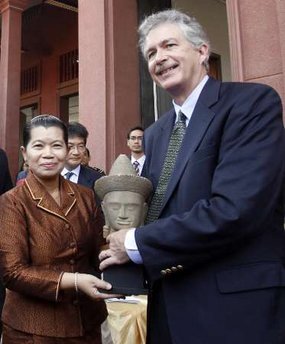
Cambodian Deputy Prime Minister Men Sam An (L) poses for a photo with U.S. Undersecretary of State for Political Affairs William Burns during a ceremony at the Cambodia National Museum in Phnom Penh July 18, 2010. Seven Angkorean artefacts which were illegally smuggled into the United States over the years were returned during the ceremony. REUTERS/Chor Sokunthea

U.S. Under Secretary of State William Burns (R) listens to Youk Chang (C), director of the Documentation Center of Cambodia, at the Khmer Rouge prison of Tuol Sleng (S-21) in Phnom Penh July 17, 2010. Also pictured is U.S ambassador to Cambodia Car Rodley (L). REUTERS/Chor Sokunthea

U.S. Under Secretary of State William Burns (R) listens to Youk Chang, director of the Documentation Center of Cambodia, at the former Khmer Rouge prison of Tuol Sleng (S-21) in Phnom Penh July 17, 2010. REUTERS/Chor Sokunthea

U.S. Under Secretary of State for political affairs William Burn, right, listens to Youk Chhang, left, director of Documentation Center of Cambodia, as they walk through cells of Tuol Sleng genocide museum, formerly the regime's notorious S-21 prison in Phnom Penh, Cambodia, Saturday, July 17, 2010. Burn on Saturday takes his official visit to Tuol Sleng genocide museum before his official scheduled to meet Cambodia's Prime Minister Hun Sen at Cambodian Council of Minister. (AP Photo/Heng Sinith)

Men Sam An, left, the Cambodian deputy prime minister, receives a sandstone sculpture from U.S. Undersecretary of State William Burn, right, at the Cambodian National Museum in Phnom Penh, Cambodia on Sunday, July 18, 2010. Cambodia on Sunday held its official handing-over ceremony to receive seven sculptures from the Angkorian era that had been smuggled out of Cambodia, from the United States. (AP Photo/Heng Sinith)

Photographers and TV cameramen try to shoot images of artifact sculptures returned from the U.S. during its handing-over ceremony at the Cambodian National Museum in Phnom Penh, Cambodia on Sunday, July 18, 2010. Cambodia on Sunday held its official handing-over ceremony to receive seven sculptures from the Angkorian era that had been smuggled out of Cambodia, from the United States. (AP Photo/Heng Sinith)

U.S. Under Secretary of State for political affairs William Burn, right, listens to Youk Chhang, left, director of Documentation Center of Cambodia, at Tuol Sleng genocide museum, formerly the regime's notorious S-21 prison in Phnom Penh, Cambodia, Saturday, July 17, 2010. Burn is scheduled to meet Cambodia's Prime Minister Hun Sen at Cambodian Council of Minister on Saturday. (AP Photo/Heng Sinith)

The head of a male divinity artefact dating from the 12th century and the torso of a male divinity artefact dating from the 11th century are displayed during a ceremony at the Cambodia National Museum in Phnom Penh July 18, 2010. Seven Angkorean artefacts which were illegally smuggled into the United States over the years were returned during the ceremony. REUTERS/Chor Sokunthea

A sandstone sculpture is on display at the Cambodian National Museum in Phnom Penh, Cambodia on Sunday, July 18, 2010. Cambodia on Sunday held its official handing-over ceremony to receive seven sculptures from the Angkorian era that had been smuggled out of Cambodia, from the United States. (AP Photo/Heng Sinith)

A Cambodian, rear, stands behind sandstone sculptures on display at the Cambodian National Museum in Phnom Penh, Cambodia on Sunday, July 18, 2010. Cambodiaon Sunday held its official handing-over ceremony to receive seven sculptures from the Angkorian era that had been smuggled out of Cambodia, from the United States. (AP Photo/Heng Sinith)

Angkorean artefacts are displayed during a ceremony at the Cambodia National Museum in Phnom Penh July 18, 2010. The artefacts are an Angkorean decorative ornament used in temples (front), a head of a male Angkorean Divinity artefact (C) dating from the 12th century and a torso of a male Angkorean Divinity artefact (rear) dating from the 11th century. The artefacts are part of the seven Angkorean artefacts which were illegally smuggled into the United States over the years and returned during the ceremony. REUTERS/Chor Sokunthea

 
Angkorean artefacts are displayed during a ceremony at the Cambodia National Museum in Phnom Penh July 18, 2010. Seven Angkorean artefacts which were illegally smuggled into the United States over the years were returned during the ceremony. REUTERS/Chor Sokunthea

Wonders of southeast Asia

via Khmer NZ

Couple takes long-awaited trip to Cambodia, Thailand, Vietnam

BY TRACIE SIMER


Richard and Linda Higgins pose at the back on Angkor Wat, Cambodia, built in the early 12th century as a state temple and capital city, and is the best preserved temple at this site. (Photo submitted)

When Richard Higgins served in Japan with the Air Force 40 years ago, he used to fly into countries such as Vietnam. When he came home, he promised his wife Linda that someday he would return with her to visit southeast Asia.

And in late March, the couple finally made that trip, taking a two-week vacation with 12 other people to Cambodia, Thailand and Vietnam. Linda said her husband told her of all the cities he used to fly out of — such as Saigon (present-day Ho Chi Minh City) and Bangkok.

"He always wanted to take me to Vietnam," she said. "He wanted me to try the French food in Saigon. When we got there, he said it changed so much. We couldn't find any French restaurants."

Read all about the Richard and Linda Higgins' trip to southeast Asia in today's print edition of The Jackson Sun.

Abhisit: Thailand objects to Cambodian plan for Preah Vihear area management

http://www.mcot.net/

via Khmer NZ

BANGKOK - Prime Minister Abhisit Vejjajiva on Sunday reiterated that Thailand would object the World Heritage Committee (WHC) when it meets later this month to discuss a management plan around Preah Vihear ancient temple, earlier granted the World Heritage status by the United Nations Educational, Scientific and Cultural Organization (UNESCO).

Mr Abhisit said during his weekly TV and radio address that his government would continue to object a management plan around the 11th century temple during the WHC meeting in Brazil between July 25 to August 3, for Thailand and its neighbour Cambodia still have to resolve their border demarcation problem.

Thailand continues to insist on using watershed mark as the border between the two countries, said Mr Abhisit, adding that Thai people should not worry that the country would lose some of its territory to Phnom Penh.

The Thai government’s stance on the Thai-Cambodian border remains unchanged, except that of the Preah Vihear temple as the International Court of Justice has already ruled that the temple belongs to Cambodia and the Thai government has to obey the order, he said.

The UNESCO has about two years ago listed the temple as the World Heritage site while the site was awarded to Phnom Penh by the International Court of Justice in 1962 in a decision rankling with most Thais.

Armed clashes of the two countries have occurred frequently after the listing of the temple as World Heritage site, while Cambodia maintains the demarcation of the disputed area, which it says has to be based on a map drawn in 1908.

Both Thailand and Cambodia have historically laid claim to the temple site, which sits on Cambodian soil but can only be easily accessed from Thailand.

Mr Abhisit said although clashes occurred from time to time but generally speaking both sides try to refrain from fighting.

Thailand has informed several countries that as long as border dispute continues to exist, it is inappropriate for Cambodia to handle the management plan around the Preah Vihear temple, he said.

The WHC will meet for its 34th annual session and Suwit Khunkitti, minister of Natural Resources and Environment, is expected to head the Thai delegation at the meeting.

Cambodia is scheduled to submit its management plan expected to involve the 4.6-square kilometre overlapping area near Preah Vihear Temple to UNESCO during the meeting.

Mr Suwit earlier notified the cabinet that he will ask the committee to postpone its consideration of the Cambodian management plan as there has not been a resolution of the territorial dispute between the two countries regarding the area. (MCOT online news)

Treasures return to Cambodia

via Khmer NZ

By Elanor Harding

Monday, 19 July 2010

CHHIN SOTHY/ AFP/GETTY IMAGES
Cambodian dancers are seen here performing a ceremonial dance in Phnom Penh yesterday to celebrate the repatriation of seven precious Khmer artefacts.

Cambodian dancers are seen here performing a ceremonial dance in Phnom Penh yesterday to celebrate the repatriation of seven precious Khmer artefacts. The pieces, which were recovered by officials in the US, are made of sandstone and bronze and are thought to date back to the 10th and 12th century of the Angkor period. Included are a decorative temple element, the head of a male divinity and a horse.


A US envoy handed them over to the Cambodian National Museum to mark the 60th anniversary of relations between the the US and the South-east Asian country.

The US under secretary of state, William Burns, said at the handover ceremony: "Our efforts to return these artefacts exemplify the respect we have for Cambodian historical patrimony and culture."

The ceremony came just weeks after Human Rights Watch said it was "outrageous" that the United States was supplying equipment worth millions of dollars to Cambodian army units which are accused of human-rights abuses within the country. After yesterday's festivities, US officials were travelling today to Indonesia, with which Washington is seeking stronger ties.

US State Department Defends Military Aid to Cambodian Army

Robert Carmichael | Phnom Penh
18 July 2010

via Khmer NZ

Photo: AP
US Under Secretary of State for Political Affairs William J. Burns, addresses a press conference (File Photo)

A senior U.S. State Department official visiting Cambodia defended U.S. support for Cambodia's military on Sunday. His comments follow strident criticism by a leading opposition parliamentarian over U.S. support for Cambodia's military.

The Under-Secretary of State for Political Affairs, William J. Burns, was in Cambodia this weekend to return seven looted antiquities recovered by U.S. officials.

Burns's visit coincides with the 60th anniversary of the establishment of U.S.-Cambodian diplomatic ties.

It also comes during a two-week military exercise in Cambodia involving more than 1,000 troops from 23 Asia-Pacific nations and the United States. It is part of the Global Peace Operations Initiative, a U.S.-run effort to improve peacekeeping skills among other nations.

But some Cambodian military units, including the tank unit hosting the provincial exercise, stand accused of human rights abuses.

Earlier this month Human Rights Watch said it was "outrageous" that the United States was supplying millions of dollars of equipment to army units, and undermined U.S. protests against forced evictions and land-grabbing.

Some local politicians are also displeased. Opposition M.P. Mu Sochua condemned American support for the Cambodian military.

"This is a huge insult to the people of Cambodia," said Mu Sochua. "This is not about helping democracy in Cambodia - this is about serving the US interests in the region."

At a news conference on Sunday, Burns stressed that all of America's military relationships were consistent with U.S. law, and said his government carefully vetted all participants.

But Mu Sochua said Washington was evading its responsibility. She said the U.S. Department of Defense had lied when it told Congress that none of Cambodia's military units were guilty of human rights violations.

"I am extremely disappointed by President Obama for allowing this to happen in Cambodia," she added.

Mu Sochua said donors, who earlier this year pledged more than $1 billion to Phnom Penh, must tie aid to human rights and democracy.

She said failing to do so meant the international community was failing in its obligations to Cambodia.

Mu Sochua's comments came Thursday as she awaited possible arrest for refusing to pay a fine levied in a defamation case filed by Cambodian Prime Minister Hun Sen.

The court fined her $4,000 after ruling that she had defamed Hun Sen by announcing her plan to sue him for defamation over comments he had made.

Her case was thrown out of court, but Hun Sen went on to win his.

She said the case was highly political, and was further evidence that democracy was being undermined by the ruling party.

William Burns alluded to her case when he said the political arena was a better venue for resolving such disputes than the courts. Freedom of expression, said Burns, was "an essential value for any healthy political society".

US envoy defends military relations with Cambodia

http://www.asiaone.com/

via Khmer NZ

Sun, Jul 18, 2010
AFP

PHNOM PENH, CAMBODIA - A senior US diplomat on Sunday defended relations with allegedly abusive Cambodian military units as he concluded a two-day visit to the capital Phnom Penh.

William Burns, US Under-Secretary of State for political affairs, said military aid from the United States to Cambodia was intended to boost a civil-military relationship that was essential to a "healthy political system".

"Any military relationship that we conduct around the world is consistent with US law. So we look very carefully and vet very carefully the participants from Cambodia, from other countries," Burns told a press conference.

He spoke as Cambodia conducted its first ever large-scale international peacekeeping exercise, co-sponsored by the US Army, on the grounds of a military unit accused of being involved in illegal landgrabs.

Phil Robertson, deputy Asia director at Human Rights Watch, said last week it was "outrageous" that Cambodia's ACO Tank Unit was hosting 700 military personnel from 23 countries in the "Angkor Sentinel" exercise.

The rights group said the US State Department and human rights organisations have documented soldiers of the unit using armoured vehicles to seize land from Cambodian villagers and farmers.

Burns made his trip while a Cambodian opposition politician faced an arrest warrant after controversial defamation proceedings.

Mu Sochua of the Sam Rainsy Party faces jail for refusing to pay 4,000 dollars in fines and compensation on a conviction last year for defaming premier Hun Sen when she announced plans to sue him for allegedly insulting her.

Burns, who met with Hun Sen and other government and opposition officials during his visit, said he spoke "about the importance of freedom of expression".

"It's very important to very carefully to weigh importance of issues like defamation suits... often times the kind of criticism that goes on is best in the political arena rather than the judicial system," he said.

The UN High Commissioner for Human Rights said last week that defamation proceedings against Sochua illustrated the "alarming erosion" of Cambodia's free speech and judicial independence. --AFP

Malaria-proof mosquitoes could save millions of lives

http://www.tribune.com.ng/

via Khmer NZ

Written by Sade Oguntola
Monday, 19 July 2010

Malaria, a mosquito-borne infectious disease is the fifth largest cause of death from infection in the world. Researchers working on eradidisease this disaa have developed a genetically modified mosquito which can stop the mosquito-borne parasitic spreading this disease, reports Sade Oguntola.cating this Malaria infects 250 million people a year and kills more than a million of them, mainly children, but it needs mosquitoes. In a potential step towards eradicating the disease, scientists for the first time have created a genetically modified mosquito which cannot pass malaria to humans.
The genetically altering mosquitoes was developed by University of Arizona entomologists in a way that renders them completely immune to the malaria parasite, a single-celled organism called plasmodium.

Malaria is caused by plasmodium. Only the female anopheles mosquitoes feed on blood, which they need to produce eggs. When they bite an infected human or animal, they ingest the malaria parasite. It takes one malaria parasite to infect a human and make a new malaria victim.

A person bitten by mosquito experiences symptoms, which include fever, headache and vomiting, which usually appear between 10 and 15 days.

The deadliest type of malaria is that transmitted by Plasmodium falciparum, which is endemic in sub-Saharan Africa. Left untreated, malaria can quickly become life threatening by disrupting the blood supply to vital organs such as the brain.

Current control strategies involve spraying mosquitoes with insecticides, sleeping under insecticide-treated nets or using drugs to kill the parasite once it infects humans. Unfortunately, these methods are becoming less effective as both pests evolve ways to resist the toxic treatments, so new methods to prevent malaria are sorely needed.

Artimisinin has been highly effective for treating malaria, particularly in places where resistance to other drugs has developed. But now some patients along Cambodia’s border with Thailand are taking longer to respond to the treatment.

In recent years, scientists have fiddled with the insect’s genes with hopes of developing modified mosquitoes incapable of transmitting the parasite. Although promising, these efforts produced mosquitoes with only reduced parasite transmission.

Previous attempts to create genetically modified mosquitoes have failed because although they reduced the insects’ ability to pass on the germ that causes malaria through its saliva, it was not eradicated all together.

Howevee, total blockage is very crucial. Other groups have been able to reduce the insects’ ability to pass the malaria germ between 90 and 95 per cent combining various genetic alterations, but such less-than-perfect protection could allow the germ to evolve around the mosquito’s blocking mechanism, in much the same way that drug-resistant bacteria can arise if antibiotic treatments are not completed.

For their experiments, the scientists used Anopheles stephensi, a mosquito species that is an important malaria vector throughout the Indian subcontinent.

They manipulated the mosquito’s genes, injecting new genetic information, into it and into the eggs as well. That manipulation influenced the mosquito’s life span as well as its immune response.

The mosquito’s immune system naturally destroys many malaria parasites so it stands to reason that a beefed up immune system could destroy all of the parasites. The mosquito’s digestive system could also simply consume the parasites as it digests its blood meal.

By targeting this gene, they created insects that died young so that the malaria parasite did not have the 16 days in the mosquito gut it needs to mature. Even a modest reduction in lifespan could significantly impact parasite transmission.

To test the effect of that change, researchers reporting in the journal PLoS Pathogens injected 90 of the mosquitoes with the malaria parasite. Ten days later, at a point when normal mosquitoes would have bellies full of parasites, they didn’t find a single one.

Despite this genetic engineering success, there are two main hurdles before such mosquitoes could be used to reduce malaria infections. First, the modified gene would have to multiply throughout the entire mosquito population. Usually, this would occur only if the gene can be passed down to the modified mosquitoes’ offspring - thereby making sure that the gene eventually spreads throughout the population. However, these malaria resistance genes do not have that effect.

Certainly, the process of introducing this malaria proof mosquito would need at least 10 years, in order to show concrete signs of success and ultimately end up replacing the wild mosquitoes capable of transmitting malaria parasite.

Of course, there are serious ethical concerns about releasing a genetically modified insect into the environment. Once the science is fully understood, the risks and benefits to the environment, and to human health, will have to be properly assessed.

Even so, researchers are optimistic that genetic engineering of mosquitoes and vaccines will both be important pieces of the malaria-prevention puzzle.

They suggested that a two-pronged approach that targets both disease-transmitting mosquitoes, perhaps via genetic engineering, and susceptible human populations, probably by vaccines, will probably be required for eventual eradication of this fifth largest cause of death from infection in the world.

Meanwhile, until designer mosquitoes are unleashed into the wild, there are always insecticide-laced nets that can do the job. Insecticide-treated bed nets or drugs to cure the malaria are effective ways [to prevent malaria], except resistance is developing against the parasites.

US defends military aid to Cambodia after opposition criticism

via khmer NZ

Posted : Sun, 18 Jul 2010
By : dpa

Phnom Penh - A senior US diplomat defended military aid to Cambodia on Sunday, following criticism from a prominent opposition parliamentarian.

William Burns, US under secretary of state for political affairs, said military exercises in Cambodia involving troops from the US and 23 Asia-Pacific nations were part of efforts to improve regional humanitarian and peacekeeping capabilities.

"Any military relationship we conduct around the world is consistent with US law, and so we look very carefully and vet very carefully the participants," Burns said at a ceremony in Phnom Penh to return seven ancient Cambodian artefacts recovered from the US.

The two-week exercise that began July 12 is part of the 2010 Global Peace Operations Initiative, a US-run effort to train peacekeepers.

Burns spoke after opposition legislator Mu Sochua said US support for military units have been implicated in human rights abuses was "a huge insult to the people of Cambodia.""So I am extremely disappointed by President Obama for allowing this to happen in Cambodia," Mu Sochua said.

She also accused the US Department of Defense of lying to the US Congress when it said Cambodian military units had not been involved in human rights abuses.

Mu Sochua said the international community was repeatedly failing in its obligations to Cambodia. She called on donors, who pledged more than 1 billion dollars this year, to impose conditions such as respect for human rights.

Cambodia to send 200 military engineers, de-miners to Lebanon in October

via khmer NZ

July 18, 2010

A top Cambodian minister said on Saturday that Cambodia is ready to send 150 military engineers along with another 50 de-miners, as part of the U.N. request, to assist U.N. operation in Lebanon.

Prak Sokhon, deputy minister of the Council of Ministers and also Chairman for national committee in charges of sending Cambodian troops for U.N. peace keeping operation, told reporters that the group will leave for Lebanon in October this year.

"They will help Lebanese to build bridges, roads and buildings, " Prak Sokhon said on the same day as Cambodia hosted a large- scale peacekeeping drill with participation of more than 700 military personnel from 24 countries.

The drill, called "Angkor Sentinel 2010," was co-hosted by the United States, and focused on the contribution of the developing countries to UN peacekeeping operations.

"The U.N. personnel helped us to organize the Cambodian election in 1993, it is now for us to help other countries for humanitarian assistance within the U.N. mandate," said Prak Sokhon.

Cambodia sent 557 peacekeeping troops in total since 2006 to clear mines in three war-torn African nations, namely Sudan, Chad and the Central African Republic. The Cambodian military personnel and de-miners, who were dispatched to fulfill mission under the U. N. umbrella in the three African nations, have been rotated every year.

Prak Sokhon said there are now 52 Cambodian military de-miners working in Sudan and 42 others de-miners in Chad.

Source: Xinhua

Cambodia hosts drill

via Khmer NZ

KAMPONG SPEU (Cambodia) - CAMBODIA opened its first ever large-scale international peacekeeping training exercise with a ceremony on Saturday at a military base south of the capital.

Over 700 military personnel from 23 countries will participate in two weeks of field training during the 'Angkor Sentinel' exercise, focusing on developing nations' contributions to UN peacekeeping operations.

'From a country that used to receive blue hat soldiers to help keep peace, Cambodia has become a country that sends blue hat soldiers to help keep peace in other nations,' Cambodian Prime Minister Hun Sen said, referring to UN troop uniforms.

Cambodia was the focus of a UN peacekeeping mission in the early 1990s to help end decades of civil war, but has recently deployed troops to work as UN peacekeepers in Chad, Sudan and the Central African Republic. But the exercise, co-sponsored by the US Army, has been criticised by New York-based Human Rights Watch for using the grounds of the Cambodian military's ACO Tank Unit, which has been accused of being involved in illegal landgrabs.

'For the Pentagon and State Department to permit abusive Cambodian military units to host a high-profile regional peacekeeping exercise is outrageous,' said Phil Robertson, Human Rights Watch deputy Asia director, in a statement.

'The US undermines its protests against the Cambodian government for rampant rights abuses like forced evictions when it showers international attention and funds on military units involved in grabbing land and other human rights violations,' he added. The 'Angkor Sentinel' is part of the 2010 Global Peace Operations Initiative, a US effort to help train peacekeepers around the world. -- AFP

Cambodia women see future in sports and big muscles

via Khmer NZ

Cambodia women are rising fast in the wide world of sports. Pétanque player Duch Sophorn has alone won gold, silver, and bronze medals in international competitions over the past decade.

By Kounila Keo, Contributor / July 16, 2010

Phnom Penh, Cambodia

Cambodia women are breaking free of social stigmas and disproving myths to succeed in the world of sports.

Vath Chamroeurn, secretary-general of the National Olympic Committee of Cambodia, says that over the past several years women have accounted for 30 percent of the total population of athletes representing Cambodia in international contests. In 2009 alone, Cambodian female athletes won one gold medal, four silvers, and 13 bronzes in the 25th Southeast Asian Games held in Laos. Events included pétanque, tae kwon do, volleyball, weight lifting, and wrestling.

Lack Som Ath, general director of the General Department of Sports at the Ministry of Education, Youth and Sport, says that Cambodian female athletes participate in as many as 20 sports.

One shining example is Duch Sophorn – Cambodia’s finest player of pétanque (a form of boules), who has won gold, silver, and bronze medals in international competitions over the past 10 years. Her success has inspired many young girls to pursue athletics. But she admits it has come at a price in a society that views athletic-looking women as sterile and unattractive.

“I have developed muscles and [I am] very strong. [If] men don’t like me, I don’t care, as long as I love myself,” says Ms. Sophorn.

Friday, 16 July 2010

Hamill seeks clues to murdered brother's last days


via Khmer NZ

Friday Jul 16, 2010

Rob Hamill. Photo / Herald on Sunday

Former champion New Zealand rower Rob Hamill has appealed for people in Australia's Northern Territory to help him piece together some of the last days of his brother's life there, before he set off in a yacht and was brutally murdered by the Khmer Rouge.

Kerry Hamill, 27, was tortured and forced to falsely confess to being a CIA agent before the Cambodians killed him.

He spent several years in Darwin before buying a yacht and being captured in Cambodian waters in August 1978.

Rob Hamill testified at the Khmer Rouge Tribunal in the case against the party's torture master Guek Eav Kaing - known as Comrade Duch - in Phnom Penh last year.

The verdict is set to be handed down on July 26, and Mr Hamill, 46, plans to attend the sentencing.

The New Zealander is now asking people who met his brother in Darwin to shed some light on his life there, the Northern Territory News reported. He said any information, photographs - or even video footage - was "precious" and would help the family come to terms with the tragic loss.

"Just anything would help," he said.

Kerry Hamill arrived in Darwin as part of an overseas adventure, after Cyclone Tracy hit on Christmas Eve in 1974.

He worked with Riteway Concrete, helping build Anula school, before moving in with Canadian Stuart Glass and his wife Susan. The two men bought a yacht, Foxy Lady and together with Englishman John Dewhurst sailed to southeast Asia until their boat was blown into Cambodian waters.

Mr Glass was killed as soon as the crew were captured by the Khmer Rouge.

The other two members were held at the S21 prison -- a former high school which was turned into a torture facility -- until they died.

The Hamill family only found out about the capture 16 months later, in a story in their local newspaper.

The Khmer Rouge killed and tortured thousands of people while they governed the country from 1975 to 1979.

Duch, who as a young student won national mathematics prizes, designed the torture factory, in which 20,000 people are believed to have died.

Mr Hamill has formally requested an interview with Duch and expects to find out after the sentencing whether the request has been approved.

"I want as much information about my brother as I can get. And I really want to understand him (Duch)," Mr Hamill said.

He believed Duch should be sentenced to 40 years -- "the rest of his living days" -- the term sought by the prosecution.

"Anything less than that would be a victory to the (Duch) defence team, I suspect. He took my brother's freedom away, he took away 14,000 others' freedom . . . he should really have his freedom taken away too".

Mr Hamill said he would also visit sites in northern Cambodia to film a documentary, Brother Number One.

- NZPA

Cambodia: Appeal No. MAAKH001 Progamme Update, 16 July 2010


via Khmer NZ


Date: 16 Jul 2010


Full_Report (pdf* format - 666.5 Kbytes)

In brief

Programme outcome: To support the Cambodian Red Cross (CRC) to realize its vision of being the country's leading humanitarian organization.

Programme summary:

The first half of 2010 has seen Cambodian Red Cross (CRC) continue to focus on an ambitious series of changes that will set the direction of the national society for the coming years. Its commitment to decentralization continued and was very much reflected in CRC's strategic review and planning process. This process – leading to the adoption of a new strategy 2011-2020 at CRC's 5th general assembly in August – has really committed the national society to a challenging agenda of humanitarian action. Decentralization of authority and action is the catalyst of much of this and the opportunities are significant. However, CRC acknowledges that several changes need to occur for these ambitions to be realized but it is determined to try, with partners' support, to do so. One aspect of this is a commitment for the voice of youth to be heard throughout the national society, including on its highest forum of governance via a representative.

CRC continued to display its extraordinary ability to fundraise domestically around the 8 May World Red Cross Red Crescent Day, with donations to this year's event the highest yet. Internationally, CRC remains an active contributor to the meaning of Federation, particularly in Southeast Asia, and is proudly taking its hosting duties seriously for the youth directors meeting in September.

CRC continues to maintain good and long-term relations with many partners, including the Federation secretariat. There is room for a more consolidation and coherence in the way partners work with CRC and that is part of a longer term change for all involved: both partners and CRC. In terms of Federation secretariat support, a combination of low response to the support plan and less-than-hoped-for implementation has meant for an indifferent first half of 2010. This has prompted a budget revision downwards from CHF 1,068,173 to CHF 695,843. On the upside, the Federation has identified a new representative for both Cambodia and Lao PDR, who will start in September and is very experienced in the Movement, bringing a strong background of domestic programming and international support to the position.

US hopes for quick end to Thai state of emergency

via Khmer NZ

2010-07-16

BANGKOK, Friday 16 July 2010 (AFP) - A senior US envoy expressed hope Friday that a state of emergency imposed in parts of Thailand since April in response to violent street protests would be lifted "as soon as possible".

But William Burns, the State Department's number three, stressed that Thailand was able to find its own way out of the political crisis, reiterating US calls for a democratic and peaceful solution.

"Clearly the US hopes that the state of emergency ... can be lifted as soon as possible," Burns told reporters after discussions with Thai officials.

He said Americans had been "deeply saddened" by the violence and deaths suffered during the two months of opposition demonstrations in Bangkok that ended with a bloody army crackdown in May.

Ninety people, mostly civilians, were killed and nearly 1,900 were injured in violence sparked by the anti-government "Red Shirt" rally.

The emergency powers -- enabling authorities to detain suspects without charge for up to 30 days and shut down anti-government media -- were extended last week for three more months in Bangkok and 18 other provinces.

Prime Minister Abhisit Vejjajiva has set out a five-point reconciliation plan, which the US Congress has said should form the basis of efforts by all parties in Thailand to resolve their differences.

The next stop on Burns' regional tour will be Phnom Penh on Saturday for events marking the 60th anniversary of relations between Cambodia and the United States.

He is then set to head to Indonesia, with which President Barack Obama has been seeking stronger ties, and will round off his trip on Monday and Tuesday in the Philippines, another close US ally, for talks with the new administration of President Benigno Aquino.