Friday, 17 September 2010

Four Khmer Rouge leaders indicted


Khieu Samphan at a court hearing in Phnom Penh in this file photo.


Four high-ranking leaders of Cambodia's disgraced Khmer Rouge government of the 1970s were on Thursday indicted for “crimes against humanity, war crimes, and genocide”.

The four — Khieu Samphan (79), Nuon Chea (84), Ieng Sary (85) and Ieng Thirith (78) — would continue to be detained, according to the two Co-Investigating Judges of the Extraordinary Chambers in the Courts of Cambodia (ECCC).

ECCC official Reach Sambath later told The Hindu from Phnom Penh that the trial, now ordered by the judges, was expected to begin in the first half of 2011. The internationally recognised Trial Chamber of the specialised ECCC would decide whether the four accused should be prosecuted together or individually, said Mr. Reach Sambath.

For now, the decision to bring the surviving top leaders of the Khmer Rouge to justice was “significant news for the people of Cambodia who had waited for [over] 30 years” for this day. The trial would begin a “healing process” for Cambodia's future, he said. The ECCC said in a statement the case file against the four accused “extends to over 350,000 pages, more than 223,000 of which relate to substance”. The case would focus on some aspects of the Khmer Rouge's crimes, which caused “an estimated 1.7 million to 2.2 million deaths, of which approximately 800,000 were violent [killings]”. While the perceived crimes against humanity and genocide related to “an attack against the entire population of Cambodia”, the charge of war crimes was filed “in the context of [Cambodia's] international armed conflict with Vietnam” during the Khmer Rouge's reign.

Of the four accused, Khieu Samphan was head of state. His doctoral thesis on Cambodian economy, obtained in Paris in 1959, was often cited for the disastrous policies pursued by the Khmer Rouge's highest-ranking leader, Pol Pot, who died in 1998 without being brought to justice. As Pol Pot's deputy for long, the now-indicted Nuon Chea was “Brother Number Two” in the organisation.

Ranking as “Brother Number Three”, Ieng Sary was the Khmer Rouge Foreign Minister. His wife, Ieng Thirith, now indicted, was the movement's most senior woman leader and the regime's Social Affairs Minister.

Thursday's indictments follow the conviction of a lower-level Khmer Rouge official, Kaing Guek Eav (67), in July this year for his role in mass executions at a security centre which was also used as a killing field in the 1970s.

Angkor Wat and other ruins, legacy of Khmer empire dot Cambodia's countryside

via CAAI

By The Associated Press (CP)

SIEM REAP, Cambodia — Tourists gather every day before dawn to watch the sun rise over Angkor Wat, a 12th-century temple and the grandest legacy of Cambodia's once mighty Khmer empire. Even at 5 a.m., the heat and humidity is enough to make the visitors break into a sweat.

More than one million people come annually to see the remains of the Khmer temples that dot the sprawling Angkor region, 230 kilometres northwest of the country's capital, Phnom Penh.

For Cambodians, the temples are nothing less than a symbol of their nation; an outline of Angkor Wat adorns the national flag.

A nearby temple, Wat Thmei, also includes a reminder of a dark chapter in recent Cambodian history. A memorial stupa houses bones and skulls from the victims of the "killing fields," who were executed by the brutal Khmer Rouge regime that ruled in the late 1970s.

Today, Angkor is a vital contributor to the poor nation's economy, with almost all visitors to the country travelling to the ruins. After a hot day visiting the temples, tourists head to the bars and Western-style air-conditioned restaurants in the nearby town of Siem Reap.

Cambodian censors axe 'love for auction' TV series

Cambodians watching TV in a village


via CAAI

PHNOM PENH — Cambodia on Thursday cancelled a TV mini-series about a beautiful woman whose suitors have to bid for her hand in marriage at auction -- with a starting price of one million dollars.

The Ministry of Information ordered the Cambodian Television Network (CTN) to stop showing the popular film series "Strange Lovers" because it was "totally opposite to good Cambodian tradition."

It "seriously affects the reputation and dignity of Cambodian women as well as drawing a lot of reaction from the audience," a statement from the ministry read.

The story revolves around a young, wealthy woman called Nuon Neang Lom-orng, who has all the qualities of the ideal modern wife: she is smart, comes from a good family, has studied abroad and knows all about art and music.

She is inundated with marriage proposals until her mother, after agonising over who should be allowed to wed her daughter, decides to auction her off at a starting price of one million dollars.

The story of "Serial Lovers" was to be told over 60 episodes, but the government intervention means viewers are left hanging after just 13 episodes.

The show's writer Poan Phuong Bopha said she regretted the decision, describing the ban as a threat to the movie makers. "This feels like we are being beaten with a stick," she said.

It is not the first time Cambodia has outlawed entertainment it considers harmful to the country's traditional values.

In 2004, the government banned a pop song that showed scenes of a Buddhist monk hugging and kissing a girl while bathing in a pond near a pagoda.

Last year, the country?s first rock opera 'Where Elephants Weep' was axed after monks said it was insulting to see actors dressed as clergy breaking into song and dance.

Ministry Orders Closure of Soap Opera on Cultural Grounds

Pich Samnang, VOA Khmer | Phnom Penh
Thursday, 16 September 2010

via CAAI

“It is like the auction of objects and animals, which completely opposes good Khmer tradition and custom.”

The Ministry of Information has ordered the closure of a popular soap opera, after it depicted a scene where rich men were bidding money for a woman on display.

In a letter to the Cambodian Television Network, the ministry said the show, “Strange, Predestined Couple,” had gone against Khmer tradition and hurt the image of Khmer women.

“It is like the auction of objects and animals, which completely opposes good Khmer tradition and custom,” the letter said. “So the TV series must be taken off the air immediately and forever.”

The scene in question shows a group of masked, wealthy businessmen bidding for a beautiful woman. A man takes her for $5 million.

CTN officials could not be reached for comment, but the writer of the show, Pann Phuon Bopha, a woman and longtime playwright, said she had heard the news and found it discouraging.

“How can we help restore our dying film industry if we don't have freedom of expression?” she said.

94 European Tanks Purchased, En Route: Officials

Sok Khemara, VOA Khmer | Washington, D.C
Thursday, 16 September 2010

via CAAI

Photo: ASSOCIATED PRESS
Cambodian army soldiers.

“The purchase of military equipment by individual countries in the world is normal.”

Cambodia has purchased 94 T-55 tanks from eastern Europe to bolster its military capacity, officials said.

“The purchase of military equipment by individual countries in the world is normal,” a senior military official said on condition of anonymity. “Cambodia has bought tanks and armor that is due to arrive soon. That's to protect its sovereignty if there is any intent to invade from a foreign country.”

Officials would not disclose details of the deal, but the purchase comes amid a prolonged military standoff with Thailand over a disputed border area near Preah Vihear temple.

Koy Kuong, a spokesman for the Ministry of Foreign Affairs, confirmed the deal, saying the tanks would arrive in a few weeks.

Military officials said the price of used tanks could be towards $1 million. Cambodia's annual defense budget is about $300 million.

Yim Sovann, a spokesman for the opposition Sam Rainsy Party, did not disagree with the purchase of the military equipment, but said the prices should be public.

“Whether the purchase is transparent or not, and the buying follows the market price,” he said. “We're not making accusations. But it should be published.”

Auditing, Irrigation Among Agreements With India

Chun Sakada, VOA Khmer | Phnom Penh
Thursday, 16 September 2010

via CAAI

Photo: ASSOCIATED PRESS
Cambodia's King Norodom Sihamoni, front right, walks with Indian President Pratibha Patil on the front steps of the Royal Palace after a meeting in Phnom Penh, Cambodia, Tuesday, Sept. 14, 2010. Patil is on a six-day official visit to Cambodia.

“If Cambodian auditing officials have a capacity for fairness and knowledge, they can find irregularities...and can fulfill their auditing work with great effectiveness and transparency.”

During a weeklong visit from Indian President Pratibha Patil, Cambodia received a boost to its National Audit Authority, along with other agreements.

India agreed to provide training to at least eight Cambodian audit officials per year in New Delhi, under its Comptroller and Auditor General. Officials said the training will help the auditors carry out their functions as an independent entity and help improve governance and public finance.

“In principle, the Cambodian and Indian sides will have a mutual auditing experience exchange,” Uth Chhon, president of the National Audit Authority, told VOA Khmer. “Importantly, India has a national auditing institute for auditing skills and professionalism. So we can cooperate with the Indian side to send our officials to study.”

“Public auditing is a new thing in Cambodia,” he said. “If we do not upgrade our capacity, we will not follow world development.”

Auditing experts say a lack of transparency and reliability has hindered Cambodia's development.

“If India strengthens the skillful auditing capacity of Cambodian officials, for higher standards than present, that will be very good,” said Huoth Sony, a tax manager for Accounting Solution Cambodia Co., Ltd.

“If Cambodian auditing officials have a capacity for fairness and knowledge, they can find irregularities...and can fulfill their auditing work with great effectiveness and transparency,” said Leap Chamnan, a private auditor.

India has also provided $15 million in credit to Cambodia for water resource development in Kampong Speu province.

The deal will help irrigate about 25,000 hectares of crops and prevent flooding at Stung Tassal in Oral district.

An agreement was signed between Export-Import Bank of India Director P. Dalal and Aun Porn Moniroth, a secretary of state for the Ministry of Economy and Finance.

The Stung Tassal Water Resource Development Project will help water crops in both the rainy and dry seasons, prevent flooding and provide hydropower, said Chan Yuttha, cabinet chief for the Ministry of Water Resources.

Farmers will benefit from two seasons of rice crop, said Dith Sareth, head of the Kampong Speu provincial agricultural office.

However, Yim Kimthan, a project director for the Cambodian Center for Study and Development in Agriculture, said farmers would also need proper technical knowledge to ensure they benefit from the irrigation.

'More Space' Urged in Cambodian Democracy

Kong Sothanarith, VOA Khmer | Phnom Penh
Thursday, 16 September 2010

via CAAI

Photo: ASSOCIATED PRESS
Cambodian Buddhist monks read local newspapers at a ceremony in Phnom Penh, Cambodia.

“I take this opportunity to call [on the government] not to impose restrictions over democracy.”

Civic leaders called for “more space” for democracy, as well as judicial reform, on Wednesday, as they marked World Democracy Day.

Leaders from civil society called for more tolerance between the political majority and minorities. Political freedoms that were won in the 1980s, following the ouster of the Khmer Rouge, have been in decline, the leaders said.

“I take this opportunity to call [on the government] not to impose restrictions over democracy,” said Thun Saray, president of the rights group Adhoc and chairman of the Cambodian Human Rights Action Committee.

“In Cambodia,” he said, “the acceptance of criticism is limited.”

Cheam Yiep, a lawmaker for the Cambodian People's Party, said freedom of expression in Cambodia has been “developed and reinforced.” He agreed with calls for tolerance between the parties, but added, “the minority party must do things based on law.”

The ruling government has come under increasing criticism for restrictions on freedoms in recent years. Last month, the Observatory for the Protection of Human Rights Defenders issued a report that found union leaders, rights activists and journalists facing rights violations and legal restrictions.

Sok Sam Oeun, executive director of the Cambodian Defenders Project, a legal organization, said the government must urgently reform the judiciary with the help of the international community.

Cheam Yiep said the government is already doing that.

Cambodia War Crimes Court Indicts Former Khmer Rouge Leaders

Robert Carmichael, VOA | Phnom Penh
Thursday, 16 September 2010

via CAAI

Photo: AP
This combo shows file photos of the four top surviving leaders of the Khmer Rouge regime from left to right: Nuon Chea, the group's ideologist; former head of state and public face of the regime, Khieu Samphan, former Foreign Minister Ieng Sary; and his wife Ieng Thirith, ex-minister for social affairs.

"This is addressing the leadership - those who are believed to have orchestrated all the crimes in the country. So of course for the people of Cambodia this means that those who are believed to have set in place the whole system now will face charges in a court."

The Khmer Rouge tribunal has indicted four senior surviving leaders of the 1970s government that devastated Cambodia.

The tribunal Thursday announced the indictments of Nuon Chea, the Khmer Rouge's chief ideologue, the former head of state Khieu Samphan, former foreign minister Ieng Sary, and his wife, the former social affairs minister, Ieng Thirith.

Their trial is expected to start in the first half of next year. The suspects deny the charges against them.

Investigating judge You Bunleng says the four face charges ranging from genocide to crimes against humanity to torture and religious persecution.

You Bunleng says the charges should be seen in the context of an attack on the nation's entire population.

He says a demographic survey produced during the investigation showed that between 1.7 million and 2.2 million people died under the Khmer Rouge - many from overwork and illness.

Around 800,000 of the deaths were violent.

From 1975 to 1979, the Khmer Rouge tried to remake Cambodian society and forced most people out of the towns to labor in the countryside.

You Bunleng says the genocide charges relate to the killings of the minority Cham Muslims, and the deaths of ethnic Vietnamese living in Cambodia.

His co-investigator, Marcel Lemonde, acknowledges the case is complicated.

Judge Lemonde says some people have compared the complexity of the case to the Nuremberg trials of senior Nazis at the end of the Second World War. It is a comparison he feels is fair.

More than 2,100 people have been admitted as civil parties, which means the court recognizes that they or their relatives suffered from the specific crimes the four have been charged with.

It took years to form the joint international-Cambodian tribunal, but in July it wrapped up its first case. The judges sentenced Kaing Guek Eav, known as Duch, to 30 years in prison for war crimes and crimes against humanity.

Duch admitted running the S-21 prison in Phnom Penh, where as many as 20,000 people are thought to have been tortured and condemned to death.

Court spokesman Lars Olsen says Thursday's indictments move the court beyond Duch's case.

"This is addressing the leadership - those who are believed to have orchestrated all the crimes in the country. So of course for the people of Cambodia this means that those who are believed to have set in place the whole system now will face charges in a court," said Olsen.

But the four defendants are all in their late 70s or 80s. Many Cambodians fear they will not all live to hear a verdict.

The Killing Fields and Indonesia's Relations with Cambodia Revisited

http://www.huffingtonpost.com/

Thought Leaders and Global Citizens
Posted: September 16, 2010

via CAAI

I first met Benny Widyono at an Indonesian Consulate fete years ago. I knew upon meeting him that he had an extraordinary mind and knew Asia's southeast as well as he knew this nation's northeast. Living in Connecticut and commuting to his office at the U.N. for decades - when he wasn't living in Phnom Phen, clued me into that reality. I told him if he ever wrote his memoirs I wanted to read them. Sure enough, they arrived by post last week. And they are riveting.


The book Dancing in Shadows: Sihanouk, the Khmer Rouge, and the United Nations in Cambodia has just been published. It is excellent. I had planned to read it next month, but I could not put it down. It is well written, engaging, and highly informative. I now understand so much more of Cambodia's Cold-War history and how it led to the Killing Fields in which about two million Cambodians perished. Google reviewers have given this excellent book 4.5 stars.


Dr. Benny Widyono was born "Hong Lan Oei," but during the madness of the anti communist/anti-Chinese period in Indonesia that killed 800,000 suspected Communists including ethnic Chinese - also a result of the Cold War - his name was "nativized" under the Suharto regime. Indonesians were still not allowed to read or speak Chinese when I first arrived there in 1995. Thus, my struggle to adopt an Indonesian Chinese infant then to get him away from there. However, today normalcy has returned to the Republic and Chinese language and culture are no longer criminalized.

Benny is thus an excellent guide to post-colonial Cambodia. As a recipient of the title of Commandeur de L'Ordre Royal de Sahametrey in 2004, the highest title for civilians bestowed by H.M. King Sihanouk of Cambodia, Benny played an integral role working with the U.N. in the recovery from the death and destruction of Pol Pot in a way that a non-South East Asian could have. Another key player at the time was the Japanese head of United Nations in Cambodia, Yasushi Akashi.

Benny notes in his book the King's words to the Japanese head of the U.N. presence in Cambodia:

"I wish to thank you, Excellency Mr. Yasushi Akashi, for sending another prince from Java to help bring peace to Cambodia," quipped Norodom Sihanouk, the King of Cambodia, referring to me.

We were at the official inauguration of my office, the provincial headquarters of the U.N. Transitional Authority on Cambodia (UNTAC) in Siemreap, Cambodia in 1992, the U.N. Peacekeeping operation established to bring peace to Cambodia.

Prior to our arrival, Cambodia was, due to its political location, been for 20 years the subject of turmoil, civil war and Khmer Rouge induced genocide. To end the stalemate of Cambodia having two governments... the U.N. became the temporary government until elections could be held.

Yasushi Akashi was the head of UNTAC and therefore, temporarily, the head of the country. I was his "governor" of Siemreap Province, home of the world famous Angkor Wat temple.

Benny's life is fascinating because he was raised in Indonesia in a minority religion - Roman Catholicism - and yet he attended the most prestigious university there, the University of Indonesia in Jakarta. He went on to study economics in the University of Texas. His Ph.D. dissertation compared the role of petroleum in economic development in Mexico and Indonesia. One week after he graduated he was offered a position with the United Nations in Thailand, beginning his professional and personal odyssey.

In 1981, Benny was transferred back to New York to work on helping countries cope with multinational corporations. In his new capacity he writes of coming home late from New York City as now his work at the U.N. consisted of "going to endless cocktail parties to lobby with ambassadors and other diplomats of member states. Most of the work gets done in these parties."

At the U.N. cocktail parties, he notes ruefully, the poorer the country the more lavish its reception:

One day Ethiopia celebrated its tenth anniversary of the Marxist revolution in that country with unlimited shrimps and other delicacies and whiskey and wine flowing all evening while we see pictures on BBC TV of starving Ethiopians looking like corpses.

Another anomaly was that the Khmer Rouge ambassador, who was responsible for killing 1.7 million of its own people, would strut about shaking hands with everybody to lobby against that bad fellow Hun Sen, Prime Minister of Cambodia who de facto ruled the country since 1979, because the U.S. and China spearheaded a resolution in the U.N. to continue to recognize the Khmer Rouge instead of the People's Republic of Kampuchea.

It is this encounter with the Khmer Rouge ambassador, plus his experiences in Thailand where he had witnessed Cambodian refugees escape the Khmer Rouge atrocities and appear -- one by one -- from the jungle like emaciated corpses. These survivors reminded him of those in Ethiopia which made me decide to volunteer for Cambodian service for the U.N. I wrote about such survivors such as my good friend Ambassador Sichan Siv, whose story I have also told.

Benny eventually represented the U.N. Secretary General in Cambodia after the Killing Fields in which about two million Cambodians perished

We all have this myth that we control our lives. Benny tells it as it is:

One day, in the restroom of my floor, the 31st floor of the United Nations, I stood next to Yasushi Akashi, who just became the head of UNTAC in Cambodia. I congratulated him and asked whether he can take me along to Cambodia. Knowing me well he said yes, you will be the governor of Siemreap Province., which has Angkor Wat and is the most Khmer Rouge invested province.

I said yes as I did not want to languish in some idyllic province on the beach where nothing happened. Thus the last five years I was transferred to Cambodia, where I was at the political forefront of the political turmoil in the tragedy of Cambodia. It turned out to be the best assignment and I found out that my real fascination was with politics which I watched first hand. It is like studying while getting paid at the same time.


In his capacity of UNTAC Governor, Benny inspected U.N. forces in Cambodia.


Benny writes in his book that Akashi was right:

I got plenty of excitement and adventure in Siemreap where the Khmer Rouge murderers were ever present although at day time Hun Sen's People's Republic of Kampuchea (PRK) reigned supreme in almost all the country.

Siemreap was attacked many times by the Khmer Rouge. Since it was too dangerous for wives to join their husbands my wife stayed in Connecticut although she came to visit me several times. Live was very primitive as the Hun Sen government was isolated by the U.N.

Danger was ever present and at night I could not sleep if I don't hear mortar fire as Hun Sen's troops were fighting the Khmer Rouge. One day Siemreap was attacked by 800 Khmer Rouge. I called my wife in Stamford from the only telephone at my headquarters. After a full day Hun Sen troops drove them away.

Soon he received a phone call from the powers that were in U.N. Headquarters in New York and he was appointed the political envoy of the Secretary-General Boutros Boutros Ghali in Cambodia.

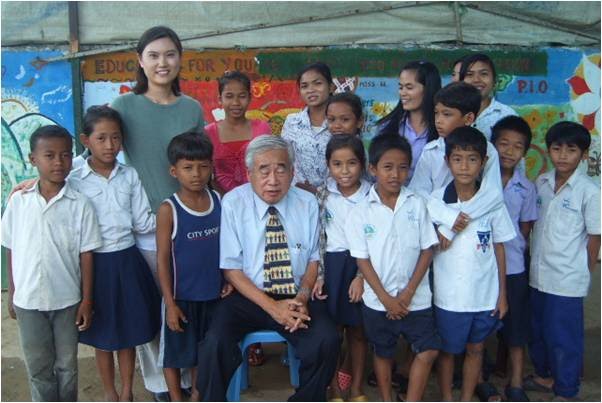
Benny Widyono, Mrs. Bintari Sudarpo, King Norodom Sihanouk, Queen Monineath, with Indonesian Ambassador Taufik Sudarpo, and Benny's wife Francisca.

Soon, his wife joined him full time. They were often invited, together with other ambassadors, to dinner with the King. He watched over dinners and diplomatic dispatches - and reported to his new boss Kofi Annan - that as Cambodia acquired two prime ministers who were former enemies, and with the "wily king pulling the string from behind the scene," he smelled trouble. Both sides clashed and in 1997 Hun Sen became the only prime minister. Benny then reached the age of 60 -- the mandatorily retirement age at the U.N. - and he moved back to the U.S. to teach at several universities including Cornell.

Dr. Benny Widyono with Prime Minister Hun Sen who after the clash in 1997 continued to consolidate his power until today 2010.

Benny has remained active with Cambodia and continues includes a board position with the Peoples Improvement Organization, an NGO running slum area schools in Phnom Penh now with 850 students who each day get lunch and education in English. These schools were founded one of his former staffers, Phymean Noun, who became a CNN hero in 2009 for her work with children.

Benny sits on the Board position of an NGO running slum area schools in Phnom Penh founded one of his former staffers honored as a CNN hero for her work with children.

I have been delighted to know Dr. Benny Widyono, born "Hong Lan Oei," as an outstanding Indonesian-American active with the United Nations in Cambodia and around the world. His compassion for all - especially children - has impressed me greatly. Above and beyond being a thought leader and global citizen, Benny has been able to share his gripping life in an exceptional book. I highly recommend it.

High-spirited business


via CAAI

Thursday, 16 September 2010 21:14 Catherine James

INDIA’s United Spirits Ltd – the world’s second-largest spirits distiller – has selected Cambodia as a target market.

USL said yesterday its level of commitment in the Kingdom represented its “first significant step outside the Indian subcontinent”, and that the firm hadstarted importing and distributing spirits through trading company Vimpex Ltd.

Vimpex aims for US$1 million in sales by the end of the year, Managing Director Naresh Kumar Dinodiya said yesterday.

“We will be covering the whole nation, and we don’t have any particular segment, but we’ll be doing whisky, vodka, wine, rum, and gin also. And maybe we’ll add beer later on,” he said. ... read the full story in tomorrow’s Phnom Penh Post or see the updated story in online from 3PM UTC/GMT +7 hours. (New York 4AM, Los Angeles 1AM, Chicago 3AM, Paris 10AM, Toronto 4AM, Sydney 6PM, Bejing 4PM, Tokyo 5PM, London 9AM, Johannesburg 10AM, Riyadh 11AM, Mumbai 1:30 PM)

Strike called off early


Photo by: UY NOUSEREIMONY
Workers decry the new minimum wage during a strike at the Grantex garment factory in Phnom Penh on Wednesday.

via CAAI

Thursday, 16 September 2010 20:59 Kim Yuthana and Brooke Lewis

A UNION leader said yesterday that he had called off a mass garment sector strike that began on Monday -- and was originally scheduled to last for five days -- after the government indicated a willingness to negotiate benefits for workers earning the minimum wage.

Ath Thun, head of the Cambodian Labour Confederation, announced the strike shortly after a July decision from the government and industry representatives that set the minimum wage for garment workers at US$61 per month.

The new rate, which is set to go into effect in October, increased the previous minimum wage, established in 2006, by $5, falling far below the $93 dollars that union leaders had campaigned for.
“If they do not give us the chance to hold new negotiations, we will still hold the strike,” Ath Thun said last month.

Yesterday, however, Ath Thun said that he had called off the strike at midday after receiving a letter from the Ministry of Social Affairs inviting employers and union representatives to meet later this month to discuss “benefits” for those receiving the minimum wage.

The letter, signed by Social Affairs Minister Ith Sam Heng, states that, during a meeting to be held on September 27, “we will discuss an agenda connected with some benefits for the workers to add to the minimum wage”.

Ath Thun yesterday said that although the letter did not mention the prospect of revising the minimum wage, the proposed meeting was a sign that the strikes had been successful.

“It is really a success for the workers because the strike has not yet finished but it made the government officials agree to negotiate with us,” he said. ... read the full story in tomorrow’s Phnom Penh Post or see the updated story in online from 3PM UTC/GMT +7 hours. (New York 4AM, Los Angeles 1AM, Chicago 3AM, Paris 10AM, Toronto 4AM, Sydney 6PM, Bejing 4PM, Tokyo 5PM, London 9AM, Johannesburg 10AM, Riyadh 11AM, Mumbai 1:30 PM)

Indictments just the beginning


via CAAI

Thursday, 16 September 2010 20:46 James O'Toole and Vong Sokheng

THE Khmer Rouge tribunal capped a three-year investigation yesterday by issuing formal indictments for four regime figures, setting the stage for the court’s second trial to begin in the first half of next year.

The four – former Khmer Rouge head of state Khieu Samphan, foreign minister Ieng Sary, social action minister Ieng Thirith and Brother No 2 Nuon Chea – face charges including genocide and crimes against humanity.

They are alleged to have helped mastermind a regime under which as many as 2.2 million Cambodians died, 800,000 violently, according to a demographic survey produced in the investigation.

French Co-Investigating Judge Marcel Lemonde – responsible, along with his Cambodian counterpart You Bunleng, for directing the investigation – said it was “a more complex case even than the Nuremberg Trials” for former Nazi leaders, with the case file extending to more than 350,000 pages.

“We make absolutely no claim at all that we have written the definitive history of the Khmer Rouge era,” Lemonde said at a press conference yesterday. “What we have done, however, is to establish the fundamentals, the framework, for a high-level judicial debate which we expect to be conducted in public.”

Prosecutors have 30 days to appeal against the closing order, while defence lawyers will likely move to raise challenges as well. The court’s Pre-Trial Chamber must rule on such appeals within four months before the case is sent to the Trial Chamber.

International co-prosecutor Andrew Cayley said in June that the court’s second trial would stretch “at least two years”.

Court observers say Case 002, with four defence teams and the four defendants vigorously contesting the charges against them, will be a significantly more complex affair than the tribunal’s first case, that of former S-21 prison chief Kaing Guek Eav. The infamous Khmer Rouge jailer, better known as Duch, was found guilty in July of crimes against humanity and grave breaches of the Geneva Conventions, receiving a 30-year jail term.

$1bn Siem Reap airport talks


Photo by: Tracey Shelton
Tourists visit Angkor Wat.


via CAAI

Thursday, 16 September 2010 20:34 May Kunmakara

A SOUTH Korean company is set to discuss construction of a new US$1 billion international airport in Siem Reap province today.

The firm – which was involved in the construction of South Korea’s largest airport, Incheon International – will meet with State Secretariat of Civil Aviaition (SSCA) officials today to study the domestic aviation industry, SSCA deputy cabinet director Long Chheng said.

“They want to conduct a feasiblity study of Cambodia’s civil aviation sector,” he said, but added it was too early to discuss the exact size of the planned facility.

Long Chheng also declined to release the name of the firm until the conclusion of today’s meeting, but said Cambodia welcomed foreign direct investment in the sector.

“Under the government’s open skies policy, we’re very welcoming to any investment in the country’s aviation sector,” he said.

Siem Reap province deputy governor Bun Tharith said yesterday the proposed $1 billion airport would be able to land larger aircraft than was currently possible with the runway capacity at Siem Reap’s existing airport. ... read the full story in tomorrow’s Phnom Penh Post or see the updated story in online from 3PM UTC/GMT +7 hours. (New York 4AM, Los Angeles 1AM, Chicago 3AM, Paris 10AM, Toronto 4AM, Sydney 6PM, Bejing 4PM, Tokyo 5PM, London 9AM, Johannesburg 10AM, Riyadh 11AM, Mumbai 1:30 PM)

Judge to quit court


Photo by: Tracey Shelton
International Co-investigating judge Marcel Lemonde at an outreach event in Pailin in early 2008.

via CAAI

Thursday, 16 September 2010 18:47 James O'Toole

AS the Khmer Rouge tribunal marked the issuance of indictments in its second case yesterday, French Co-Investigating Judge Marcel Lemonde announced that he would be stepping down from his critical position after a four-year tenure.

“I… am passing the baton to someone else,” Lemonde said yesterday at a press conference announcing indictments in Case 002. “I have other long-standing plans that I cannot now ignore.”

Siegfriend Blunk, who currently serves as reserve Investigating Judge, will take over Lemonde’s position later this year, as the court moves forward with pending investigations in its third and fourth cases.

Lemonde has been pursuing these investigations on his own after his Cambodian counterpart, You Bunleng, declined to sign off on the investigations in June.

Defence lawyers sought to have You Bunleng removed following the incident, claiming that the uniform opposition among the court’s Cambodian staff to further investigations is the result of interference from the Cambodian government.

You Bunleng explained in June that he believed the court should focus on the second case before proceeding with Cases 003 and 004. But with the Case 002 investigation concluded as of yesterday, his position on the issue remained elusive. ... read the full story in tomorrow’s Phnom Penh Post or the see the updated story in Sport online from 3PM UTC/GMT +7 hours. (New York 4AM, Los Angeles 1AM, Chicago 3AM, Paris 10AM, Toronto 4AM, Sydney 6PM, Bejing 4PM, Tokyo 5PM, London 9AM, Johannesburg 10AM, Riyadh 11AM, Mumbai 1:30 PM)

Cambodia to host ATF 2011


via CAAI

Joy Roy Choudhury - Kolkata

The Kingdom of Cambodia will host the upcoming 30th ASEAN Tourism Forum (ATF 2011) to be held at the newly-built Diamond Island Convention and Exhibition Center in the capital Phnom Penh from January 15-21, 2011.

The theme of ATF 2011 is 'ASEAN – A World of Wonders and Diversity'. Quoting a message from Dr Thong Khon, minister of tourism, the Kingdom of Cambodia and the chairman of ATF 2011 Host Committee, Pan Chantra, under secretary of state, Ministry of Tourism, the Kingdom of Cambodia told Express TravelWorld, "ATF 2011 will offer a golden opportunity for all participants to discuss the development regional and individual tourism products of ASEAN member countries. It is also a cooperative regional effort to promote ASEAN, a world of wonders and diversity, as a single tourism destination. ATF 2011 will be a great platform for both sellers and buyers to meet and exchange business through Seller-Meet-Buyer (SMB) and Buyer-Meet-Seller (BMS) sessions."

ATF is a cooperative regional effort to promote the Association of Southeast Asian Nations (ASEAN) region as one tourist destination. This annual event involves all the tourism industry sectors of the 10 member nations of ASEAN, namely, Brunei, Cambodia, Indonesia, Laos, Malaysia, Myanmar, Philippines, Singapore, Thailand and Vietnam.

Chantra said that though the main objective of ATF 2011 is to attract more tourists to ASEAN member countries and promote intra-ASEAN travel, but several Indian tour operators and travel agents are likely to attend the SMB and BMS sessions as more and more Indian tourists are visiting these ASEAN nations.

Chantra was in Kolkata recently to attend a travel and tourism exposition, as head of a delegation from the Ministry of Tourism, the Kingdom of Cambodia. He said that there is huge interest among the Indian tourists about the UNESCO World Heritage Site of Angkor Vat in Cambodia.

Thai and Cambodian Border Patrol Conference held in Jomtien

http://www.pattayapeople.com/

via CAAI


On Wednesday morning, the annual meeting of the Army Patrol Committee covering the border between Thailand and Cambodia got underway at the Welcome Jomtien Beach Hotel. At the two-day conference, high-level representatives of both the Thai Army and the Cambodian army will discuss several na-tional security issues and review the progress of various devel-opment plans, including projects involving the environment, so-cial welfare and science and technology. The conference is being presented in both Thai and Khmer, Cambodia’s national lan-guage, and is an important aspect of maintaining good relations between the two countries, especially regarding border areas.

Cambodian garment workers call off strike

Cambodia's garment industry employs about 345,000 workers

via CAAI

PHNOM PENH — Cambodian union leaders on Thursday called off a mass strike by tens of thousands of garment workers demanding higher wages after the government stepped in and arranged talks with manufacturers.

Ath Thun, president of the Cambodian Labour Confederation, told AFP employees had started to return to work after unions released a joint statement saying the response from the government was reasonable.

Social Affairs Minister It Samheng said the government would sit down with both sides in the dispute on September 27 to discuss "benefits for garment and footwear workers".

The minister warned that further stoppages could "affect benefits for the workers, employers, and our nation that is facing the impact of the global financial crisis."

The breakthrough brings an end to the latest large-scale industrial action in an Asian country, where employees are growing increasingly vocal in their demands for a larger share of the region's economic success.

Cambodia's garment industry -- which produces items for renowned brands including Gap, Benetton, Adidas and Puma -- is a key source of foreign income for the country and employs about 345,000 workers.

Turnout estimates for the strike have been hotly disputed, with unions saying around 210,000 workers at 95 factories were on strike Thursday morning, up from 60,000 on Monday when they started the stoppage.

But the Garment Manufacturers' Association in Cambodia (GMAC) said Wednesday the figure was much lower, at around 30,000.

The strike followed a deal between the government and industry that set the minimum wage for garment and footwear staff at 61 dollars a month.

Unions say the salary is not enough to cover food, housing and travel expenses, and want a base salary of 93 dollars.

Manufacturers have warned that the strike will result in a loss of production and a drop in orders from buyers, harming Cambodia's standing among investors.

Court: Top Khmer Rouge cadre charged with war crimes

via CAAI

By Miranda Leitsinger, CNN
September 16, 2010

(CNN) -- Four of the top former surviving Khmer Rouge cadre were charged with war crimes in Cambodia by a U.N.-backed war crimes tribunal for their role in the late 1970s genocide that left nearly one-quarter of the country's population dead, the court said Thursday.

The four also face charges of genocide, crimes against humanity and offences under the Cambodian Criminal Code 1956, including murder, torture and religious persecution.

The accused are Nuon Chea, acting prime minister under the Khmer Rouge, who also was known as Brother No. 2; Ieng Sary, the Khmer Rouge's deputy prime minister; Ieng Thirith, the regime's minister of social affairs and action; and Khieu Samphan, head of state.

"The charges are officially brought against the accused," co-investigating judge You Bunleng said at a news conference on the outskirts of Phnom Penh. The indictment was signed Wednesday.

It is not known when the trial will begin, but the trial chamber has four months to hold substantive hearings, You Bunleng said. He noted that more than 2,100 civil parties have been admitted to the case.

Victims of the Khmer Rouge welcomed the decision.

"It's good news, but it's about time," said Cambodian-American Theary Seng, chairwoman of the Center for Justice and Reconciliation. "It's just another signal to the larger public that the court is ... alive and kicking."

"It opens the door for the trial of the second case to move forward, and of course, this is the heart of the matter," she added.

The decision follows the July 26 conviction of the notorious chief of a torture prison, where more than 14,000 people died during the Khmer Rouge's reign from 1975-79 .

Kaing Guek Eav, also known as Duch, was convicted of war crimes, crimes against humanity, murder and torture. He was sentenced to 19 years by the tribunal, also known as the Extraordinary Chambers in the Courts of Cambodia.

Duch is appealing his sentence. His lawyers say he should be acquitted because he was "a witness of the events of the relevant period" and should be in witness protection.

His sentence sparked anger as word spread outside the courtroom. Some said it made them lose faith in the U.N.-backed war crimes tribunal.

Prosecutors are appealing Duch's sentence, saying the punishment was too light.

At least 1.7 million people died under the ultra-Maoist Khmer Rouge regime, from execution, disease, starvation and overwork, according to the Documentation Center of Cambodia.

An estimated 800,000 of those were violent deaths, You Bunleng said.

Duch's verdict was the first for the tribunal, which began its work in 2007 after a decade of on-and-off negotiations between the United Nations and Cambodia over the structure and functioning of the court.

President lays foundation of Asian textiles museum in Cambodia

via CAAI

Rakesh Mohan Chaturvedi

Siem Reap (Cambodia), Sept 16 (PTI) President Pratibha Patil laid the foundation stone of a museum dedicated to traditional Asian textiles here today as part of initiatives by India to reach out to member countries of the Mekong-Ganga Cooperation (MGC).

Patil, who reached Siem Reap from Phnom Penh during the last leg of her on-going state visit to Cambodia, went directly from the airport to the site of the Museum to lay the foundation stone.

Siem Reap is famous for the Angor Wat temples.

Prime Minister A B Vajpayee had announced a financial grant of USD 1 million for setting up of the "Museum of Traditional Asian Textiles" during his visit to Cambodia in April 2002.

MGC comprises of six members -- India, Thailand, Burma, Cambodia, Laos and Vietnam -- and the grouping aims to work on cooperation in tourism, culture, education, and transportation linkage.

At a Mekong-Ganga Cooperation Ministerial meeting of 2007, all the MGC countries committed support to this project in terms of expertise, exhibits and artifacts.

Besides the exhibits and interactive facilities, the proposed museum will have a training centre and workshops for Cambodians, a fashion design and development centre using traditional ethnic designs, and a children activity and learning centre.

The Cambodian government has alloted one hectare of land in prime location in Siem Reap for this project.

Indian Council for Cultural Relations (ICCR) has been designated by the Government of India as the nodal agency for implementing the project.

A Memorandum of Understanding was signed in 2004 between ICCR and APSARA - Authority for Protection and Management of Angkor and the region of Siem Reap, which is the nodal body for the project on behalf of Cambodia.

Under this MoU, a project implementation and Supervisory Committee (PISC) has been constituted by the Cambodian government under the chairmanship of Cambodian Senior Minister Yim Nolla.

Indian embassy sources said Government of India has approved revised financial projections of USD 1,772,219 as the original estimates prepared in 2005 have escalated.

"An appropriate arrangement has to be worked out to administer as well as do policy planning for the museum after construction," Indian embassy sources said.

A board of governors consisting of representatives drawn from APSARA, Indian Mission here and from all MGC countries may be formed in future, sources said.

President speech at India-Cambodia meeting

via CAAI

Blooms News Service

Phnom Penh (Cambodia), Sept 16 (IBNS) Indian President Pratibha Patil addressed the India-Cambodia Business Meeting here on Wednesday.

Her speech:

I am delighted to be amongst the captains of business communities of our two countries. At the outset, I would like to thank the President of the Cambodian Chamber of Commerce for organizing this event. The Indian business delegation consists of representatives from Indian companies and from the three major business associations of India namely the Confederation of Indian Industry, the Federation of Indian Chambers of Commerce and Industry, and the Associated Chambers of Commerce and Industry, reflecting the interest to engage with Cambodia. Today's meeting offers an opportunity for business persons from both countries to interact and explore business potentials.

India and Cambodia have deep civilizational links and a time-tested friendship. Our peoples have known each other for more than two thousand years. Our ancestors exchanged ideas and techniques, and created such architectural marvels that are now termed as the wonders of the world. Indian traders sailed to this region, playing an important role in not only establishing trading links, but also in promoting people to people contacts. Those ancient friendly ties which continued for many centuries, once again flourished in the era of Pandit Jawaharlal Nehru and Prince Norodom Sihanouk, which saw an upswing in political interaction, not only on the bilateral platform, but also in the international arena. After the fall of the Khmer Rouge regime, India was among the first countries to re-establish its diplomatic Mission in Phnom Penh in 1981. Since then, our two countries have worked together to bolster bilateral ties covering almost all sectors. Prime Minister Hun Sen's visit to India in 2007 and my interaction with the leadership of Cambodia during my visit not only reconfirms the time-tested bonds but is a desire to further strengthen our friendship. A background of such a rich interaction accompanied by a strong commitment by the leadership of the two countries to promote ties, provides numerous opportunities for businesspersons to forge trade and investment linkages.

It is worth mentioning that India and Cambodia started the process of economic liberalization in the 1990s - almost at the same time. Since then, the pace of economic growth in both countries has accelerated. Cambodia figured among an exclusive group of countries to achieve double digit growth in its GDP for a few years in a row, prior to the global economic crisis. India was one of the few countries where the impact of the global economic downturn was limited. This was largely on account of Indian economic growth being propelled by domestic consumption. India is trillion dollar economy and is ranked as the fourth largest economy in the world on the basis of purchasing power parity. India is a large, attractive and a growing market.

Ladies and Gentlemen, vIndia-Cambodia economic relations are at a modest level but there exists much greater scope for expansion. Total bilateral trade is approximately US$ 50 million with pharmaceuticals being the dominating item of India's export basket. I am certain it is possible to expand the bilateral trade basket, which requires initiatives to create awareness among the business communities of the two countries about the quality and prices of exportable goods and import requirements. In order to promote trade with Cambodia, India has extended a duty free tariff preference facility since last year. I encourage the Cambodian business community to avail of this facility in full at an accelerated pace.

Indian companies have invested overseas and are looking for opportunities to do more business. Frequent business interactions will help in identifying the many investment opportunities in mining, oil and gas, hydropower, infrastructure, tourism, among others. Moreover, in the economies of both India and Cambodia, agriculture continues to play an important role. I am told that the Royal Government of Cambodia is exploring ways to improve agriculture productivity, as well as to transform Cambodia into a rice basket and a key rice exporting country in the world. We welcome these initiatives of the Cambodian Government and I can assure that India would cooperate and share its experience with Cambodia in achieving this objective. India would be happy to extend training support and also depute Indian experts to Cambodia under bilateral co-operation arrangements. I am informed that trade and investment opportunities in the agriculture sector have also generated a lot of interest among reputed Indian business companies. I am hopeful that the current visits by some of them would fructify into actual business transactions.

India has a strong presence of small and medium enterprises, which have been in operation for many centuries. I believe Cambodia is keen to expand its manufacturing base to add value to its local agro-produce and also for other products to meet local demand. These sectors, alongwith IT and IT enabled services, could be areas which are worth exploring. I am glad that an Indian bank - Bank of India - is now operating in Cambodia. This should help facilitate business between the two countries.

Ladies and Gentlemen, Cambodia's central location in the ASEAN region is useful as India seeks to expand its economic engagement with the region. We are also helped by the fact that for Indians, South East Asia is an important travel destination. In this context, I would like to mention that India-Cambodia tourism trade has tremendous potential for expansion. I am also told that a large number of Cambodian tourists travel to India for pilgrimage purposes. Such visits boost our tourism business and people to people contacts. One of the best catalysts to promote tourist traffic between the two countries would be the establishment of a direct air link between India and Cambodia. This would open possibilities of attractive tour packages, and also significantly reduce travel time.

Cambodia is a country with which we have historical ties and there exists an abundance of goodwill for India at all strata of society. Therefore, I urge my own compatriots to share their experiences learnt over the years and play a positive role in the development of Cambodia. There exists tremendous scope for developing trade and investment relations between India and Cambodia, which should be realized by businesspersons of the two countries.

I wish you good luck and success in this endeavour.

Thank You.

Cambodia's U.N.-backed genocide tribunal indicts four top surviving leaders of Khmer Rouge regime

via CAAI

By SOPHENG CHEANG (AP)
Thursday, September 16th 2010

This combo shows file photos of the four top surviving leaders of the Khmer Rouge regime from left to right: Nuon Chea, 84, the group's ideologist; former head of state and public face of the regime, Khieu Samphan, 79; former Foreign Minister Ieng Sary; and his wife Ieng Thirith, ex-minister for social affairs, both in their 80s. Cambodia's U.N.-backed genocide tribunal has indicted the four blamed for 1.7 million deaths in the 1970s, paving the way for the panel's long-awaited second trial next year. The defendants, now frail octogenarians, deny any guilt for their roles in the radical communist rule during which about a quarter of Cambodia's population died due to starvation, overwork or execution. (AP Photo/Heng Sinith/Chor Sokunthea, File)


Audey Elliot of Adelaide, Australia, right, 91, touches a painting depicting Khmer Rouge torture as she tours in the former Khmer Rouge's notorious S-21 prison now known as the Tuol Sleng genocide museum in Phnom Penh Cambodia Thursday, Sept. 16, 2010. Cambodia's genocide tribunal Thursday indicted the four top surviving leaders of the Khmer Rouge regime blamed for 1.7 million deaths in the 1970s, paving the way for the panel's long-awaited second trial next year. (AP Photo/Heng Sinith)


Audey Elliot, 91, of Adelaide, Australia, watches a painting depicting Khmer Rouge torture as she tours in the former Khmer Rouge's notorious S-21 prison now known as the Tuol Sleng genocide museum in Phnom Penh Cambodia Thursday, Sept. 16, 2010. Cambodia's genocide tribunal Thursday indicted the four top surviving leaders of the Khmer Rouge regime blamed for 1.7 million deaths in the 1970s, paving the way for the panel's long-awaited second trial next year. (AP Photo/Heng Sinith)

PHNOM PENH, Cambodia — Cambodia's U.N.-backed genocide tribunal on Thursday formally indicted the four top surviving leaders of the Khmer Rouge regime blamed for 1.7 million deaths in the 1970s, paving the way for the panel's long-awaited second trial next year.

The frail, elderly defendants, who have been in detention since 2007, deny any guilt for their roles in the radical communist rule during which about a quarter of Cambodia's population was either executed or died due to starvation or overwork.

The trial, due to start by mid-2011, will bring to the stand Nuon Chea, 84, the group's ideologist; former head of state Khieu Samphan, 79; former Foreign Minister Ieng Sary, and his wife Ieng Thirith, ex-minister for social affairs, both in their 80s.

Each faces four charges: crimes against humanity, genocide, war crimes and a combined charge of murder, torture and religious persecution, co-investigating Judge You Bunleng told a news conference. They will be tried together.

Several other major Khmer Rouge figures have already died, including supreme leader Pol Pot in 1998, adding pressure on the tribunal to expedite proceedings against the four indicted Thursday.

Nuon Chea and Khieu Samphan have high blood pressure and have suffered strokes. Ieng Sary has a heart problem and Ieng Thirith suffers from chronic mental and physical illnesses, according to defense lawyers.

The indictments follow the conviction in July of the regime's chief jailer, Kaing Guek Eav, also known as Duch, on charges of war crimes, crimes against humanity, torture and murder. He was sentenced to 19 years in prison — a term criticized by many Cambodians as too lenient. Prosecutors are appealing for a longer sentence, while Duch has filed his own appeal seeking an acquittal.

Duch, 67, (pronounced DOIK) was the first defendant to be tried. He supervised the notorious S-21 prison where as many as 16,000 people were tortured before being executed.

Duch cooperated with prosecutors and the meticulous record-keeping at S-21 made his trial more straightforward. The upcoming trial of the senior leaders is likely be more complicated and politically sensitive because some current Cambodian leaders were once lower-level Khmer Rouge cadres themselves.

The devastation to Cambodia caused by the group's radical policies during its 1975-79 rule is beyond doubt. Towns and cities were depopulated in a disastrous agrarian experiment that shunned technology and persecuted the nation's educated classes. Perceived opponents of the regime, even within its own ranks, were ruthlessly purged.

But the opaque nature of the regime's workings may make it harder to establish complicity of the accused.

"Given the magnitude of the crimes committed" under the Khmer Rouge, the case will focus on "a specific selection of sites and criminal activities," the tribunal said in a statement.

Though the tribunal — more than 10 years and $100 million in the making — has been credited with helping the traumatized nation speak out publicly for the first time about atrocities committed three decades ago, it has been criticized as well.

The government insisted Cambodians be on the panel of judges, opening the door for possible interference by current leaders — including the prime minister — who were once low-level members of the Khmer Rouge. It also sought to limit the number of suspects being tried — to avoid, some say, implicating its own ranks.