Monday, 4 October 2010

Analysis: Employers have rights, too


via CAAI

Written by Ken Loo  
Monday, 04 October 2010 15:01
 
Analysis

Ken Loo


Photo by: Pha Lina
Garment workers in Kandal province protest against an announcement that employees taking part in strikes last month over the minimum wage would not be allowed to return to work. PHa Lina
In Dates:

July 8, 2010
Labour Advisory Committee raised the minimum wage from US$50 to $61. The LAC announced that other allowances will be open for negotiations at a later date.

July 9, 2010
Free Trade Union submitted request to negotiate other allowances.

July 11, 2010
Met FTU’s Mr Chea Mony and agreed to negotiate but only after October 2010. Mr Chea Mony agreed and called off strikes scheduled for July 13.

July 14, 2010
CCTU’s Mr Vong Savann submitted request to negotiate other allowances.

July 16, 2010
Met with Mr Vong Savann and expressed willingness to negotiate but after October 2010. He agreed.

July 18, 2010
NACC’s Som Aun submitted request to negotiate other allowances.

July 20, 2010
Met with Som Aun and expressed willingness to negotiate but after October 2010. Som Aun agreed.

August 3, 2010
Received official notification from CLC and CNC threatening to strike unless GMAC renegotiated minimum wage; GMAC replied that it will not renegotiate minimum wage again and that a request must be submitted to LAC to negotiate other allowances.

August 19, 2010
Received CC’d letter from CLC and CNC to minister of labor demanding renegotiations in minimum wage and threatening to strike from September 13-18.

August 21, 2010
Official reply informing CLC and CNC that GMAC will not renegotiate minimum wage and to submit request on other allowances to the LAC.

September 6, 2010
Met with CLC and CNC at GMAC office and indicated willingness to negotiate other allowances but only after October 2010. CLC and CNC demanded immediate renegotiation of the minimum wage, which GMAC rejected.

September 10, 2010
Received letter from CLC and CNC threatening a strike on September 13-18 and demanding immediate negotiations on living wage and related allowances.

September 13, 2010
Strikes occur at 10 factories.
Directly after the meeting of the Labour Advisory Committee, it was clear that there would be negotiations on other allowances in addition to the change in the minimum wage. The five other union representatives of the LAC understood this point and proceeded to submit their respective demands to Garment Manufacturers Association of Cambodia for negotiations on these other allowances. The Free Trade Union – which had threatened to strike on July 13 – was the first union to do so. After meeting with GMAC and hearing our explanations and reasons, all six unions representing the majority of workers in the apparel and footwear industry agreed to delay such negotiations until after October 2010.

Only Mr Ath Thon and Ms Morm Hhim refused to accept the decision of the LAC, even though they were full voting members of the committee and the decision passed by an overwhelming majority of 25 out of a possible 27 votes. They continued to call for further negotiations on the minimum wage, claiming that the process was flawed and biased. In any democratic society, it has always been that the minority has to comply with the wishes of the majority, but we have a case here where the minority is creating trouble through inappropriate behaviour and objections to the decision of the majority.

Upon receiving their correspondence on August 19, in which unions threatened to strike from September 13-18 unless fresh negotiations took place over the minimum wage, GMAC replied via letter (reference number 081/08/10) that we would not renegotiate the minimum wage, as this had already been decided by the tripartite LAC. GMAC also informed the CLC and CNC that they should forward all other requests on related allowances to the LAC for consideration. We also responded similarly in all our interviews with the local and international media.

In a further attempt to reach a compromise and arrive at a satisfactory outcome for all, GMAC met Mr Ath Thon on two occasions to present our case casually and reason with him. Seeing no positive outcomes from these two meetings, GMAC called for an official meeting with the CLC and CNC on September 6 in a final attempt to find a compromise. We reiterated our position that we were willing to negotiate the other allowances but only after October 2010. Our main reason was to allow for the implementation of the increase in minimum wage and provide ample time for our members to assess the impacts this would have on our bottom line. However, they continued to insist on immediate negotiations that we were unable to comply with.

In a sudden twist, we received a letter on September 10 indicating that they were amending their demands from minimum wage to living wage.
The letter again threatened that GMAC must hold negotiations before September 13 or strikes would go ahead as planned.

The CLC and CNC have always claimed that the strikes were legal by virtue of the fact that they had given ample prior notice. We would like to ask for the opinion of all stakeholders if the notice given on September 10 was sufficient. In addition, was it reasonable to expect GMAC to organise negotiations over the weekend before the September 13 deadline? In any case, the labour dispute resolution process in Cambodia clearly indicates that any labour dispute must undergo arbitration before any industrial actions are sanctioned.

The strikes from September 13-16 have resulted in direct losses for our members in excess of US$15 million. This is an extremely conservative estimate based on production loss, extra costs incurred to arrange alternate transportation for delayed shipments, discounts offered to buyers because of delays in shipments and direct damage inflicted on factory property. We have not even begun to estimate the damage to reputation and good will in each factory, and indeed, the industry at large when buyers cancel and/or reduce orders. In addition, striking workers have also suffered from a loss of wages and allowances during the strike days. Workers that were prevented from turning up to work also suffered a loss of wages.

GMAC feels all these losses to the various stakeholders are totally unnecessary. The end result of such strikes is that GMAC and the unions may soon engage in negotiations on the various allowances. However, GMAC had always given our commitment to carry out such negotiations after October 2010. Had it not been for the strikes, GMAC would have had ample time to prepare for such negotiations that could begin over the next few days. But as we are still reeling from the shock and impact of the strikes, any negotiations will now have to be delayed for at least one month.
Are the unions in question really fighting for the benefits of the workers?

Finally, we would like to say that it is stated clearly in Article 337 of the Cambodian Labour Law that the courts have sole jurisdiction to rule on the legality of any strike. Hence, employers have no choice but to seek the courts’ decision to ascertain if there has been any violation of the law.

Indeed, it is for the sole purpose of upholding the rule of law in Cambodia that we turn to the courts. In the event the courts deem the strikes as illegal, all we seek is justice for our members. To respond to allegations that employers are “intimidating union activists and violating workers rights to organise and strike”, GMAC wishes to state categorically that we respect such rights of the workers but only if the strikes were conducted in compliance with procedures. We would humbly ask that all stakeholders respect our rights to protection under the law.


Ken Loo is the secretary general of the Garment Manufacturers Association in Cambodia.

Russia and Poland look to Cambodia for rice


Russia and Poland have shown a strong interest in buying rice from Cambodia. Photo by: Pha Lina

via CAAI

Monday, 04 October 2010 15:01 Vong Sokheng

A CAMBODIAN trade delegation to Russia and Poland has attracted buyers to discuss deals that could see 40,000 tonnes of rice exported to the two countries in 2011.

Composed of government officials and industry representatives, the Cambodian delegation visited the two nations in September, leading to further discussions planned for January to finalise the deal, according to Thon Virak, director general of state-run Green Trade Company.

“If there are no obstacles, we will make the contract for delivery at that time,” he said at a Ministry of Commerce press conference on Friday. The buyers from Russia and Poland are expected to order at least 4,000 tonnes per month, he said.

“I hope the number of rice export to Europe market will increase in the coming year, and we have enough quantity for exports,” he said.

Representatives of nine rice millers, including two private companies; and four government representatives from the Ministry of Commerce visited Belgium, France, the Netherlands, Germany and Poland from September 22 to 24 in search of opportunities for rice exports.

The visit also allowed industry insiders to meet with European rice traders and distributors to learn more about the regulations and quality standards required to access the European market, he said.

The delegation found that trust and reliability was the most important issue for European buyers, especially with regard to filling deliveries on schedule. Ensuring quality standards and competitive pricing were also primary concerns for European dealers.

“Before the visit to Europe we had no real idea of what the market required, but now after seeing it with our own eyes and talking directly to the buyers we know what EU consumers want,” Norng Veasna, a rice miller from Kampong Cham province said in a statement.

Lim Bun Heng, a representative from Loran Import Export, added that local rice millers need to improve processing technology to become more competitive regarding both quality and quantity.

Mao Thora, secretary of state at the Ministry of Commerce said improving milling capacity would greatly boost future exports.

Local millers are able to process a maximum of 100,000 tonnes per year at present, he said. If milling capacity was not improved, it would be difficult to meet the Kingdom’s goals for rice exports.

Many donors are funding developments in the agriculture sector. Agence Francaise Development had allocated between $10 million and $15 million for the local millers to improve capacity, but more was needed, Mao Thora said.

EU official says don’t just bank on ASEAN


via CAAI

Monday, 04 October 2010 15:01 May Kunmakara

Jakarta

CAMBODIA stands to benefit as the European Union strengthens ties with members of the Association of Southeast Asian Nations, but it should remember its “old friends” according to a senior EU official.

Relations are on the fast track between Europe and all ASEAN member nations, but the Kingdom would do well to ensure strong international relations, said the head of the EU delegation to Indonesia Julian Wilson.

“[Cambodia] must remember that the foundation of economic development is the need to keep a stable relationship for the future, as new friends emerge on the global scene,” he said.

The EU has granted duty-free status to the majority of exports from the Kingdom under its Everything But Arms initiative, aimed at benefiting United Nations-designated least-developed Countries.

Cambodia is greatly benefiting from EBA, according to the Cambodian Ambassador to Indonesia Kan Pharidh.

“We receive much support and assistance from Europe to boost our economy,” he said. “Europe wants to strengthen regional cooperation – not only with Cambodia, but with all of ASEAN as well.”

Cambodia’s main exports to Europe were garments and textiles, which increased 12 percent to US$405.5 million over the first seven months of this year compared to last year, according to the Ministry of Commerce.

The EU is presently ASEAN’s fifth-largest trading partner: Trade between the two blocs reached €134 billion (US$185 billion) in 2008.

ASEAN deputy secretary-general for community and corporate affairs Bagas Hapsoro said ASEAN's newest members still faced a number of challenges – human resources capacity-building being the biggest.

The riel turns the corner, but devaluation continues


via CAAI

Monday, 04 October 2010 15:01 Steve Finch

FOLLOWING months of concern over the sliding riel as the National Bank of Cambodia purchased US$48 million worth of the local currency, the decline now looks to have eased. However, signs the Cambodian currency has turned the corner have little to do with domestic monetary policy and everything to do with the performance of the greenback.

As most Phnom Penh money changers were offering 4,230 riels to the dollar yesterday – stronger than the 4,240-riel rate for most of last week and certainly an improvement on the typical 4,260 rate available from around May to August – the dollar has taken a turn for the worse.

Whereas a falling euro in the wake of the Greek debt crisis in April fuelled a surging greenback (and in turn, a plummeting riel), last week the dollar fell to its lowest against the euro since March as the United States Federal Reserve suggested it was considering further economic stimulus measures and would keep interest rates low in a bid to aid the misfiring American economy. So whereas investors sought safety in the US currency back then, now many appear to be avoiding a weak dollar at all costs.

The greenback hit a six-month low against the euro at US$1.379 on Friday as the US currency also slid against the yen, the Australian and New Zealand dollars, the South Korean won and the Swiss franc. It’s the same steady decline that saw Asian currencies complete a fifth weekly advance against the dollar last week. That is good news for the riel, which has struggled in recent months – and its prospects are only likely to improve up to the end of the year.

Bloomberg reported that economists have revised forecasts for the euro-dollar exchange rate up to $1.30 for the fourth quarter, a sign the greenback will remain weak on international markets in the coming months, and that the riel will likely get further breathing space.

Typically the riel strengthens at the end of the year anyway as the harvest prompts demand for the local currency when agricultural transactions – almost exclusively conducted in riel – escalate significantly. In each of the past three years, the riel rate has climbed in December on the average in July, and that looks almost certain to continue this year. Still, the Cambodian currency has fallen overall year-on-year since 2006.

In the longer term, the riel is likely to continue its slow downward slide – the Economist Intelligence Unit is forecasting an average 1.5 percent drop in the value of the local currency against the dollar this year and in 2011.

But, for the moment, the riel is in recovery.

Perhaps there is a small opportunity to develop a window of rising riel confidence in the meantime given that savings deposit rates in the local currency are the most competitive ever as more microfinance organisations obtain deposit licences and as the central bank clamps down on unregistered money changers.

These are only small developments, however. Ultimately, the tiny riel remains beholden to the whims of the mighty dollar. And thankfully, over the coming weeks the dollar is looking anything but strong.

Trans-Pacific free-trade area ratified


via CAAI

Monday, 04 October 2010 15:00 Chun Sophal

CAMBODIA’S ratification of the ASEAN Free Trade Zone with Australia and New Zealand is expected to increase trade, investment, and tourists exchanged among the signatories, according to officials.

Cheam Yeab, chairman of the National Assembly’s Economy, Finance, Banking and Audit Committee said he anticipated that the Kingdom’s approval of the free trade agreement would prove beneficial to the economy.

“Our door is now widely opened for the inflow and outflow of goods with the two countries,” he said yesterday.

The ASEAN-Australia-New Zealand FTA officially came into force on January 1, 2010, but was not ratified by the National Assembly until last Friday. It aims to realise full free trade between ASEAN members and Australia and New Zealand by 2015.

“The [free-trade] agreement hopes to create a trans-Pacific free-trade zone comprising a market of 600 million people with a combined GDP of US$2.7 trillion,” it said.

The initial agreement to establish the FTA was signed in Thailand during February 2009.

Banking boost


via CAAI

Sunday, 03 October 2010 21:18 Nguon Sovan

Cambodia's largest banks have reported substantial profit increases for the third quarter ending September, with demand for loans rising because of a resurgence in the garment, agriculture and tourism sectors.

Canadia Bank and ACLEDA Bank saw significant profit increases for the quarter from July to September compared to the previous three months, as industry officials voiced optimism about domestic economic growth.

The profit figures follow a spate of positive news for the Kingdom’s economy last week, including the Asian Development Bank increasing Cambodia’s growth forecast for this year to 5 percent from 4.5 percent and international experts at a conference in Malaysia lauding the forthcoming national stock exchange.

Canadia Bank – the Kingdom’s second-largest and most profitable bank last year – saw gross profits before tax increase by 14 percent quarter on quarter, according to Vice President Dieter Billmeier.

He said the increased profits enabled Canadia to boost its lending faster than expected with loans already surpassing its planned US$450 million budget for the year.

The increased demand was particularly from sectors such as agriculture, service, wholesale and retail, and import-export during the most recent quarter, he said.

“That clearly shows the continuing support and trust of the general public in Cambodia’s banking and finance sector,” he said.

ACLEDA Bank CEO In Channy said the garments, tourism, and agriculture sectors were all performing well, contributing to profits.

The bank – Cambodia’s largest by number of branches – earned a net profit after tax of $7.2 million in the third quarter, up 29.6 percent compared to $5.5 million in the three months previously.

“We forecast demand for loans will continue to be high towards the end of the year,” he said, and added that the gains had led to a boost in the bank’s ability to lend.

Outstanding loans climbed 9.35 percent to $671.9 million in the latest quarter, from $614.5 million during the second quarter. Deposits grew 8.17 percent to $858 million at the end of the third quarter.

Its non-performing loan rate declined to 0.7 percent by the end of the third quarter from 0.94 percent at the end of the second quarter.

Stephen Higgins, CEO at Cambodia’s fourth-largest bank ANZ Royal, said his company was seeing more transactions in agribusiness and profits were still holding up well, despite some unsustainable pricing strategies by competitors.

The bank’s NPLs were 5.4 percent last year, according to National Bank of Cambodia statistics.

Higgins said the rate of new NPLs had been fairly negligible this year.

Meanwhile South Korea’s largest bank, Kookmin Bank, saw deposits at its Cambodian subsidiary increase 53.8 percent during the quarter to $20 million. The bank – which set up shop in Cambodia in May last year – also saw outstanding loans increase 33 percent to $16 million, according to its Cambodian CEO, Jang Ki-sung.

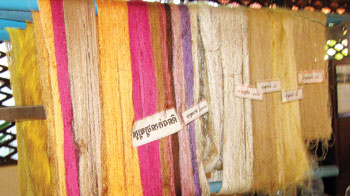
Spinners and silk weavers win support from EU


Silk weaving benefits rural women, experts say. Photo by: Sweet Redbird

via CAAI

Monday, 04 October 2010 15:00 Thik Kaliyann

HANDMADE silk in Cambodia was in the spotlight during a conference held by the National Silk Centre, with the support of the European Union, at Pouk District on the outskirts of Siem Reap.

The Silk Day was organized to promote the quality of handmade silk products and to give an insight into the industry and the challenges it faces. The event also marked the completion of a project to develop and promote the silk sector in Siem Reap and Bantey Meanchey provinces.

This was part of European Union-funded scheme and was implemented by Chantiers-Ecoles de Formation Professionelle and Khmer Silk Villages.

Mr Ke Munny, KSV deputy general secretary, told participants that Khmer silk generates 19 different export products.

“This year in southern Cambodia, there are 20,500 weavers working with silk. The entire silk sector in Cambodia generates roughly US$25 million in turnover, and employs about 25,000 professionals.’’

Dr Sok Siphana, advisor to the Royal Government of Cambodia said: “Our silk products are also attractive to tourists because they are hand-made.”

He added that silk was also an important employment opportunity for Cambodian women, helping to alleviate poverty in rural areas.

“Silk production is traditionally undertaken by women – 99.54 percent of the beneficiaries are women,” he said.

It is estimated that Cambodia consumes 400 tons per year of imported industrial white silk yarn for weaving, while it produces about three tons annually of high quality handmade golden silk.

TFC remembers lost stars during Killing Fields visit


Tennis playing veteran Yi Sarun (left) and TFC General Secretary Tep Rithivit are filmed by a CNN camera crew as they visit the Choeung Ek genocide memorial park on Thursday.
Photo by: Chheang Sowann

via CAAI

Monday, 04 October 2010 15:00 H S Manjunath

THE Tennis Federation of Cambodia paid an emotional visit to the Choeung Ek genocide memorial park, also known as the Killing Fields, last Thursday as part of their recordings for a CNN programme to be aired next month.

65-year-old tennis player and Khmer Rouge survivor Yi Sarun was accompanied by TFC Secretary General Tep Rithivit, who admittedly lost nearly a dozen of his family during the Khmer Rouge atrocities. With his eyes welling up with tears, voice breaking up and clearly overwhelmed with sadness, Tep Rithivit said: “Some of my relatives could be right here or, for that matter, some of the dozens of tennis players at the time who vanished without a trace could be here.”

Estimates believe that of the 40 odd players who were active on the courts in those days, only three survived - Yi Sarun, his younger brother Yi Sarin, and national team player Pel Oum.

“Because of its elitist tag, tennis and its players were obvious targets [for execution]. What is so tragic is that their identities have been destroyed and we have been left with nothing to remember them,” said Tep Rithivit.

“The revival of tennis is a tribute to those who perished and it is that spirit which is ingrained in our ‘Killing Fields to Tennis Courts’ message.”

The TFC started a vigorous campaign to spread this message with specially printed T-shirts endorsed by top tennis stars including Roger Federer and Rafael Nadal. The newly named TFC goodwill ambassador Leander Paes proudly sported a T-shirt during his recent visit.

“It is an eerie feeling as I walk past these graves. I could have been in one of them,” said Yi Sarun as he fought back tears. “I have nothing left from those hard days. I had to destroy all things tennis – my kit, photographs and trophies – to save my skin.”

The oldest active player in the Kingdom, who has never lost his zest for tennis through those years of hardship, grabbed centre stage last week with Leander Paes showering him with praise and the CNN team meticulously capturing his life and times on camera for an episode that is bound to stir passions all over the world. Yi Sarun could well prove to be a talisman for the now thriving TFC.

Pies are premiers


via CAAI

Monday, 04 October 2010 15:00 David Boyle

The colliwobbles are over and hordes of roaming diehards Magpie supporters stand above us claiming bragging rights that will be heartily articulated for at least the next 12 months.

In the sequel to last week’s dramatic tied grand final, Collingwood came out firing from the get-go Saturday, playing with the intensity and defensive pressure that has helped them carve up opponents all season.

It is a trait that coach Mick Malthouse is legendary for drilling into sides – military-like discipline and undying commitment to the contest – and this intent was made clear in the opening minutes of the match.

Heath Shaw’s lunging goal line smother on Nick Riewoldt as he ran into an open goal shortly after the opening bounce was the first of a relentless series of selfless Collingwood defensive acts that unnerved the Saints and left them in the midst.

From there, the Pies amassed a lead similar to last week but no room was allowed in the second half for St Kilda to work their way back as they did in the previous contest.

Once again Nick Maxwell and Dale Thomas gave the Pies sensational accountability and rebound out of the backline, as did Harry O’Brien.

Norm Smith medalist Scott Pendlebury carved up the Saints through the middle, while last week’s winner, Lenny Hayse, was well held by former teammate Luke Ball.

But perhaps most impressive of all was Collingwood’s most famous fan, Joffa, dressed in a more fittingly bogan gold sequin shirt that better optimized the sole of the club than his fancy white suit last week.

Surrounded by disciples, Joffa was celebrating early in the second half as Collingwood ran St Kilda into the ground and then nailed the point home with a spectacular cross body snap from Alan Didak.

Club president Eddie Maguire was in tears at the final siren as the mass of the Collingwood faithful joined together in their first title in the last twenty years.

They now sit just one premiership behind Carlton and Essendon, with their 15th beer-stained Cup safely locked up somewhere in the heartland.

Duo slump in Vietnam


via CAAI

Monday, 04 October 2010 15:00 H S Manjunath
IT was a disappointing day for Long Samneang and Orn Sambath Saturday, as both the Cambodian entries at the Vietnam International Juniors Championships at Bac Lieu failed to clear the first hurdle in the 32-player qualifying draw.

In less than an hour, top seed Christoffer Solberg of Sweden made short work of Orn Sambath, dropping just one game in a 6-1, 6-0 clean up.

The 16-year-old Swede, who is unbeaten in six matches this year and holds a junior ranking of 1,003, never allowed the Cambodian of the same age any liberties on the court.

Tennis Federation of Cambodia coach Chea Pouv said: “the Swedish player was too consistent and solid for Orn Sambath.”

Meanwhile, Long Samneang put up a fairly decent fight against his Thai opponent Chaitawat Paisalsiri before going down 6-2, 6-2 in a game where the Cambodian succumbed to his own unforced errors.

Both Orn Sambath and Long Samneang will play in another qualifying draw at a different venue next week when national head coach Braen Aneiros will join them.

Sunaday 03 October 2010, Mam Sonando at CAAI's Temple (Wat Odom Samakum Khmer)


War Criminal Henry Kissinger Top Speaker At State Department Conference


via CAAI

By Jeffrey Kaye
The Public Record
Oct 3rd, 2010

Henry Kissinger at the World Economic Forum's 'India Economic Summit', November, 2008, New Delhi. Phot/Wikicommons

There was also a deficiency in imagination likely to circumscribe the value of any study by Kissinger of Kissinger. Asked about his role in the Cambodian war, in which an estimated five hundred thousand people died, he’d said, “I may have a lack of imagination, but I fail to see the moral issue involved.” — Joseph Heller, Good as Gold (Kissinger’s original quote is from William Shawcross’s Sideshow: Kissinger, Nixon, and the Destruction of Cambodia)

Fred Branfman has a great article up over at AlterNet pillorying the State Department’s invitation to Henry Kissinger to address a conference on “the American Experience in Southeast Asia, 1946-1975.” The conference was scheduled for September 29-30 at the George C. Marshall Conference Center at the U.S. Department of State. Along with bona fide war criminal Kissinger, the other invitees included current Special Representative for Afghanistan and Pakistan, Richard C. Holbrooke, and Former Deputy Secretary of State, and Former Director of National Intelligence John D. Negroponte.

It was only last April here at The Seminal/Firedoglake that I reported on the declassification of a 1976 State Department cable from Henry Kissinger to “his assistant secretary of state for Inter-American affairs, Harry Shlaudeman, to cancel a formal demarche to the Uruguayan government, protesting the assassinations and other activities of Operation Condor.” Only five days later, former Chilean diplomat Orlando Letelier and his assistant Ronnie Moffat were assassinated on the streets of Washington, D.C. by a CIA-supported Chilean secret police killer.

But, as the Obama administration rehabilitation of the odious Kissinger demonstrates, memory is short in Washington, even when there is blood on the streets… unless that blood can be turned in for demagogic currency, as is the case with the deaths on 9/11. To have Kissinger honored as an authority on the Indochinese War is an obscenity of the first order. Branfman recalls some of the essential history: . . .

Kissinger orchestrated the most massive bombing in world history, dropping 3,984,563 million tons on an area inhabited by some 50 million people, twice the 2 million tons dropped on hundreds of millions through Europe and the Pacific in World War II. He dropped 1.6 million tons on South Vietnam, as many as Lyndon Johnson at the height of U.S. involvement; quadrupled the bombing of Laos, from 454,200 to 1,628,900 million tons; initiated widespread bombing of previously peaceful Cambodia, including B52 carpet bombing of undefended villages, for a total of 600,000-1 million tons; and vastly expanded the bombing of civilian targets in North Vietnam….

In Cambodia, Kissinger told Alexander Haig to undertake “a massive bombing campaign in Cambodia. Anything that flies or anything that moves,” the clearest possible violation of international law requiring the protection of civilians. Two million people in Khmer Rouge zones, as estimated by the U.S. Embassy, were driven underground by massive U.S. bombing that featured regular B52 carpet-bombing of undefended villages.

But when it comes to crimes, we’re just getting started here. Christopher Hitchens positioned part of his career as a would-be prosecutor for war criminal Kissinger. A quick review of just the first part of his March 2001 article at Harpers, “The Making of a War Criminal,” notes Kissinger’s activities. For instance, there was the “recruitment and betrayal of the Iraqi Kurds, who were falsely encouraged by him to take up arms against Saddam Hussein in 1972-75, and who were then abandoned to extermination on their hillsides when Saddam Hussein made a diplomatic deal with the Shah of Iran…” Or consider “Kissinger’s orchestration of political and military and diplomatic cover for apartheid in South Africa.” Or read Hitchen’s detailed, documentary discussion of Kissinger’s brain-trusting for assassination and coup plotting in Chile.

What Has Hillary Wrought?

Of course, Hillary Clinton deserves her own share of obloquy for inviting Kissinger and friends, including former Kissinger protege Holbrooke and the latter’s former Saigon Foreign Service roommate, the unsavory John Negroponte. (Negroponte worked at the U.S. Embassy in Saigon from 1964-68… uh huh.) One could write an entire column about the war crimes of Mr. Negroponte, who, according to the introduction by the National Security Archive (NSA) to a slew of documents implicating him, as former U.S. Ambassador to Honduras in the 1980s “sought to undermine regional peace efforts” in the Nicaraguan Civil War. NSA also cites “multiple reports of meetings and conversations [by Negroponte] with Honduran military officers who were instrumental in providing logistical support and infrastructure for CIA covert operations in support of the contras against Nicaragua.”

Holbrooke, of course, was recently implicated in a controversy with General Stanley McChrystal over policy in Afghanistan. MrChrystal got the heave-ho for being injudicious in his comments to a Rolling Stone reporter, and even though Holbrooke has been critical of U.S. goals in Afghanistan, it’s Holbrooke on the State Department podium, while McChrystal is out in the wilderness (for the time being). Branfman notes the ironies, and political agenda, behind the invite:

Clinton has also invited Richard Holbrooke, who as State Department head of Afghanistan/Pakistan policy has learned nothing from history and is repeating precisely the same policies that caused the U.S. to lose in Indochina — support of a corrupt and unpopular regime that cannot stand on its own. Inviting Holbrooke is particularly egregious, because following Obama’s strategy review, according to Bob Woodward’s new book, “perhaps the most pessimistic view came from Richard Holbrooke. “It can’t work,” he said. Lacking even a fraction of the integrity and moral courage of a Daniel Ellsberg, Holbrooke continues to promote in public a policy he privately believes is doomed to fail.

Branfman also notes that Kissinger is on hand to promote his “we lost Vietnam” garbage, claiming it was Congressional betrayal that failed the U.S. mission in Vietnam at the end. And sure enough, Kissinger was true to form at the conference, as reported by WRGW News:

“I believe most of what went wrong in Vietnam we did to ourselves,” said Kissinger, speaking candidly about his Vietnam experience in front of a capacity audience, including the Vietnamese Embassy….

Henry Kissinger… explained that during the Vietnam War “the faith of Americans in each other became destroyed in the process” of America reaching the limits of its foreign policy….

“America wanted compromise, Hanoi wanted victory,” he stated.

According to Dr. Kissinger, lack of support at home ultimately lost the war for South Vietnam and the United States.

Kissinger, Holbrooke, and Negroponte at the podium represent the true face of U.S. diplomacy today, which relies on the nostrums and machinations of an entire post-WWII generation which saw nothing wrong in ruling American Empire by means of mass murder, assassination, and the bombing of civilians. Today, the Obama administration steps up bombings in Pakistan, escalates the war in Afghanistan (as an exit strategy?), and conducts a world-wide Murder, Inc., which grants itself the right to execute without due process American citizens by Hellfire missiles, even as it trumpets secrecy for everything it does.

Obama’s embrace of Kissinger tells you all you need to know about what this administration is about. Behind the special treatment for war criminal Kissinger is the current administration’s aggressive pursuit of war in Afghanistan and military and covert operations around the world.

I try to imagine how the left would have responded if Bush had invited Kissinger to reflect for history upon the Vietnam War. I’d like to think there would have been universal derision. Today, there’s very little outrage expressed by this official government appearance by a bona fide war criminal. Whether it is fealty to Barack Obama, Hillary Clinton, or a U.S. military and national security apparatus that says it stands for democracy but really stands for endless war, the state right to assassinate U.S. critics, and to intervene anywhere in the world that U.S. “interests” are involved, what stands for politics in this country is a joke. Something is very, very rotten at the core of this country. The falsification of history by the very criminals who conducted crimes against humanity is a primary exhibit of the degeneration of political discourse in America.


Jeffrey Kaye is a psychologist living in Northern California who writes regularly on torture and other subjects for The Public Record, Truthout and Firedoglake. He also maintains a personal blog, Invictus. His email address is sfpsych at gmail dot com.

Here come maids from Cambodia and Thailand

http://thestar.com.my/

via CAAI

Sunday October 3, 2010

By SIMON KHOO

MUAZAM SHAH: Employers can look forward to employing maids from Cambodia and Thailand as an alternative to Indonesians by the end of the year, Deputy Human Resources Minister Senator Datuk Maznah Mazlan said.

Maznah said she would visit both countries next month as part of the Government’s efforts to discuss the possibility of simplifying the procedures to bring them in.

“All these years, Malaysia has been relying too heavily on one or two countries for domestic helpers.

“This cause various problems and difficulties when suddenly an issue arises affecting bilateral ties between both countries.

“As such, we felt it is high time the Government initiate efforts to explore and source maids from countries such as Cambodia, Thailand, India, Sri Lanka, the Phillipines and even Myanmar,” she said when met during her open house in Bandar Muadzam Shah here Sunday.

Maznah said presently, Cambodia and Thailand have been supplying maids to Malaysia but their numbers were relatively small.

She said it was timely for Malaysians to consider employing maids other than from Indonesia due to the on-going spat between both countries.

She believed the number would increase gradually after both governments could reach understanding on the issue.

At the same time, she said, the negotiations with Indonesia to life their freeze on new domestic helpers would continue.

Cambodia a good place for tech startup?

http://www.asiancorrespondent.com/

via CAAI

Tharum Bun
Location: Phnom Penh, Cambodia

Oct. 03 2010

An open, participatory tech conference held in Phnom Penh late last month provided Cambodian Internet users and tech lovers a chance to interact with those from outside Cambodia. I talked to regular participants to the annual unconference of BarCamp Phnom Penh 2010, tech educator Preetam Rai and tech consultant Thomas Wanhoff (whose current base is in Vientiane, Laos).

Preetam Rai, Apple Distinguished Educator

The interest in mobile technology proved to me yet again that IT professionals in Cambodia are well connected with the latest development trends and keen on exploiting them. While in the previous years we saw a lot of sessions where people talked about the possibility of technologies, this time round it was good to see sessions on actual application of these technologies.

The discussion on online payment technologies demonstrated the desire among the local entrepreneurs to run online businesses and tap on e-commerce. The discussion on content management systems also showed that people are interested in developing content sites.

The number of Job available ads at the venue was also an optimistic trend for people looking at IT as a career in Cambodia.

With more younger volunteers taking over from the previous years teams in running the event, I am confident that the BarCamp phenomenon as well as the IT revolution in Cambodia will continue to grow. I am looking forward to come back next year and I hope that smaller BarCamps can be held in the provinces.

Thomas Wanhoff, tech consultant and podcaster

Barcamp Phnom Penh is setting a standard for Barcamps in South-East Asia. Comparing a smaller, less developed nation like Camobdia to Thailand, Malaysia or even Singapore, it is astonishing to see how active and professional the IT-Community in Phnom Penh is.

Barcamp Phnom Penh still maintains the spirit of Barcamps as it should be (although the pressure from sponsors was a bit much this year), it is all about learning from each others, sharing information and - important as well, having fun.

With two days of many sessions, it's quite exhausting. But you will rarely see no smile in the faces of the participants. Also, there are always suprises, like the "How to build a Cambodian Spaceship" session, or "Developing for iPhone." I learned a lot from Chris Brown this year, who pointed out why Cambodia is a good place for start-ups: "You can dvelop and create the product for the whole world while having low-cost office rent, lower salaries and highly motivated young developers." I totally aggree with that.

There were many job offers I saw at the Barcamp. It reflects that there is already a small community of start-ups, and my wish is that Phnom Penh develops itself as a kind of a Silicon Valley of the region, where young creative people are working on the future of the Internet generation.

My advice for the next Barcamp is: Do it as before, maybe step back from to many sponsors, keep the spirit and have fun.

If you attended this year's BarCamp Phnom Penh, please tell us what you think; what don't like most and what you like less.

Photo courtesy of BarCamp Phnom Penh 2010

Sunday, 3 October 2010

Thai, Cambodian PMs to discuss border issues in Belgium

http://www.mcot.net/

via CAAI

BANGKOK, Oct 3 -- Thai Prime Minister Abhisit Vejjajiva said he would confer with his Cambodian counterpart Hun Sen on the two countries’ border problem on the sidelines of the 8th Asia-Europe Meeting being held in Belgium this week.

It is possible that more talks on the issue, especially on actions of concerned government units of each country, will be discussed after the informal talks of the two leaders in New York late last month, Mr Abhisit said.

Some projects such as those involving education and cultural exchanges between the two countries have made considerable progress, he said.

The border problem with soldiers of both countries facing each other on the border may be discussed further, Mr Abhisit said.

Asked whether he would ask Mr Hun Sen for a troop withdrawal to ease tensions when they meet at the upcoming meeting, Mr Abhisit said the Cambodian government fully realises that existing bilateral mechanisms agreed by the two countries must be approved by the Thai parliament.

Thailand and Cambodia signed a memorandum of understanding in 2000 to establish a Joint Boundary Commission to demarcate overlapping parts of their boundary, but the framework for border demarcation has not been approved by the Thai parliament as required by the constitution.

The two neighbouring nations have been locked in a military standoff on their disputed border since July 2008, when the historic Preah Vihear temple was granted UNESCO World Heritage status.

The International Court of Justice ruled in 1962 that the temple belonged to Cambodia, although its main entrance lies in Thailand. The exact boundary through the surrounding grounds remains in dispute, with occasional full-scale military skirmishes claiming a number of lives.

Realising that the border problem has been continuing too long, Mr Abhisit said “there are several problems which hinder a final agreement as processes must be approved by each country.” (MCOT online news)

Thai, Cambodia PMs to Discuss Border Issues in ASEM

2010-10-03
Xinhua     
Web Editor: Gongming

via CAAI

Thai Prime Minister Abhisit Vejjajiva said he would consult with his Cambodian counterpart Hun Sen on the two countries' border dispute on the sidelines of the 8th Asia-Europe Meeting in Brussels, on 5-6 October.

After the latest talks of the two leaders in New York late last month, more discussions on the border issue especially on actions of concerned government agencies of each country are possible, Abhisit said.

The Thai News Agency quoted Abhisit as saying that the border problem with soldiers of both countries facing each other on the border may be discussed further.

Thailand and Cambodia have an age-old dispute over the area along their border and over the 900-year-old Hindu Preah Vihear Temple. In 1962, the International Court of Justice ruled the temple belongs to Cambodia although its main entrance lies in Thailand.

Tensions flared up again as the UNESCO named Preah Vihear a World Heritage in 2008 and once again as Cambodia appointed Thailand's ousted ex-PM Thaksin as its economic adviser in November 2009. Armed clashes resulting in casualties on both sides have occurred occasionally in the area since then.

Thailand protested against Cambodia by recalling its ambassador soon after Thaksin's appointment, and then Cambodia followed suit. The two countries' diplomatic relations did not resume to normal until Aug. 25 of this year, when they reinstated the ambassadors to each other, following Thaksin's resignation.

Ex-Khmer Rouge in former stronghold play the numbers game (Feature)

http://www.monstersandcritics.com/

via CAAI

By Robert Carmichael
Oct 3, 2010

Pailin, Cambodia - 'They do not have blood on their hands,' said Mey Mak, Pailin's bespectacled deputy governor, of the four former Khmer Rouge leaders indicted last month by the war crimes court.

'Khieu Samphan, for example, he was responsible for the economy. Ieng Sary just went in and out of the country, and Ieng Thirith was only in charge of the social affairs ministry.'

'So it seems to me that they are victims,' he said of the movement's former head of state, foreign minister and minister of social affairs respectively.

The fourth person indicted was Nuon Chea, known as Brother Number Two, and regarded as the movement's chief ideologue.

Mey Mak, who worked for a decade as secretary to the Khmer Rouge's late leader Pol Pot, was speaking at a public meeting in late September in the former Khmer Rouge stronghold of Pailin in western Cambodia.

Senior members of the UN-backed war crimes tribunal had travelled there from Phnom Penh 400 kilometres away to explain the court's work.

Their trip into the movement's old heartland came just days after the court indicted the four surviving former leaders for genocide, crimes against humanity and war crimes.

Across Cambodia their indictments are regarded as long overdue. But that is not the case in former strongholds such as Pailin, where the defendants used to live.

Mey Mak told the audience of several hundred police, military and civilians, most of whom former Khmer Rouge, that power lay in Pol Pot's hands. Therefore trying anyone else was inherently unfair.

His comment drew a dry response from international co-prosecutor Andrew Cayley.

'I certainly anticipate in this trial, as in many others I have done, that responsibility will be laid at the feet of the dead, and the living will claim innocence,' Cayley said.

The court estimates that up to 2.2 million people died during the Khmer Rouge's catastrophic rule between 1975 and 1979. More than a million likely died violently.

But it turned out that the former cadres at the gathering were more interested in another number: How many people does the court want to try? The answer, Cayley told them, is no more than 10.

The first defendant was Comrade Duch, who was jailed in July for 30 years for his role as commandant of the S-21 torture and execution centre. Then there are the four former leaders, whose trial will likely start next year.

Lastly, the court is investigating five more, who remain unidentified.

'Those five may or may not go to trial, depending on the work of the investigating judges and what they find,' Cayley said. 'So with those 10, that is it.'

It is an answer that goes down well in places like Pailin, but which mystifies the rest of Cambodia. How can no more than 10 people be held accountable for so many deaths?

A large part of that answer is politics, which has constrained the court since before its inception. Many senior figures in Cambodia's government were in the Khmer Rouge, and a court with a wide remit might reveal some uncomfortable truths.

Further afield, the United States and China were among the countries involved in supporting the movement at one point or another, but would rather the spotlight shone elsewhere.

Other nations were involved too, but politics has dominated the life of this tribunal. It will likely rear its head again if - as some expect - the court eventually shelves the five new investigations.

Doing so would suit Prime Minister Hun Sen, who has come out strongly against them. And it seems unlikely that many of the court's Cambodian staff would feel comfortable going against the premier's wishes.

Mey Mak suggested the court should focus more on national reconciliation and less on investigating the five new suspects, although he conceded that trying the four ex-leaders fits with the tribunal's legal remit.

'But like me and others, they wanted to escape from the regime and could not,' he said, before asking his home audience: 'How could they have escaped?'

Just how responsible these four were for what happened lies at the heart of the tribunal's second case. But a more pressing fact is that the youngest defendant is 78, and one or more might not survive a lengthy trial.

So there remains the possibility that 67-year-old Comrade Duch will be the only person held accountable for one of the 20th century's most destructive regimes.

Mam Sonando in Auckland, New Zealand


The CAAI would like to announce that Mr. Mam Sonando, the president of Sambok Khmum Radio, The voice of People is visiting wat Odom Samakum Khmer in Auckland, New Zealand. He will join our kan benda and having a speach tonight. We would like to invite you all to join this special event.

Your Sincerely.

CAAI News Media

To Gain The Power is To Kill The People? Grenade attack event on March 30, 1997

Part 1


Part 2


Part 3


SunChanthy | September 30, 2010

March 30, 1997 grenade attack event on an opposition rally for judicial system reform in Cambodia led by Mr. Sam Rainsy, President of the Khmer Nation Party in front of the National Assembly building.

Cambodians Mark the Festival of the Dead


Every September Cambodians around the country celebrate the Festival of the Dead.

Hundreds gather at temples before dawn with offerings of rice balls, small cakes and water which are given to the monks and also dropped on the ground around the temple for the spirits.

Traditions say that some family members become evil spirits after they die because of the bad things they did while alive.

[Prak Bora, Monk]:
"Our people feel pity towards the evil spirits who cannot get good food through the monks’ offerings, therefore they have this ceremony before sunrise to offer food to them so they can have the food to eat."

[Chuop Khon, Festival Participant]:
"I hope what I offered today gets to those who died and may they all live in peace and bless us with good luck.”

Other families brought big cakes, drinks and money to offer to the spirits that roam in daylight.

[Meak Diep, Festival Participant]:
"When the monk offers the food, it gets to our relatives who have died. I truly believe that."

Although the war-scarred nation's annual Festival of the Dead honors all ancestors, it has taken on added significance since the fall of the Khmer Rouge which inflicted years of violence onto Cambodians during the late 70s. About a third of the Cambodian population died.

The 2-week-long festival runs through October 8th.

Boeng Kak Lake Residents" Protest Opposite PM's House


Related Video: May 28, 2010

Land Protesters From Kandal Province Suppressed by Police

Students Start School Year 2010 - 2011

USAID ផ្ដល់​ជំនួយ​ដល់​កម្ពុជា USAID Donated $M35 To Improve Cambodia Health Sector & Education System

Monks' Community Forest in Cambodia wins prestigious Equator Prize


2010-09-30

ព្រះ​តេជ​គុណ ប៊ុន សាលួត គង់​នៅ​វត្ត​ប្រាសាទ​រាជា ស្ថិត​នៅ​ខេត្ត​ឧត្ដរ​មាន​ជ័យ​។ ព្រះអង្គ​ ទទួល​ពាន​រង្វាន់ Equator នៅ​បូរី​ញីវយ៉ក សហ​រដ្ឋ​អាមេរិក ដោយ​ស្នា​ព្រះហស្ត​ក្នុង​ការ​ដឹក​នាំ​ព្រះសង្ឃ និង​ពុទ្ធបរិស័ទ​ការពារ​ព្រៃឈើ។

Cambodia's Freedom Park worries rights groups

A Cambodian worker building toilet building for a freedom park in Phnom Penh. Photo courtesy: AFP.

Cambodian children holding portrait photos of Prime Minister Hun Sen and his wife Bun Rany during a protest in front of Prime Minister Hun Sen's residence in Phnom Penh. Photo courtesy: AFP.

Cambodian children holding portrait photos of Prime Minister Hun Sen and his wife Bun Rany during a protest in front of Prime Minister Hun Sen's residence in Phnom Penh. Photo courtesy: AFP

Cambodian women shouting as policemen try to disperse them during a protest in front of Prime Minister Hun Sen's residence in Phnom Penh. Photo courtesy: AFP

Cambodian workers laying bricks for a freedom park in Phnom Penh. Photo courtesy: AFP.

Cambodian workers pushing a cart loaded with bricks for a freedom park in Phnom Penh. Photo courtesy: AFP