Tuesday, 9 November 2010

Kandal workers say recruitment firm defrauded them


via CAAI

Monday, 08 November 2010 15:03 Buth Reaksmey Kongkea

FORTY-FOUR workers from four districts in Kandal province filed a complaint against a labour recruitment firm last week for allegedly cheating them out of money paid to secure jobs abroad, police said yesterday.

Chhuon Chhin, one of the workers suing two CDM Trading Manpower Co employees in connection with the firm’s agreement to find jobs in Thailand, said he and the other workers paid US$150 to CDM representative Um Roeun in May.

He said they have still received no work and are demanding their money back.

“We want the company to return our $150 to each of us, and we would also like to appeal to the police to take legal action against this company,” he said.

Kandal police chief Iv Chamroeurn said yesterday that police had received the complaint on Friday, adding that he expected the police to begin an investigation today.

Touch Manak, general manager of CDM’s office in Phnom Penh, yesterday blamed delays on political instability out of his control. “Our company has no intention of cheating the workers”, he said, adding “we are late because of Thailand’s political turmoil as well as the tension of politics between Cambodia and Thailand in the past six months.”

Third man charged in Takhmao murders


via CAAI

Monday, 08 November 2010 15:03 Chrann Chamroeun

A THIRD suspect has been arrested and charged with premeditated murder in connection with the triple murder of three women in Kandal province’s Takhmao district last month.
All three victims were found shot dead on the morning of October 9 at a restaurant adjoining their home, the day after they were believed to have been murdered.

The victims have been identified as 47-year-old Sok Koeu, her daughter, 24-year-old Seng Muoy Kea and a 17-year-old waitress whom police would not name.

Kandal provincial court prosecutor Ouk Kimseth said yesterday that a third suspect, Bun Vuthy, 27, had been arrested and charged with premeditated murder, in addition to two suspects who were charged on Thursday: Sok Koeu’s 44-year-old nephew Sok Seng, and former soldier Toan Sarom, 30.

“The judge has already ordered [Bun Vuthy] to serve pretrial detention pending further investigations,” he said.

He said Bun Vuthy was arrested on Friday in Kampong Speu province’s Baset district, where he had been hiding following the arrests of his two accomplices. If found guilty, each suspect faces between 15 and 20 years in prison.

Kandal provincial police chief Iv Chamroeun said last week that “according to our investigation and from the testimony of the suspects, Sok Seng killed his aunt, her daughter and the waitress after Sok Koeun did not give him US$2,000 to borrow.”

Sok Seng told police following his arrest that the trio went to visit his aunt to request the loan on October 8, which was approved by her daughter, but who said she would have to wait for her mother to return from the market.

However, when Sok Koeu returned to the house she refused the loan.

“Sok Seng then asked his colleagues, who were waiting outside, to rob her,” Iv Chamroeun said on Thursday.

They then tied up all three victims and demanded the money, but Sok Koeu refused though she had $10,000 hidden under her mattress.

Sok Seng then used Toan Sarom’s gun to shoot all three women in the head, before the men fled the scene on motorbikes and making off with “some cash and jewellery”.

Am Sam Ath, a technical supervisor for the rights group Licadho, yesterday welcomed the arrests, but stressed that court officials work “in a thorough way to make sure they are the real killers to provide justice for the victims”.

Shot actress asks for truce on lawsuits


via CAAI

Monday, 08 November 2010 15:03 Mom Kunthear

AN actress who was shot in the arm during a film crew party last month said she will drop her charges against the military police officials who caused her injury if assault charges against her four friends were also dropped.

Sveng Socheata, 30, was accidentally shot while officials attempted to break-up a post-shoot party that had turned loud and disruptive. Two officers were wounded, while four of the actress’s friends were arrested and charged with assault for their role in the altercation.

“If the officials withdraw the complaints against my friends who were arrested and charged, then I will not sue them,” said Sveng Socheata.

“But if they don’t withdraw the complaints, I will file complaints against the military police involved.”

Nhem Sila, deputy military police chief of Siem Reap province, said the behaviour of the actress’s friends was reckless, and that charges wouldn’t be dropped.

“The police did not fight them,” said Nhem Sila. “They fought us until two military police officials were seriously injured.”

The police chief said that Sveng Socheata’s attempt to bargain on her friends’ behalf was “like a kid’s idea”.

The actress said some of the blame for the altercation should go to Bich Savin, the owner of Seven Productions, the production company that is overseeing the film project, since he was the one who called police to complain about the party.

“I wasn’t the one who caused any problems; it was the production owner who called the police,” said Sveng Socheata. “This all happened because of him.”

The actress has threatened to sue Bich Savin, who has said that he would file a counter-lawsuit if that happened.

Sveng Socheata is currently recovering at a private clinic in Siem Reap province and underwent surgery yesterday. She said that she was still unable to move her arm, and that the film had been put on hiatus until the issues are resolved.

Freed journalist to file appeal


Photo by: Sovan Philong
Ros Sokhet is led into a van before being returned to prison after a hearing at Phnom Penh Municipal Court in October 2009.

via CAAI

Monday, 08 November 2010 15:02 Tep Nimol

A JOURNALIST who was recently released from prison after serving a year on disinformation charges says he will file an appeal today to the Supreme Court to have his conviction quashed and to demand US$120,000 in damages from the government.

Ros Sokhet, who was sentenced to two years in prison after allegedly sending threatening text messages to news anchor Soy Sopheap, was released last month after serving a year in prison. Despite his
release, which followed the intervention of Information Minister Khieu Kanharith, Ros Sokhet said he wanted his “whole case” re-investigated.

“If the court increases my jail term, I’ll accept it, but only if the court makes it clear for me,” he said yesterday.

Ros Sokhet said Khieu Kanharith wrote to Justice Minister Ang Vong Vattana on Friday, thanking him for helping secure the journalist’s release.

He added, however, that this was merely a way for the information minister to close the case without addressing the charges he wanted dropped.

But Sam Brochea, a cabinet chief at the Ministry of Justice, said government officials had been working on Ros Sokhet’s release since September, before the journalist said he wrote to officials requesting his release.

Ros Sokhet said he was confident he would be awarded the $120,000 he was seeking in compensation, and that he planned to donate $50,000 to the Sam Rainsy and Human Rights parties for their 2013 national election campaigns.

He also intends to start an anticorruption newspaper that will target Prime Minister Hun Sen and provide a platform for the opposition parties.

Factory strike: Workers call for return of union head


via CAAI

Monday, 08 November 2010 15:02 Mom Kunthear

Factory strike

REPRESENTATIVES of about 600 workers who began a work-stoppage last week said yesterday that they would continue striking outside the PY garment factory in Sihanoukville’s Number 4 district to agitate for the reinstatement of their fired union leader.

The strike began on Thursday after the company agreed to guarantee some of a list of 12 basic working conditions employees had requested, but refused to reinstate union leader Mao Piseth, who they say was fired last month for cursing the manager.

Phem Yoeun, a 29-year-old garment worker, said yesterday that workers would continue to strike until Mao Piseth was allowed to return to work.

“I expect that there are more workers who will join the strike on Monday because they know about the unfair [treatment] that the factory owner did with our union leader,” she said.

Yov Kemera, director of the provincial labour department, said negotiations between the factory and the workers had been unsuccessful and that he had submitted the case to the Arbitration Council on Friday and was waiting for a response.

Beijing top brass give thanks for Kingdom’s South China Sea policy


via CAAI

Monday, 08 November 2010 15:02 Cheang Sokha

CHINA has thanked Cambodia for its opposition to the “internationalisation” of disputes in the South China Sea, following visits to the Kingdom last week by top Chinese and American policymakers.

Minister of Information Khieu Kanharith said last week, following a meeting between Prime Minister Hun Sen and Wu Bangguo, China’s top legislator, that Wu had thanked Cambodia for supporting Beijing’s “One China” policy, as well as for remarks the premier made at last month’s ASEAN summit in Hanoi regarding the contentious South China Sea.

China claims sovereignty over the waters, though the United States has waded into the dispute as well, calling for freedom of navigation in the area. Other ASEAN members including Vietnam, the Philippines and Malaysia have also staked territorial claims in the area.

“China thanked the government of Cambodia for its stance on China’s reconciliation, and thanked the just stance of Samdech Hun Sen for objecting to attempts to internationalise the matter of the South China Sea,” Khieu Kanharith said on Thursday.

“Regarding the relations between ASEAN and China, China expressed its stance that it does not intend to seek power or own ASEAN, and supports the role of ASEAN,” Khieu Kanharith said.

In July, US Secretary of State Hillary Clinton called freedom of navigation in the South China Sea an American “national interest”, and has suggested multilateral discussions to resolve territorial disagreements in the area. Clinton was in the Kingdom last week for a two-day visit.

US embassy spokesman Mark Wenig said in an email yesterday that he knew of no “official dialogue on this issue between the US and Cambodia”, but that “the US position has consistently been that the South China Sea is within international waters”.

During Wu’s four-day visit, which concluded on Saturday, Chinese officials announced plans to invest US$1.6 billion in 23 infrastructure projects in the Kingdom over the next five years, projects Khieu Kanharith said would include “roads, bridges, ports, railways and information technology”. Cambodia and China also signed 16 agreements related to hydropower and water resources.

ADDITIONAL REPORTING BY JAMES O’TOOLE

Underage sex: Man accused of abusing girl aged 16


via CAAI

Monday, 08 November 2010 15:02 Chrann Chamroeun

Underage sex

A CAMBODIAN man was sent to Phnom Penh Municipal Court for questioning after being accused of sexually abusing an underage girl up to six times at a guesthouse in Daun Penh district.

The suspect, a 20-year-old tuk-tuk driver, was arrested in Chey Chumnas commune on Thursday following a complaint lodged by the 16-year-old victim’s parents.

Deputy district police chief Em Saroeun said the suspect was sent to court on Saturday following his arrest, where he confessed to having sex with the girl at a guesthouse.

“After eating and drinking at a local restaurant … the suspect lured a girl to a guesthouse, where he had sex with her up to six times that night,” Em Samroeun said.

State set for munitions talks


Photo by: Tracey Shelton
A cluster munition is shown at an ordnance disposal facility in Kampong Chhnang
.

via CAAI

Monday, 08 November 2010 15:02 Thet Sambath

DELEGATES from around the world will descend on Laos this week to discuss an international treaty banning cluster bombs, which continue to ravage the Kingdom after they were dropped by the thousands decades ago.

Once instrumental in drafting the treaty, Cambodia has yet to ratify it, despite being among the countries most severely affected by cluster munitions.

Chan Rotha, Deputy Secretary General of Cambodian Mine Action Authority, said the impact of cluster munitions in the Kingdom made a Cambodian presence at the meeting symbolically important. CMAA deputy secretary general Prum Sopheak Mongkol, who will attend the meeting as an observer, departed for Vientiane yesterday.

“We want to show the world that Cambodians are victimised by American cluster munitions, and that we hate [the bombs] and want them destroyed and gone because they have killed many people”, Chan Rotha said.

Representatives from about 100 countries will attend the four-day summit, according to the Cluster Munition Coalition, an advocacy group. CMC said the meeting “is expected to be a defining moment in the life of the Convention on Cluster Munitions, the most significant disarmament treaty in over a decade”.

Country representatives are expected to adopt an “action plan” to implement the agreement at the meeting, which ends on Friday.

Cluster bombs, launched from the ground or dropped from the air, split open before impact to scatter multiple bomblets over a wide area. Many initially fail to explode and can lie hidden for decades.

State parties to the 2008 Convention on Cluster Munitions, ratified by 45 countries, must immediately end the use and production of cluster munitions. The agreement went into effect in August, and also requires signatories to provide support to victims, destroy existing stockpiles and clear contaminated land.

The government has cited security concerns in explaining its reluctance to endorse the treaty, noting that regional rival Thailand had yet to sign. It has also voiced concerns about its ability to clear munitions within the prescribed timeline.

Heng Rattana, director general of Cambodian Mine Action Centre, said CMAC had cleared more than 50,000 cluster munitions since 2002. Some 223 people in Cambodia were reported killed or injured by landmines and explosive remnants of war in the first nine months of this year, according to the CMAA.

ADDITIONAL REPORTING BY AFP

Massage brothel busted


via CAAI

Monday, 08 November 2010 15:02 Rann Reuy

The Phnom Penh Municipal Court has charged a woman accused of running a brothel out of her Tuol Kork district home, which doubles as a massage parlour.

Keo Thea, police chief of the municipal anti-human trafficking and juvenile protection bureau, said yesterday that the 53-year-old woman was charged with procuring prostitution on Saturday and detained at Prey Sar prison pending trial.

He said the woman was arrested following a raid on her property in Boeung Salang commune on Thursday, when police discovered four massage therapists who admitted that they had been selling sexual services and splitting the profits with the owner of the parlour.

“The [woman] operated the massage parlour. It is not wrong that she opened it, but there were sex services there,” he said.

Procuring prostitution – the definition of which includes drawing a financial profit from the prostitution of others – is illegal under Article 26 of the Law on the Suppression of Human Trafficking and Sexual Exploitation, which states that a conviction on charges of procurement is punishable by two to five years imprisonment.

Koeur Bunnara, deputy prosecutor at the Municipal Court, said yesterday that investigations were ongoing and a trial date had not been set.

Suon Chhoeung, deputy director of Phnom Penh Municipal Social Affairs Department, said police had sent the four women to the ministry, which would refer them to partner organisations offering support services.

Seven arrests made over murder of baker


via CAAI

Monday, 08 November 2010 15:01 Khouth Sophakchakrya

SEVEN suspects were arrested yesterday in connection with the murder and robbery of a bakery shop owner last month, whose body was dumped at the Ministry of National Defence.

Phnom Penh military police chief Ya Kim Y said Sim Ritha, the victim, who owned a bakery in Dangkor district’s Choam Chao commune, was killed on October 15 and his body dumped at the Ministry.

He said a total of seven people had been arrested, with one man primarily charged with murder and robbery, and the remaining six charged with robbery and accomplices to murder.

“The [main] suspect has confessed to shooting the victim in a revenge attack,” he said and added that all seven suspects would be sent to Phnom Penh Municipal Court today for further questioning.

Police Blotter: 8 Nov 2010


via CAAI

Monday, 08 November 2010 15:01 Sun Narin

Speeding moto driver killed while overtaking
A 21-year-old man was killed while trying to overtake a car on his motorbike in Siem Reap province on Thursday. A witness reported that the car and the bike were travelling in the same direction, when the bike began to overtake the car on the right hand side. However, he clipped the car and came off, “breaking his head” on the road. The car fled the scene as the man remained on the road, bleeding to death. Police said the victim died because he did not wear a helmet and drove “very fast”. Police are searching for the driver.
RASMEY KAMPUCHEA

Fake police loot victim and are forced to fire
A man was shot in his house in Kampong Cham’s Thbong Khmom district by a group of thieves posing as policemen on Thursday. Police said the four suspects were dressed as policemen and pretended to search the victim’s house on a fake warrant in order to rob him. However, the victim quickly discovered the ruse and began to fight the faux-cops, who then proceeded to shoot the victim four times. The real police heard the shots and quickly intervened, arresting two suspects and taking the victim to hospital with severe injuries.
RASMEY KAMPUCHEA

No phone credit leads man to down rat poison
A 37-year-old man attempted to kill himself in Svay Rieng province by drinking rat poison because his wife was angry with him for using all their mobile phone credit. The wife said her husband was easily upset and disappointed, and that on Tuesday she had blamed him for the lack of credit. He was drunk at the time, and the accusation caused his anger to boil over. He began to damage house property before storming out of in a huff. His wife did not go to console him, leading him to down “too much” rat poison. However, he failed to kill himself, and doctors said remains in hospital in serious condition.
KOH SANTEPHEAP

Three drunks drive speeding car into tree
Three drunken men were sent to hospital with severe injuries after crashing their car into a tree in Takeo’s Treang district on Wednesday. Police said the three men were all drunk and the driver “drove very fast” when he lost control and veered into a tree on National Road 2. Police impounded the car and sent the victims to hospital for treatment.
KOH SANTEPHEAP

Careless tree lopper crushed by trunk
A man died in Pursat province after a tree fell on him last week. A witness said the victim was hired to cut down the tree for a local company. He failed to follow protocol and began to haphazardly cut the tree. The tree then fell on him and killed him instantly.
KAMPUCHEA THMEY

Second Chinese bank plans Kingdom launch


via CAAI

Monday, 08 November 2010 15:00 Nguon Sovan

A SECOND Chinese bank has been granted in-principle approval to operate in Cambodia, officials said yesterday.

Head of the Governor’s Office of the National Bank of Cambodia Thai Saphear, said yesterday that the central bank gave the Industrial and Commercial Bank of China approval late last week.

“The governor Chea Chanto granted approval-in-principle to open a branch in Cambodia while meeting with the management of ICBC,” he said. “This is the huge bank.”

ICBC’s entry follows the scheduled launch of the Bank of China, set to open later this year. Last week, BoC signed a refinancing deal with domestic mobile provider Mobitel for US$591 million.

Malaysia’s CIMB is also entering the market, and has now already granted the licence to operate, according to Thai Saphear. Its official launch is expected next week.

“Many foreign banks with international standards are investing in Cambodia, reflecting a confidence in political stability and economic potential of investment opportunities,” he said.

“More banks will bring more capital for the development of the economy, bring more technology for the industry, and create more jobs.”

ICBC now has six months to meet NBC requirements on registered capital, statutes and potential location.

Jiang Jianqing, president of ICBC, met with Prime Minister Hun Sen on Friday, according to officials.

Hun Sen’s spokesman Eang Sophaleth told reporters that ICBC said that the bank was looking at expansion to the Kingdom due to the close relationship between the two countries.

“The bank’s loans target mainly the energy sector and construction of hydro-power projects. Currently, many Chinese firms are investing in these sectors,” Jiang Jianqing was quoted as saying by Eang Sophaleth.

ICIB has branches in Singapore, Thailand, Vietnam, Indonesia and Malaysia.

Hun Sen’s spokesman said the premiere welcomed ICBC’s move, but urged the bank to focus on agriculture.

General Manager of Foreign Trade Bank of Cambodia Gui Anvanith said yesterday that the arrival of such huge banks would be positive for large-investment projects, but may not represent direct competition for Cambodian rivals.

“We don’t have much concern about new comers because we have different battles [to fight].

"They focus their loans mainly on huge projects invested by their respective countries’ investors, such as hydro-power and coal-fired power, and we focus on local companies,” he said.

“However, we don’t ignore them in the context of competition — we have to keep close eyes on their granting of interest rates on deposits and loans,” he said.

When the three new banks come online, the number of commercial banks in Cambodia will rise to 31.

Bank of China soars, ANZ feels Swan effect


via CAAI

Monday, 08 November 2010 15:00 Jeremy Mullins

BANK of China, which announced it had refinanced Cambodia’s largest mobile provider Mobitel on Thursday, closed up 5.3 percent on the week, reaching HK$4.85 (US$0.63) a share in Hong Kong by end of play Friday.

The firm’s President Li Li Hui inked a deal with Kith Meng, chairman of Cambodian conglomerate The Royal Group, that would see its subsidiary Mobitel refinanced through a US$591 million long-term loan from the Chinese bank.

Mobitel had previously been financed through a US$421 million loan from a number of banks and funds, including Australia and New Zealand (ANZ) Banking Group.

Australia-listed ANZ saw its share prices drop 3.5 percent last week to end at A$24.09 (US$24.45).

The firm – which is 55 percent owner of Cambodia’s fourth largest bank ANZ Royal – had been up in trading on the week until Wednesday, when Australian Treasurer Wayne Swan vowed to crack down on “arrogant banks” down under.

Meanwhile, Brighton Mining Group Limited closed up 5 percent in its first week of trading on the Australian Securities Exchange.

The firm had listed at A$0.20 on Wednesday, after it conducted an initial public offering that raised A$2.2 million.

Managing Director Jonathon Remta has said the firm would be funded from three or four other sources, besides the recent float.

Brighton has the right to acquire by transfer 70 percent of Cambodian-incorporated joint venture Sun Hill Minerals Co Ltd, which owns the exclusive rights on three semi-contiguous concessions in Mondulkiri province, according to the firm’s prospectus.

Record-setting gold prices last week helped push up Cambodian concessionaire Southern Gold’s share price on the ASX.

Gold hit a record high of $1,398.25 an ounce on Friday and in its wake sister metal silver nailed a 30-year peak of $26.90.

Oil also struck the highest level since late 2008 last week after the United States Federal Reserve agreed to pump the world's biggest economy with fresh stimulus.

“Currency wars, quantitative easing and global economic uncertainty all pose risks to investors.

“To protect themselves, many have sought the safety of gold,” said Anthony Grech, an analyst at trading firm IG Index.

“Silver has the potential to continue outperforming gold, with the metal likely to be driven by increasing industrial use and investment demand.”

In Sydney, Southern Gold closed out the week at A$0.078 a share, up four percent from the week’s open. The firm is exploring properties in Australia as well as six tenements in northeastern Cambodia.

Axiata Group Bhd, the owner of Cambodian mobile provider Hello, saw its share price drop 1.6 percent during trading on the Bursa Malaysia last week, closing out at 4.44 ringgit (US$1.44).

The firm launched its “Axiata Roam” service on Wednesday, which offers discounted rates for users travelling between countries with Axiata networks.

ADDITIONAL REPORTING BY AFP

Mobitel gains time, but who will buy company?


via CAAI

Monday, 08 November 2010 15:00 Steve Finch

MOBITEL’S announcement of a US$591 million deal with Bank of China to refinance last year’s $421 million agreement buys Mobitel time, but the country’s leading network has still not found an international telecoms partner.

The refinancing package means Mobitel has breathing space – as the terms of the new deal are longer term – but that also means the firm will likely be saddled with interest payments for more time.

The network had been expected by many within the sector to have found a global telecoms firm to buy a stake. That would have permitted repayment of the original loan, meaning a replacement lending package would not have been required.

Most people will no doubt come to the conclusion that has overshadowed the Cambodian mobile phone sector for some time now: Selling off mobile phone assets in part or in full has become tricky given the high level of competition and low current returns.

That certainly seems to be the case, but then setting up a deal to sell part of Mobitel is a large and complex issue that would naturally be expected to take time. The question for any investor though remains: How much is Mobitel worth and what are the network’s longer-term prospects?

When The Royal Group took on Millicom’s majority stake last year, the operation was valued at $605 million in terms of assets, but then 2010 has hardly been a good year for anyone in the sector as competition has stifled revenues.

Companies looking at Mobitel’s longer-term prospects though could only come to the conclusion the firm is still in pole position to outlast the current sector-wide malaise.

In a market in which consolidation is likely, Mobitel will continue to be the market leader and by committing to infrastructure expansion following two deals with Huawei worth a combined $500 million, the network is positioning itself in the right way.

Expansion into more rural areas allows Mobitel to battle its main competitor Metfone, whose main advantage is its wide coverage following a rapid infrastructure rollout. In the past 18 months Mobitel has been much better at competing in urban areas. Prospective buyers including France Telecom, according to reports, will therefore see long-term value in a Mobitel stake.

Committing to the long haul in the mobile sector, while uncertainties, including the lack of a long-awaited telecoms law, remain, is a big commitment for a foreign company that would almost certainly have no experience of the Kingdom. So, who will get into bed with The Royal Group by taking on Mobitel?

Singapore has always been canny at adapting to change


via CAAI

Monday, 08 November 2010 15:00 Roger Mitton

ITS leaders are masters at knowing when a formerly sacrosanct policy is near its sell-by date or when the fuse on a tense situation is close to detonation point.

In 1976, when I first visited, the city-state was known for strict censorship laws, anti-littering rules, and edicts against everything from long hair to gays to gambling.

When I was posted there in 1989, the People’s Action Party government still banned Cosmopolitan, the racy women’s magazine, and vetoed the sale of chewing gum.

But as the millennium came and went, the PAP realised that in a digital age it could no longer act as a nanny to the region’s most educated citizenry.

In swift succession, it began openly employing gays, lifted the ban on Cosmo, allowed sugar-free gum and long hair and all the trappings of a hedonistic society.

Massive glitzy shopping malls selling every expensive frippery you never really needed rose up beside Michelin-starred restaurants, vintage wine bars and Condomania stores peddling prophylactics on tony Orchard Road.

This year even gambling was approved and two huge ultra-modern casinos opened their doors. Las Vegas Singapore, yeah!

But while this was occurring, another more difficult and portentous challenge loomed: the issue of national leadership.

In the past, there has never been much doubt about who would lead Singapore. Lee Kuan Yew became prime minister in 1959 and ruled for 31 years. He is still there now, as minister mentor.

When the party began to consider who would replace him, Lee favoured fellow intellectual Tony Tan, who held several ministerial portfolios.

But Tan did not want the job, so Defence Minister Goh Chok Tong got it in 1990 and became the most popular figure in the party.

When he stepped down in 2004, Lee Kuan Yew’s eldest son, Lee Hsien Loong, who had been long groomed for the job, took over.

That made two smooth transitions in a row. The current PM Lee, 58, is unlikely to step down until his mid-60s, but that is not far off and there is no credible younger candidate to replace him at the moment.

What to do? Well, this is where Singapore shows its adaptive prowess.

Although a general election is not due until early 2012, the authorities have recently examined 1,400 polling station venues.

Clearly, an election is imminent and will provide a chance to induct fresh talent – and with any luck a potential new prime minister.

Now, if you thought the advent of casinos and gay civil servants were shockers, consider this: the new leadership candidate may not be a member of the PAP or even Singapore born.

Remember, the city-state is a canny exponent of foreign talent. As Prime Minister Lee said in his national day address in August: “We have very good people, but never enough and therefore we need to draw from all over the world to supplement our local pool.”

He spoke of the professions and the business world, but it is true of politics too. Some years ago, a PAP MP told me that within his lifetime he expected the party to open up to non-Singaporeans.

It will not be as easy as unbanning Cosmopolitan, but the process is already underway and older leaders are being phased out.

Last month, Senior Minister S Jayakumar and DPM Wong Kan Seng relinquished their other ministerial portfolios and are now in the retirement waiting room.

Of the younger generation, only Home Minister

K Shanmugam and Transport Minister Raymond Lim have leadership potential, but they are both 51 and so likely out of contention already.

A new candidate is urgently needed at the coming general election.

It’s a tempting job for the right person. After all, it comes with a salary of US$2.7 million plus perks.

Vespa riders rally for road safety


Photo by: Pha Lina

via CAAI

Monday, 08 November 2010 15:00 Pha Lina

Vespa owners in Phnom Penh turned out for their second annual rally yesterday at Independence Monument, aiming to celebrate Cambodia’s National Independence Day and promote road safety by raising awareness of the dangers of drink driving. After a short tour of city streets, members of the Vespa owners’ club scooted off for lunch.

Monday, 8 November 2010

Myanmar goes to polls (Updated)


Photo by: REUTERS
A woman casts her ballot at the Sittwe polling station in Rakhine state yesterday. Myanmar voted in its first election in 20 years in a well-orchestrated exercise that assures army-backed parties an easy win.

via CAAI

Sunday, 07 November 2010 19:51 AFP

Myanmar has voted in its first election in 20 years as complaints of intimidation added to fears the poll was a sham to create a facade of democracy after decades of iron-fisted military rule.
Democracy icon Aung San Suu Kyi remained locked up and two pro-junta parties were together fielding about two-thirds of the total candidates, leaving the splintered opposition little chance of success.

Nobel Peace Prize winner Suu Kyi swept her party to power in 1990 but the result was never recognised by the ruling generals.

She has been detained for most of the past 20 years and supported a boycott of the election.

Some saw the poll as a small step towards democracy after almost five decades of autocratic rule, with opposition parties finally set to get a voice in parliament.

Despite the generals’ unpopularity, their Union Solidarity and Development Party appears secure, helped by huge financial and campaigning advantages and a climate of fear.

In many constituencies the poll was a two-horse race between the USDP and the National Unity Party, the successor to late dictator Ne Win’s party and closely aligned with the military.

A quarter of the seats in the two-chamber national parliament and regional legislatures are reserved for military appointees whatever the outcome. It is unclear when the results will be announced.

Two opposition parties accused the USDP – formed by ministers who retired from the military in April – of illegally collecting advance ballots.

“My sense is that there were certainly cases of intimidation,” said Britain’s ambassador to Myanmar, Andrew Heyn, who expressed concern about the many anecdotal reports of advance voting irregularities. These votes are very open to abuses.”

The National Democratic Force, created by former members of Suu Kyi’s disbanded party, said some people complained they were told by the USDP there was no need to vote as their ballots had already been collected.

NDF leader Khin Maung Swe said his party was optimistic about its prospects in those areas where it was standing, with queues forming at some polling stations, which closed at 4pm. “I heard they voted mostly for the bamboo hat,” he said, referring to his party’s logo.

More than 29 million people were eligible to vote, but it was uncertain how many would actually cast ballots in the impoverished nation of about 50 million that runs from the mountainous Kachin state in the north, bordering China, to the southern coast on the Andaman Sea.

“I don’t know about any of the parties. I will vote how my mother tells me,” said Myo Zaw, a 22-year-old newspaper delivery man. AFP

Ice makers warm to training (Updated)


Photo by: AFP
A Cambodian worker sews at a factory in Sihanouk province. Experts think the industry may benefit from a weakened dollar
.

via CAAI

Sunday, 07 November 2010 19:43 Soeun Say

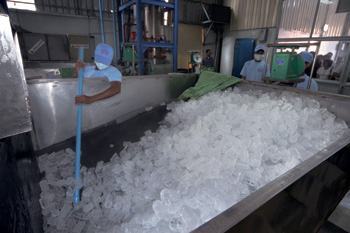
Ice and bottled water manufacturers have called for government advice to help strengthen the sector, highlighting the need for professional knowledge to improve quality.
A lack of skilled industry professionals together with the high cost of utilities were concerns for a group business people, officials and development workers who took part in a tour of Phnom Penh factories at the weekend.

Dang Heng, business service coordinator for private sector promotion at German development agency GTZ, said there were now 650 ice and drinking water enterprises in Cambodia, but only five percent had been accepted as meeting GTZ quality standards.

Dr Davin Uy, of the Food Industries and Biotechnology Institute of Technology of Cambodia, who helps GTZ and the government, warned that bad quality ice and water could lead to diarrhea, stomach ache, colds and headaches. He pointed to factory cleanliness and water filtration as key issues in the production line.

Manufacturers interviewed by the Post on Saturday were united in expressing a desire to improve standards and acknowledged the importance of quality in the market.

Khim Nary, owner of ice company Pop Ice Enterprise, said that her Tuol Kork district factory opened more than 20 years ago.

Although she sells ice to local restaurants, hotel and clubs, the facility lacks professional skills in order to improve products – for instance by keeping ice at low temperatures for longer amounts of time to prevent melting – and therefore widen business opportunities.

“We need more professional skills and advice from the government and NGOs to improve our business,” she said.

Fellow ice manufacturer Chea Sok, owner of Daun Keo City Enterprise, from Takeo province, complained that Vietnamese ice imports were sold cheaply at market due to the lower production costs abroad. He warned that 18 factories in Takeo faced bankruptcy.

“We’re still facing lack of professional skills,” he said. “But we’re focusing on good quality as the main point for competition.”

While Choun Sokha Phu, vice director of VESA Drinking Water, located in Takhmao town, Kandal province, agreed that some in the sector lacked adequate budgets and skills to improve ice and water production.

However, help is on the way courtesy of the government and development groups – such as GTZ – which hope to improve standards.

“We will train them to improve in order to compete with neighbouring countries,” said GTZ's Dang Heng.

Klot Sokha, deputy director of the technical department at the Ministry of Industry, Mines and Energy, said that the ministry’s goal was to establish a technical committee to help skills training.
Production knowledge, he said, had traditionally been passed down through family lines.

Heng Heang, chairman of Phnom Penh Small and Medium Industry Association, added: “If we help SMEs, it will reduce poverty.”

Dollar dip may have benefits (Updated)


Photo by: AFP
A Cambodian worker sews at a factory in Sihanouk province. Experts think the industry may benefit from a weakened dollar.

via CAAI

Sunday, 07 November 2010 19:36 Jeremy Mullins

Cambodia’s garment industry stands to benefit from the declining value of the United States dollar, according to Jayant Menon, principal economist at the Asian Development Bank’s Office of Regional Economic Integration.

The riel has strengthened against the dollar since an announcement last Wednesday that America’s Federal Reserve would buy up Treasury debt at a rate of around US$75 billion per month to the end of June, bolstering the struggling United States economy by $600 billion.

National Bank of Cambodia statistics show the riel strengthened in value by about two percent from Monday to Friday last week, trading at 4,134 riel against the greenback at the end of the working week.

Money changers near Phnom Penh’s Central Market on Sunday were buying one US dollar for 4,060 riel in some instances.

Jayant Menon said the Cambodian garment industry in particular could benefit from the strengthening riel.

“Since the US dollar is Cambodia’s de facto currency, this implies that for exports, both domestic costs and international receipts are determined in US dollars,” he said.

For the Kingdom’s competitors, many received payments in dollars, but paid all domestic costs in the local currencies – which would likely strengthen as the greenback lost value, he said.

“This effect could be particularly important for Cambodia’s clothing exports,” he said.

The declining value of the dollar against most currencies including the riel could also contribute to the “dedollarisation” of the Cambodian economy in the longer run, according to Menon, as “its [US dollar] status as a reliable store of value is likely to be eroded”.

However, he emphasised there were a number of other options besides the dollar for Cambodians to hold savings, such as baht, yuan or gold, and “that the real solution still lies with improving overall confidence of the riel”.

But Garment Manufacturers Association of Cambodia Secretary General Ken Loo said there would likely be little immediate impact from the latest United States stimulus package, as most competing nations were "selling [garments] in US dollars anyways".

Murder she wrote at Freedom Park


via CAAI

Sunday, 07 November 2010 19:33 Meas Sokchea

0diggsdigg Share The president of the Cambodian Independent Teachers Association has said he plans to screen a controversial documentary about murdered trade unionist Chea Vichea at the city’s newly-opened “Freedom Park”.

Who Killed Chea Vichea?, a 2009 film suggesting the outspoken Free Trade Union leader was killed for his activism, has been barred from being screened publicly in Cambodia, but CITA President Rong Chhun said he would attempt to screen it after Independence Day.

“We’re showing this film because we want people to know who killed Chea Vichea,” he said. “We want the government to investigate this case and punish the killer.”

Two suspects, Born Samnang and Sok Sam Oeun, were tried and convicted for Chea Vichea’s 2004 murder, though their convictions were later overturned. Government officials say investigations are ongoing.

Rong Chhun said he would inform City Hall about the screening on Wednesday. Phnom Penh Municipal Governor Kep Chuktema, who inaugurated the Freedom Park last week, could not be reached for comment.

Royalists to unite for congress (Updated)


Photo by: Heng Chivoan
Prince Norodom Ranariddh greets members of the media after announcing his retirement from politics in 2008.

via CAAI

Sunday, 07 November 2010 19:20 Meas Sokchea

The Kingdom’s two royalist parties will hold a joint congress early next year, marking a key milestone in the planned reunification of the groups ahead of commune elections in 2012.
Funcinpec President Keo Puth Reaksmey said his party and the Nationalist Party, formerly the Norodom Ranariddh Party, will hold the congress in February or March in a bid to cement their merger.

He said the new party, which will go under the Funcinpec banner, would also make an effort to attract past members of the royalist movement, many of whom have defected to the ruling Cambodian People’s Party and other opposition groups since Funcinpec split in acrimony in 2006.

It is still uncertain whether Prince Norodom Ranariddh, Funcinpec’s former president, will return from retirement to lead the party. The veteran politician retired from politics in October 2008.

“Everything is up to Samdech Krompreah’s decision as to whether or not [he] will re-enter politics,” Keo Puth Reaksmey said.

“We are going ahead. If the prince is with us, we will get along better, but we will still go ahead without the prince.”

Nationalist Party spokesman Pen Sangha said both parties’ leaders planned to formally invite Prince Ranariddh to head the new-look Funcinpec.

“So far we have not written an official letter to invite the prince. We should be optimistic and must have a step-by-step strategy in place,” Pen Sangha said.

Since romping to victory in United Nations-backed elections in 1993, the royalist movement has experienced a steady decline at the polls.

In 2006, Prince Ranariddh was removed as Funcinpec party president in connection with accusations he embezzled funds from the sale of party property. The self-named breakaway party he formed, renamed the Nationalist Party earlier this year, has fared no better. The two parties won just four seats between them in the 2008 elections.

But Prince Ranariddh’s spokesman Chea Chanboribo dismissed speculation the veteran politician, currently an adviser to King Norodom Sihamoni, is planning a political comeback.

He also criticised Funcinpec officials for driving the Prince out in 2006, and now expecting favours from him as they seek to resurrect the party’s political fortunes.

“Funcinpec’s [officials] have criticised the prince for leading the party down and down until they fired the prince as party president. Now when they are stuck, they call for the prince, but everything is too late,” Chea Chanboribo said.

“It is better that the Prince stays neutral and works for humanity and for the nation.”

Chinese to study four dams (Updated)


Photo by: AFP
Prime Minister Hun Sen and Finance Minister Keat Chhon at the opening of the first stage of Kampot's Kamchay dam in late 2008.

via CAAI

Sunday, 07 November 2010 17:27 Cheang Sokha

related coverage
Cambodia 'most exposed' to dams threat

Cambodia and China have signed an agreement to study the feasibility of four proposed hydropower dam projects amid fresh concerns about the long-term environmental impact of Mekong dam developments.

Suy Sem, the Minister of Industry, Mines and Energy, said the agreement was one of 16 signed on Thursday during meetings with a visiting Chinese delegation led by Wu Bangguo, chairman of the standing committee of China’s National People’s Congress. .

“The signing of these four hydropower dams will allow the companies to study the feasibility of the projects,” he said after the meeting.

“We will discuss this in detail after the completion of the studies, and then will allow for the construction.”

The agreement will pave the way for two state-owned Chinese firms – China Huadian Corporation and China Guodian Corporation – to conduct feasibility studies of the proposed 108-megawatt Cheng Areng dam in Koh Kong and the Srepok III (340 megawatts) and Srepok IV (230 megawatts) projects in Stung Treng.

The firms will also study the feasibility of the Sambor Dam project, planned for the Mekong mainstream in Kratie province, and decide whether the government should proceed with a 460-megawatt option or a more complex 2,600-megawatt design for the site.

Suy Sem did not reveal the total cost of the four proposed projects, but said construction could cost as much as US$1.5 million per megawatt of generating power.

The announcement comes on the heels of a recent report, commissioned by the Mekong River Commission, which argues that dam developments slated for the Mekong mainstream could have far-reaching impacts on Cambodia.

The report claimed more than one million fisheries-dependent people were at risk from the impact of Mekong dams.

The Sambor project, coupled with another proposed dam on the Mekong in Stung Treng, could create an “extreme crisis” for the populations of affected provinces, the report said.
Due to the likely impacts, it recommended a 10-year delay to dam constructions on the river.

Chith Sam Ath, executive director of the NGO Forum on Cambodia, said he was concerned by the news of the four new dam studies, adding that such research was only valuable if conducted independently.

“The evaluators of the environmental impact assessments should be experts from an independent organisation,” he said. “The government should clearly monitor the documents of the feasibility studies before giving permission for the construction of the dams.”

Suy Sem said the Chinese feasibility studies would determine the impact of the dams and play a role in whether they go ahead. “If we figure out that there are serious impacts, then we will not allow the constructions,” he said.

Suy Sem said five hydroelectricity dams are currently under construction in Cambodia, all by Chinese state power companies. Huadian Corp has already been contracted to construct the US$412 million Stung Russey Chrum Krom dam in Koh Kong province.

OSK plans to open 2 branches a year in Cambodia


via CAAI

By Rupinder Singh
Published: 2010/11/08

OSK Holdings Bhd (5053) wants to expand its presence in Cambodia with plans to open at least two new branches a year and introduce services like electronic banking and Internet banking, says a company executive.

OSK owns a commercial bank called OSK Indochina Bank Ltd in Cambodia with eight branches in five provinces.

"We are already in the first and second tier cities ... so our focus would be in expanding to third tier cities," said OSK Indochina chief operating officer and country head Lim Loong Seng.

To fast track its expansion, the company aims to set up more automatic teller machines (ATM) and launch its Internet banking later next year.
"We will be expanding our ATM network and install them at higher traffic areas such as shopping malls and factories. We are already embarking on that," Lim told the media after the official opening of four new branches in an event in Siem Reap, Cambodia on Friday.

With each new branch costing between US$400,000 to US$500,000 (RM1.2 million to RM1.5 million) to set up, Lim said, ATMs would be a cheaper way to reach the masses.

OSK Indochina branches are equipped with Cambodia's first ever 24-hour full-function ATM, offering cash deposit, cash withdrawal, cheque deposit, and cross currency withdrawal facilities, all in one.

Lim said Cambodia represents an enormous opportunity given that less than 10 per cent of the 14 million population has a bank account.

"All we need is basically 5 per cent of the 12.6 million people who don't have a bank account. That is sizeable," he said.

Meanwhile, OSK Indochina's four new branches are located one each in the province of Battambang, Kampong Cham, Preah Sihanouk and Siem Reap.

"With the addition of the four new branches, we will be able to reach out to serve a wider section of the Cambodian population and businesses especially people in the provinces," he said.

OSK Indochina has presence in five of Cambodia's provinces.

The bank recorded a maiden profit of RM234,000 for the first six months to June 30 2010.

OSK Investment Bank group managing director and chief executive officer Ong Leong Huat expects at least a 5 per cent return on investment from OSK Indochina next year.

The group's subsidiary, OSK Indochina Securities Ltd, was recently granted a licence to undertake securities underwriting business, securities dealing business, securities brokerage business and investment advisory business in Cambodia.

Ong said Cambodia holds great potential for the OSK group, more so with the opening of its capital market next year which is expected to spur foreign direct investment and the economy.

Faldo to Create Two New Courses in Cambodia’s Capital


via CAAI
Published by Ozgur Tore

Sunday, 07 November 2010

Sir Nick Faldo was in the Kingdom of Cambodia recently to visit the site for his next golf course design project at the Vattanac Golf Resort in Phnom Penh.

Vattanac Properties has appointed Faldo Design to create two 18-hole championship-standard golf courses that will sit at the heart of a luxury resort 15km from the centre of Cambodia's capital.

Six-time Major winner Faldo was welcomed to the country by Cambodia's Prime Minister, Hun Sen, before heading to the site to work on the golf courses' preliminary designs.

"It was an honour to meet with Prime Minister Hun Sen and I thank him for his gracious welcome to the Kingdom of Cambodia," said Faldo. "This is a large site and offers real flexibility to create two completely contrasting golf courses. We believe the Vattanac Golf Resort in Phnom Penh will complement our existing championship course at Angkor Golf Resort in Siem Reap and further raise the standard for golf in Cambodia, attracting more visitors to the country from across the region."

Sam Ang Vattanac, Executive Director of Vattanac Properties, said: "Partnering with Faldo Design is a match made in heaven. We are a premier property developer and aim to set new benchmarks for quality and innovation in Cambodia. The development of the Vattanac Golf Resort will be another testimony to this.

"We strongly believe in the Faldo Design principles, which will bring out the best that our development has to offer. With a good location and design, I am positive that the golfing landscape and standard will be remarkably transformed. I look forward to the exciting future!"

The Vattanac Golf Resort will include at least one luxury hotel, select private residences and a number of sports, recreation and entertainment facilities that will cater for all the family. It is also intended that the courses will set a benchmark for environmentally responsible and sustainable design in the region.

The Vattanac Golf Resort is the latest addition to a portfolio that includes over 25 Faldo Design projects open for play in 17 different countries across the globe. It is the fifth new project to be undertaken by Faldo Design in Asia within the past 18 months, with work already underway on other sites in India, Vietnam and China.

For more details on Faldo Design visit http://www.nickfaldo.com/