Wednesday, 30 June 2010

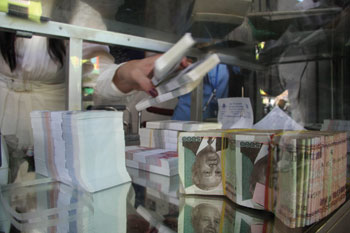
Biggest riel buy-up yet


Photo by: Pha Lina
A money changer exchanges currency at an outlet in Phnom Penh on Tuesday.


via Khmer NZ News Media

Wednesday, 30 June 2010 15:01 Nguon Sovan and Jeremy Mullins

NBC’s latest auctions will bring dollar sales to $30m this year

THE National Bank of Cambodia (NBC) on Tuesday announced a further US$13 million purchase of riels in order to boost the faltering local currency, bringing total buys to $30 million worth so far this year.

The value of the Kingdom’s riel has fallen about 2 percent since April, reaching record lows earlier this year. On Tuesday, it traded at 4,275 to a dollar, from around 4,190 in mid-April, according to Ly Hour’s Phnom Penh exchange.

The riel’s devaluation has sparked NBC to take large amounts of riel out of circulation, in a bid to create artificial demand for the notes, therefore raising its value against the greenback.

The latest $13 million currency sale will be put out by the NBC for bidding in separate, $1 million lots from July 2 to 30. It follows a $7 million sale announced June 13 and $10 million in sales conducted in the three weeks previous.

So far, the ploy has had little success. The June sales were announced when the riel was trading at a stronger level of 4,252 a dollar, and it has remained above the NBC’s preferred rate of between 4,000 and 4,200 riels since.

Analysts believe that the bank’s ploy is the only possible course of action to take in an economy dominated by the dollar.

Asian Development Bank (ADB) Office of Regional Economic Integration’s chief economist Jayant Menon said Tuesday that the government was constrained in its options.

“In most un-dollarised countries, if they felt the exchange rate was unwarranted, they could raise domestic interest rates,” he said.

In such countries raising interest rates, he said, would attract foreign exchange, thereby increasing demand for domestic currency.

But in Cambodia’s case, because the dollar and riel are so transferable, raising interest rates would have little long-term affect on exchange rates.

“The problem with buying up riels is that [US dollar] reserves can’t last indefinitely,” he warned.

But in the meantime, traders remain unconcerned, with Ly Hour Exchange owner Sieng Lim stating Tuesday that the depreciation is “still small”.

ACLEDA Bank officials added Tuesday that a modest depreciation in the riel over the course of the year would not significantly affect financial plans.

“If the riel depreciates a little we are not surprised,” Chief Treasury and Information Officer Cheam Teang said.

The NBC is banking on a seasonal upsurge in riel value late this year, when tourists pump dollars into the economy.

NBC Director General Tal Nay Im said: “Every year, the currency gains value in September or October.”

In the past two years, the riel has bottomed out in July, falling to 4,187 last year.

NBC held $2.5 billion in foreign reserves as of May.

Police Blotter: 30 Jun 2010


via Khmer NZ News Media

Wednesday, 30 June 2010 15:00 Sen David

WOMAN KILLS SELF OVER DAD’S CRITICISM
A 22-year-old killed herself by swallowing poison on Monday after becoming enraged that her father was criticising her for switching phones frequently, police in Kampong Cham province said. The woman’s father reported that on the day in question, he berated his daughter because she was always changing phones to get hold of the latest flashy models. He also had harsh words for her fondness for long evening strolls. This caused the woman to become angry, and she eventually decided to swallow some poison. Her father sent her to hospital, but the effects of the poison occurred too quickly, and she died.
KAMPUCHEA THMEY

BOYFRIEND ACCUSED OF STABBING WOMAN
An 18-year-old woman died on Monday after her longtime boyfriend allegedly stabbed her with a knife when she tried to leave him, police in Battambang reported. Police who arrived at the scene said they managed to speak with the victim as she lay dying. Despite the stabbing, she told them that she and her boyfriend loved each other very much. She had decided to leave him, she said, because he had no money to support her. The boyfriend, who attacked the victim while she was home alone, fled the scene afterwards. The victim’s family members have urged police to arrest him quickly.
DEUM AMPIL

WAT PHNOM CAMERA THIEVES NABBED
Two men were arrested after they allegedly swiped a foreign tourist’s camera at Wat Phnom in Phnom Penh’s Daun Penh district on Saturday. Police said the foreigner took his camera out with the intent of documenting the beauty of the capital’s landmark attraction. But two men came along and stole the device. Both were arrested a short while later. Police said such actions negatively affect Cambodia’s all-important tourism industry. The suspects allegedly admitted to the crime, then helpfully informed police that it was not the first time they had stolen from foreign tourists. They have been sent to court.
RASMEY KAMPUCHEA

BOY DROWNS AFTER LOSING MOTHER
A 5-year-old boy drowned on Monday while he apparently was trying to look for his mother, police in Kampong Cham province said. The impoverished mother of two went to work at the market that morning. The 5-year-old went along with her, but he became separated from her at some point during the journey and lost his way. Frantic, the mother asked police for help. After three hours, villagers found the boy’s dead body in a lake.
DEUM AMPIL

Kingdom’s bilateral trade with UK climbs


via Khmer NZ News Media

Wednesday, 30 June 2010 15:01 May Kunmakara

BILATERAL trade between Cambodia and the United Kingdom is on track to exceed last year’s total, marking further growth in a relationship that has remained resilient throughout the economic crisis, new data show.

Trade between the UK and Cambodia has increased steadily since 2008, even during the global financial crisis when trade with many of Cambodia’s partners plummeted.

In 2009, total trade between the nations was worth US$272.25 million – a 41 percent increase on the 2008 total of $191.49 million.

Trade growth is set to continue in 2010. Statistics released by the British embassy in Phnom Penh on Monday state that trade was 21 percent greater in the first four months of this year when compared to the same period last year, reaching $90.54 million up from $82.27 million.

The import-export breakdown reveals UK imports from Cambodia increased 18 percent, to $93.93 million from $79.75 million, while UK’s exports more than doubled, rising from $2.48 million to $5.53 million.

Neng Vannak, spokesman of the British Embassy, wrote in an email Tuesday that British companies were active in finance, construction, agriculture and garments.

He said the main products the UK sought from Cambodia were clothing and footwear, while the UK’s main exports to Cambodia were machinery, equipment and livestock.

Nguon Meng Tech, director general of Cambodia Chamber of Commerce said that although trade levels are still relatively low: “If we can increase cooperation it would be good for us.”

Fighting the traffic tide


Photo by: Heng Chivoan
A Cambodian Red Cross volunteer uses a megaphone to provide some driving suggestions.

via Khmer NZ News Media

Wednesday, 30 June 2010 15:00 Roth Meas

Teens volunteering for the Cambodian Red Cross do their part to calm the chaos that prevails on the streets of Phnom Penh

TEENAGERS stand in small groups on each corner of the Peth Chen intersection in Phnom Penh, lecturing drivers and passers-by.

Wearing dark blue trousers or skirts, light blue caps, and light blue shirts covered with red vests, some of the teenagers mill about, while others hold flags bearing the logo of the Cambodian Red Cross (CRC).

One of them, 19-year-old Net Vanthet, speaks through a megaphone, his words aimed at the passing motorists.

“We are youths from the CRC, and we would like to inform everyone on the road that you should wear helmets for your safety and never drive over the speed limit. For motorcycles, the speed limit is 30 kilometres per hour, and for cars it is 40 kilometres per hour.”

“Please never use drugs or drink alcohol,” he continued. “Please use headphones when speaking on your mobile phone. Respecting traffic signs will help save your life. The youths of the CRC wish you a safe trip.”

Net Vanthet has been doing traffic duty every Sunday morning since he became a CRC volunteer in 2007.

“I’m happy to spend free time doing social work because I believe it can help reduce road accidents and make travelling safer,” he said.

He said that when he started working as a volunteer, he immediately noticed that many people ignored traffic signs, stopped in the middle of crosswalks and even ran red lights right in front of the CRC youths.

“When people stopped beyond the pedestrian line we would ask them to back up a little, but they would yell at us and didn’t care what we said. Their words hurt our feelings, but we kept working,” Net Vanthet said.

Another volunteer, 14-year-old Prom Panha, said she started volunteering in late 2009 after she saw many traffic accidents near her house and school, and along the roads of the city.

“I always see traffic accidents in many places. I’m scared about that, so I decided to help the Cambodian Red Cross to reduce traffic accidents,” she said.

She said she has noticed that many drivers respect the Red Cross logo when they see it, so they’re more willing to follow her suggestions.

“Drivers habitually stop over the pedestrian line, especially motorcycles,” she said. “Sometimes a driver will stop in the crosswalk, and then when he sees me he will get embarrassed and move back.”

“Many people don’t care about the law, but they care what people think, and they will correct their mistakes when they see people are watching.”

The president of CRC’s safety traffic project, Kim Pagna, said the project has been run since 2005 in cooperation with 12 secondary and high schools in Phnom Penh, including Bak Touk, Boeng Trobak, Wat Koh, Antarak Tevy, Chbar Ampov, Chompou Van, Russey Koe and Toul Tompoung.

At present, there are 1551 students, 817 of whom are female, volunteering for the project.

“Our purpose is to help the government reduce the road traffic accidents in Cambodia,” he said, adding that he targets teenagers to be volunteers because many traffic accidents involve young people.

“To reduce road traffic accidents, we start with the youth first because they are the backbone of the country,” Mr Pagna said. “This project also gives them a chance to learn about traffic laws because we train them about the law before we send them out to the intersections.”

According to statistics released by Handicap International Belgium and Cambodia’s Ministry of Interior, in 2005 there were 904 traffic fatalities in Cambodia. In 2009 the number rose to 1717.

The Phnom Penh Post News in Brief


via Khmer NZ News Media

Bikers race out in Kep

Wednesday, 30 June 2010 15:00 Dan Riley

HONG Chanmakara stormed to victory in the second round of the 2010 Cambodian Mountain Bike Series Sunday in Kep. The local rider finished a minute ahead of the Kheng Ty, with Sieng Makara coming in third in the A class race. A total of 84 participants competed in four divisions of varying standard over the challenging course around Kep National Park, which included a “3-kilometre climb followed by a rewarding downhill section” according to event organiser Pierre-Yves Catry. “Next round is confirmed on July 25 at the Phnom Baseth track [near Phnom Penh] ,so I guess we will see many riders training there in the coming weeks,” added Catry.

Teen TV fans rise

Wednesday, 30 June 2010 15:00 Catherine James

TEENS were the fastest growing age-group among Cambodia’s television viewers in the last six months, according to market research company Indochina Research Ltd (IRL). Figures from IRL’s bi-annual survey show the Kingdom’s youth-dedicated network MYTV has 11 percent of the market, up from 7 percent in the survey released in January. The driver was an increase in 15- to 19-year old viewers, rising to 32 percent from 20 percent. CTN, meanwhile, saw its market share fall to 55 percent from 62 percent. “This decrease is mainly due to the increase of MYTV,” IRL said Monday.

Falling salt price

Wednesday, 30 June 2010 15:00 Chun Sophal

THE price of salt per bag in Cambodia is down 42 percent compared to last year as domestic production exceeded demand because of good weather conditions, according to the Cambodia Salt Producers Association (CSPA). CSPA President Ly Seng said Monday the association sold one 50-kilogram bag of salt to its distributors for 11,600 riels (US$2.76) this week, whereas the same amount of salt sold for 20,000 riels (US$4.87) last year. CSPA has produced 174,000 tonnes of salt this year. In 2009, the association produced just 30,000 tonnes because of poor weather.

More businesses seek registration

Wednesday, 30 June 2010 15:00 May Kunmakara

BUSINESS registrations in the Kingdom increased 32 percent in the first half of 2010, compared to the same period of 2009, according to the Ministry of Commerce (MoC) Tuesday. The number of foreign business registrations surged 46 percent to 620, while Cambodian registrations increased 24 percent to 936. Hum Hean, director general of the MoC’s Business Registrations Department, said companies were restarting their businesses after the crisis. South Korea topped the list for number of foreign business registrations, followed by China and Vietnam. “Most of these countries are investing in agriculture,” Hum Hean said.

Maybank opens its eighth local branch

Wednesday, 30 June 2010 15:00 Jeremy Mullins

MALAYAN Banking Bhd opened its eighth Cambodian branch in Battambang Tuesday, according to a press release. During a speech in January, the Kuala Lumpur-based bank’s chief executive officer, Abdul Wahid Omar, cited a target of increasing its Cambodian branches from 7 to 11 during “the next few years”. The bank opened its first branch in the Kingdom in 1993, but did not expand outside Phnom Penh until June last year.

Border Crisis: Anti-Thai rally to mark anniversary

Wednesday, 30 June 2010 15:02 Cheang Sokha

Border Crisis

The Cambodia Watchdog Council (CWC) plans to gather at Wat Botum on July 15 to express anger at Thailand’s “invasion” near Preah Vihear temple two years ago. On July 15, 2008, Thailand sent troops to disputed border areas close to Preah Vihear temple, a week after UNESCO accepted Cambodia’s application to have it listed as a World Heritage site. “The purpose of the ceremony is to show Thailand that the Cambodian people are dissatisfied with the invasion of Cambodian territory,” said CWC president Rong Chhun.Tith Sothea, spokesman for the Council of Ministers’ Press and Quick Reaction Unit, said organisers would need to obtain permission from the Interior Ministry. “Any gathering without permission would be nonsense,” he said.

Official sold our land, say city families


via Khmer NZ News Media

Wednesday, 30 June 2010 14:00 May Titthara

AROUND 195 Phnom Penh families have accused an Environment Ministry official of selling off 403 hectares of land in Pursat province’s Veal Veng district that was included in a social land concession awarded to them by the government.

Math Osman, a representative of the families, which live along the Tonle Sap river in Russey Keo district, said their request for a social land concession in Veal Veng – filed back in 1999 – had been approved last year.

Following the approval, however, the official, Keo Huo, denied the villagers access to the land and began selling it off to third parties for profit, Math Osman said.

“He has been selling it to other people for about US$700 to $1,500 per hectare,” Math Osman said.

On Monday, the Russey Keo families filed a complaint to the Veal Veng district office, Math Osman said.

He added that only around 20 of the families had received the 25-by-100-metre plots of land they were promised, and that as many as 25 families that were not in the group that was awarded the concession had purchased 1-hectare plots from Keo Huo.

Another villager, who identified himself only as Sras, said that the families that were awarded the concession had been told they could purchase the 25-by-100-metre plots of land for $300.

“My family doesn’t have enough money, so we are still living on a boat,” he said.

When contacted Tuesday, Keo Huo denied that he was involved in any attempt to take the families’ land.

“I did not cheat those 195 families. We have already provided every family with a 1-hectare plot of land,” he said. “Some families who have not been given land have laid accusations against me, but they are bad people.”

Veal Veng district governor Chhe Chhiv said he had not seen the complaint, but added that he doubted Keo Huo was in the wrong.

“No authorities have sold that land. About 45 families have recently come to live in the area, but most of the new villagers have not come yet,” he said.

Penrith CUA regional manager’s charity ride in Cambodia

via Khmer NZ News Media

30 Jun 10
by Lawrence Machado

WHEN Peter Jensen hops on his bicycle in Cambodia, he will be thinking of the educational benefits of the ride in addition to the thrill of discovering a new country.

Peter Jenson is cycling to raise funds to reduce poverty through education and financial help. Picture: MELVYN KNIPE

The Penrith CUA regional manager is embarking on his first charity ride, raising funds to reduce poverty through education and financial help from July 20-24.

“I am looking forward to the ride, though I am not a regular cyclist,” Mr Jensen said.

“But since I was nominated for the ride by my office, I have stepped up my cycling.

“I was into sport a lot until recently, playing cricket, baseball, Oztag, rugby league and soccer.”

The father of two will be joined by nine others for Credit Union Foundation Australia’s Cambodian Leadership Challenge.

“This is the first time I am undertaking such a ride, though I have done community work in the past,” Mr Jensen said.

“I used to mentor teenagers, including some homeless, to help them get into the workforce.”

All riders have to raise $3000 each, with the money going directly to the children.

“We will also be visiting some schools during the 340km ride,” he said.

“It’s a good goal and something I can’t wait to start.”

The challenge raises awareness and funds for a literacy program for children to help alleviate poverty through education.

To make a donation go to cufa.com.au/service/information.php

Cambodian PM and 3 ministers treated for swine flu

via Khmer NZ News Media

By SOPHENG CHEANG (AP)

PHNOM PENH, Cambodia — Cambodian Prime Minister Hun Sen and three other Cabinet ministers have contracted swine flu and the premier is recovering after several days of medical care, the health ministry said.

Hun Sen, 59, required "urgent treatment" after Friday's weekly Cabinet meeting, the Public Health Ministry said in a brief statement released late Tuesday.

"After receiving treatment from medical specialists, the health of Prime Minister Hun Sen is back to normal," the statement said.

The prime minister publicly mentioned last week he had come down with fever and flu-like symptoms, and he was absent from the 59th anniversary of his ruling Cambodian People's Party on Monday.

"Prime Minister Hun Sen has canceled some of his schedule because of his health," said government spokesman Khieu Kanharith.

He said Hun Sen was still receiving medical attention, but gave no details.

The statement also said that Yim Chhay Ly, one of several deputy prime ministers, and two other Cabinet-level ministers — Chhay Than and Tao Senghour — had caught the H1N1 virus. It did not give details about their condition.

At least six Cambodians have died from swine flu and at least 600 have contracted it since the virus was first detected in the country last June.

Hun Sen has been at the center of the country's politics since 1985, when he became the world's youngest prime minister at age 33. He has held or shared the top job ever since, bullying and outfoxing his opponents to stay in power.

MacKillop students off to Cambodia

via Khmer NZ News Media

JACINTA BOLSENBROEK
30 Jun, 2010

MACKILLOP Catholic College Year 12s are heading over to Cambodia this week for a life changing experience.
The 12 students have worked hard during their high school years, volunteering their time in community service, and will embark on their journey this Saturday for 12 days.

Students were selected to go as part of their Service Learning Program based on their participation in voluntary community service over the years.

They also had to be ready and willing to take on the challenge of leaving home and helping members of the community they will live in.

The program has run since 2004, first in East Timor and for the past three years they have been going to Cambodia. Students have helped at the local orphanage, and done some hard labour too.

They are chosen from a large number of students who nominate in Year 11 and spend the next three terms preparing themselves and learning as much as they can about Cambodia, and fundraising.

This year’s group raised $28, 000 from sausage sizzles, movie nights and a local golf day event.

The school works closely to donate money to the community in Cambodia as well as their past community in East Timor.

The money goes entirely to meet the expressed needs of the various organisations.

Students meet all their own costs, and with the support of their families, work extremely hard to fundraise to support the three places they visit, LaValla a Marist school for disabled young people, New Hope for Cambodian Children, an orphanage whose children are infected with HIV, and Hagar, a Christian organisation which works with women and children, (some orphans, many children with disabilities and women and children rescued from the sex industry).

Lisa Baddock, Amber Bateman, Rikki Clark, Luke Hegney, Lauren Hogan, Chelsea Marino, John-Jake McMaster, Perri Nelson, Dean Papalia, Tessa Parry, Emma Ryan and Jack Smith are the 12 students selected, who said they were excited for their adventure.

Kathy Jackson, Paul Byrne and Ollie and Marion Behiels, will be accompanying the students on their trip.

Cambodia Is Hard Sell for Investment Companies


via Khmer NZ News Media

By SIMON MARKS
Published: June 29, 2010

PHNOM PENH — Douglas Clayton arrived in Phnom Penh in 2007 to start a private equity fund, looking to get $100 million in funds under management. His firm, Leopard Capital, started in 2008, is one of four private equity funds here backed by overseas investors, and the first to have completed an investment.

“Anyone can announce they want to start a fund, but getting investors to back you is a challenge,” Mr. Clayton, Leopard’s chief executive and managing partner, said in an interview. “All the groups that started here had no track record, including us. It’s a doubly hard story to sell.”

Mr. Clayton was drawn to Cambodia after experiencing years of double-digit growth in Thailand, where he worked for a hedge fund during the 1990s.

Now ranked at 145 out of 183 countries in the World Bank’s “Doing Business” report, Cambodia is going through its own period of rapid growth. Before the global economic crisis hit in 2008, gross domestic product grew about 9 percent a year for almost a decade. After shrinking by 2.5 percent in 2009, growth is forecast to reach about 5 percent this year.

With $34 million collected so far from an array of international investors, Leopard has completed six investments, including a $2 million, 55 percent stake in Kingdom Breweries, a new microbrewery, and a 31.5 percent share in a recently built shrimp-processing factory. It has loaned about $1 million to an electricity supplier in Kompong Cham Province, in eastern Cambodia.

The traditional private equity strategy of buying out and investing in profitable, pre-existing businesses is rarely an option here, Mr. Clayton said. “The biggest range of opportunities are the businesses that have not started yet.”

Still, in a country where everything is still to be done, “for people who are willing to come in and work very hard and be very entrepreneurial and blaze their own trails, Cambodia is a paradise.”

After decades of civil war and a deadly communist regime that between 1975 and 1979 killed 1.7 million people, Cambodia remains deeply underdeveloped, with four million of its 14 million people living below the poverty threshold, according to the United Nations.

Leopard raised its first $10 million before the financial crisis struck. Cambodia Emerald, a would-be rival, also started in 2008, was not so lucky.

As the crisis bit, “we sort of basically put the fund on hold,” Peter Brimble, founding partner of Cambodia Emerald, said recently. Still, U.S. investors are starting to show interest again, and “we have plans to bring it back,” he said.

Beyond the problems of attracting foreign capital, businesses here say they are confronted with numerous local barriers, the most frequently cited being the extremely limited access to domestic capital, and high transportation and electricity costs.

In 2008, Cambodian bank lending was worth about 25 percent of gross domestic product, compared with more than 90 percent in Vietnam and Thailand.

“Capital is one of the main constraints here,” said Joshua Morris, managing director of Emerging Markets Investments, a private development fund backed by the International Finance Corp. — the World Bank’s private arm — and the Norwegian and Finnish governments. Small and medium-size enterprises “struggle to raise the money they need for expansion,” he said.

Lending is limited by low confidence in the judicial system and a lack of credit information, investment managers say. Mr. Morris, whose $10 million fund operates in both Cambodia and Laos, says he has been “incredibly careful” in identifying prospective business partners and has so far found just two in which he hopes to complete investments this summer.

Apart from their lack of access to cash, Mr. Morris said, Cambodian businesses rarely build proper corporate governance into strategies and fall short on accounting and auditing standards.

“While many businesses excel in generating revenue, there is still a lot of work that needs to be done in terms of the internal processes of the company,” he said. Skilled labor is also limited, although “a pretty solid set of business managers” is starting to emerge from the country’s universities, he added.

Yet, for all the shortcomings, Cambodia is at the heart of developing Asia, surrounded by dynamic economies in Vietnam, Thailand and Laos. Its currency, the riel, is pegged by the central bank at a stable rate of about 4,100 to the U.S. dollar, and inflation is low, at about 4 percent a year.

International road links are developing quickly, and last year Toll Group of Australia signed a contract to operate the long-neglected rail network, which is being rehabilitated. Toll says the first line, between Phnom Penh and the port city of Sihanoukville, will be open to freight by October.

“It’s a very pro-business government here,” Mr. Morris said. “They have placed very few restrictions with regards to where you can invest.”

“The private sector is our engine of economic growth,” Sun Chanthol, vice chairman for the Council for the Development of Cambodia, the government’s investment board, told a business seminar in Phnom Penh this month. “We want to be the facilitator of the private sector.”

Bretton G. Sciaroni, an adviser to the government and a partner at the law firm Sciaroni & Associates in Phnom Penh, said Cambodia had advantages that did not exist elsewhere in the region.

Foreign investors are allowed to own a company outright, without a local partner. There are no restrictions on fund transfers, no exchange controls, and Cambodia is one of the few least-developed countries to have joined the World Trade Organization.

The government is also hoping to establish a stock exchange this year.

“Senior government officials are focused on attracting investment and creating jobs,” Mr. Sciaroni said. “In addition, because Cambodia is a relatively new country with a new economy, there are business opportunities that do not exist in more developed economies. Much needs to be done in Cambodia, and opportunity abounds.” Still, the cost of doing business is higher there than in many other countries in the region. Electricity costs are high because much of the energy is imported, while transportation is costly and slow because of poor infrastructure. Moreover, “the courts do not provide an adequate venue for commercial disputes,” Mr. Sciaroni said. “Dispute resolution remains an important issue for the business community.”Corruption is another problem. “Corruption exists at many levels and is sometimes only the manifestation of a former economy based on informal processes,” said Christophe Forsinetti, vice president of the venture capital fund Devenco.Yet, the fact that Cambodia’s development lags behind that of its neighbors means there is a higher growth potential as the country catches up, Mr. Forsinetti said.Devenco has invested in Gaea, a waste collection company in the main tourist hub — Siem Reap — and in Pharm@link, a Phnom Penh pharmacy chain. “Many sectors are underdeveloped and companies with a specific knowledge can become a leader on their market with small investment amounts,” he said. “We therefore work on a smaller pie. But it is a growing one.”

Locals pressured to leave Oz Minerals mine site

via Khmer NZ News Media

Wednesday June 30, 2010
Cambodia's government has suspended plans to demolish the homes of people living around a proposed Australian mine site.

Local government had been threatening to burn or demolish the homes of people living around the Oz Minerals exploration site in Mondulkiri province to make way for a potential mine.

Melbourne-based Oz Minerals has announced the discovery of a substantial gold deposit in the area and is doing further exploration to see if it is viable.

The government wants residents and small-scale local miners who have moved into the area to move out.

While there is no new deadline for them to do so, the government is now restricting their access to mining chemicals to prevent them from working.

Road blocks and spot checks have been set up by police.

Cambodian PM infected with swine flu: government

Cambodian PM Hun Sen opens a new overpass in Phnom Penh on June 24

via Khmer NZ News Media

PHNOM PENH — Cambodian premier Hun Sen and several top officials have been infected with swine flu, a government spokesman said Tuesday.

"I can confirm he and several ministers have tested positive with the virus," spokesman Khieu Kanharith told AFP, while a letter from health minister Mam Bunheng said the prime minister was now recovering.

The premier was found to be carrying the A(H1N1) virus after his weekly cabinet meeting on Friday and medics subsequently tested all ministers and officials attending the meeting, according to the letter.

It said tests found Deputy Prime Minister Yim Chhay Ly, two senior ministers and two officials were also infected with the virus and are now being treated carefully by doctors, although it did not give their whereabouts.

"After being treated carefully by Cambodian doctors, the Prime Minister's health is returning to normal," the letter said, adding that Hun Sen had failed to attend his ruling party's anniversary and cancelled other appointments.

The World Health Organisation said earlier this month that 18,156 people had died from swine flu, a year after the influenza was declared a pandemic, but that the virus was now "globally less active".

In Cambodia six people have died from the virus and another 591 have been infected, according to the country's health ministry.

Decreased Reports of Domestic Violence

Chun Sakada, VOA Khmer | Phnom Penh
Tuesday, 29 June 2010

via Khmer NZ News Media

Photo: AP
The government survey included 150 local authorities and 150 police.

“We are happy with the positive result of the survey, but we must do our best to eliminate violence against women in Cambodia.”

Reported domestic violence against women in Cambodia may be decreasing, although the numbers remain relatively high, according to a report released Tuesday.

In a government survey of 3,000 Cambodians, 54 percent said they knew a husband who physically abused his wife, down from 64 percent in a survey from 2005. The survey included 150 local authorities and 150 police.

“We are happy with the positive result of the survey, but we must do our best to eliminate violence against women in Cambodia,” said Ing Kantha Phavi, the Minister of Women’s Affairs.

The survey, conducted with support from non-governmental agencies, also found that 22.5 percent of female respondents suffered some form of abuse at least once in her life.

Meanwhile, nearly a third of the men and a quarter of the women thought it “acceptable” in some circumstances for violent acts against a wife: such as shooting, stabbing or throwing acid.

More than half of the women questioned agreed with at least one reason or another that justified a man beating his wife.

Analysts Look for Lessons in 2008 Crisis

Ros Sothea, VOA Khmer | Phnom Penh
Tuesday, 29 June 2010

via Khmer NZ News Media

Photo: AP
In 2008, the Cambodian government has decided to double the private bank reserve requirement in a bid to reduce cash flow in the economy and tame inflation.

“And the other area is to manage natural resources more transparently, which not only provides additional sources of growth, but also additional revenue for the budget.”

Economists say the lessons of the recent economic crisis should encourage policymakers to revise some of their macroeconomic principles and make immediate improvements in fiscal management, infrastructure and other areas to make the country more competitive in the global recovery.

National and international experts met last week for a high-level workshop to find ways Cambodia might maintain economic growth in the face of the new economic realities brought about by the financial crisis.

The crisis should signal a time for improvements in fiscal policy, economic diversification, investment climate and social protection, among others, experts said.

Better fiscal management can increase revenue, while improved infrastructure, including in rural areas, can bring more investment, said Qimao Fan, the World Bank’s Cambodia country manager.

“And the other area is to manage natural resources more transparently, which not only provides additional sources of growth, but also additional revenue for the budget,” he said.

A low-income country like Cambodia depends much on external markets for growth, which also makes it vulnerable to external shocks like the 2008 crisis. The crisis caused garment orders to plummet, hitting the garment industry hard, for example.

Do Hong Hanh, Vietnam’s country representative for the Asia Competitive Institution, said Vietnam limits exports to 20 percent to any one nation to limit risk. By contrast, Cambodia depends on the US market for 40 percent of all its total exports.

Meanwhile, Vasana Mututnanont, executive director of international affairs division of Thailand’s board of investment, said a crisis was actually a good time to attract investors.

“When Thailand was hit by the financial crisis, we had to create a new incentive in order to make it more attractive,” she said. “We had to maintain and make a good connection with companies that were already in Thailand because they can be good speakers for the country, if they are happy.”

“For newcomers, when you know who to attract, you have to make appointments with them instead of waiting for them to come,” she added. “So for Cambodia, it will be better if you will do the same things.”

Improved tax collection was at the top of the agenda. Cambodia’s total tax revenue for 2009 was $1 billion, a low figure compared to other countries. As a result, Cambodia needs an additional $1 billion in assistance from international donors.

Vann Puthipol, director of department of large taxpayers at the general department of taxation for Cambodia’s Ministry of Finance, said he is working on improving collection.

“First, we have to educate taxpayers,” he said. “Second, we strengthen the tax payment service. Third, we strengthen the auditing system to find out who is avoiding paying tax, and we will punish them.”

Cambodia will also benefit from the implementation of property and petroleum taxes, he said.

An increase in the tax rate could also help, said Pisit Puapan, director of economic analysis for Thailand’s Ministry of Finance.

Still more improvement can come by diversifying the agricultural products sold by Cambodia, said Nagesh Kumar, director of macroeconomic policy at the UN Economic and Social Commission for Asia and the Pacific.

But in order to do that, Cambodia must attract more investment, increase its productivity and extend its export market.

Experts also urged Cambodia to increase economic stability by improving the banking system and taking measures to de-dollarize.

A draft of the strategies is expected this week through UNESCAP, with a more detailed report to be released later this year.

In ‘Red Light,’ a Portrait of the Sex Trade

Men Kimseng, VOA Khmer | New York
Tuesday, 29 June 2010

via Khmer NZ News Media

Photo: AP
Puerto Rican singer Ricky Martin, center, meets with victims of sexual exploitation during a visit to a shelter, in Siem Reap.

“The drunk chief of police who raped my daughter came to my home.”

A sex trade documentary that was four years in the making and took the collaboration of a politician and a former sex slave turned advocate premiered in New York last week, highlighting an ongoing problem fed in part by collaboration of society, officials and police.

“Red Light” shows how parents sell daughters, government officials use secret brothels to procure sex and the extent to which the trade exposes children to abuse.

The film, which took more than four years to make, was produced in part by actress Lucy Liu and features activist Mam Somaly, who escaped the brothels as a girl, and opposition lawmaker Mu Sochua, who was once a minister for women’s affairs.

Filmmakers used hidden cameras and took risks in brothels to bring back footage from the sex trade to increase awareness of the dangers of exploitation.

“When I saw the movie, I remembered every word those children said,” Mu Sochua told VOA Khmer after the screening. “I can still smell the mud at the brothels I passed on my way to Poipet. I can never forget the tears and emotion of these girls, who described to me their hardships and their experiences, [such as] losing their virginity for the first time, after they were sold to brothels, and being forced to serve more than 10 clients a day. We, as parents and as responsible people, cannot stand for that.”

“Red Light” examines betrayal by neighbors and friends who lure children into the sex trade. A 14-year-old girl describes her rape and subsequent sale by a neighbor to a brothel. She is then sold from one brothel to another. Two girls are sold by their own parents into brothels.

Another girl, Ani, 13, was forced to sleep with high-ranking government officials in a brothel disguised as a noodle shop.

“The drunk chief of police who raped my daughter came to my home,” Ani’s father says in the film. “He told me I should let him sleep with my daughter again. “I would never sell my daughter. You would have to kill me.”

“Red Light” is also a reminder of the loopholes in Cambodia’s legal frameworks that allow perpetrators to buy their way out of trouble.

“We need to ask ourselves, mostly men, why do men have this urge to exploit a little child, whether it’s a boy or a girl,” Adi Ezroni, one of three directors, said at the screening. “And that’s really the issue that we have to speak about.”


Film production team took risks from those who benefit from the business. They had to use hidden cameras to film in the lucrative karaokay parlors and brothels. Film makers hope their film will help raise more awareness of the danger of sexual exploitation children face.

“With enough of this education and exposure we are able to change both people’s mindset, law...and to decrease demand because as far as I am concerned kids should never ever be raped and touched by anybody,” film maker Guy Jacobson told journalists. “I don’t care who the kid is and I don’t care who the adult is, there is absolutely no scenario in which it is okay for an adult to have sex with a kid; period.”

However, victims get discriminated when they try to integrate back into society.

“I would like to make a new appeal to please have a pity on those people both the children and women. It was not their choice to fall into this trap of prostitution,” said Mu Sochua. “Once the society discriminates against them, they will lose their future.”

The premiere drew a wide range of audience including celebrities and rights activists.

“I just feel that we need to take some actions and that a lot of countries need to get involved than being involved now,” Cynthia Kirchner, an actress and model, told VOA Khmer. “The girls are so strong to have gone through what they’ve gone through and to tell their story and they are just so brave and I think that everyone that has involved has done such a good job in getting their story told.”

CAMBODIA: Life of sells spiders to travellers

A Cambodian woman sells deep-fried spiders at the town of Skun, Kampong Cham province, 75 kilometers (46 miles) northeast of Phnom Penh, Cambodia, Tuesday, June 29, 2010. The town is the well-known place for selling deep-fried spiders to travelers, who stop by on their way to and from the country's northern and northeastern provinces. Live spiders are also put into rice wine to make traditional medicinal liquor. (AP Photo/Heng Sinith)


A Cambodian girl sells deep-fried spiders to at the town of Skun, Kampong Cham province, 75 kilometers (46 miles) northeast of Phnom Penh, Cambodia, Tuesday, June 29, 2010. The town is the well-known place for selling deep-fried spiders to travelers, who stop by on their way to and from the country's northern and northeastern provinces. Live spiders are also put into rice wine to make traditional medicinal liquor. (AP Photo/Heng Sinith)


Cambodians buy deep-fried spiders at the town of Skun, Kampong Cham province, 75 kilometers (46 miles) northeast of Phnom Penh, Cambodia, Tuesday, June 29, 2010. The town is the well-known place for selling deep-fried spiders to travelers, who stop by on their way to and from the country's northern and northeastern provinces. Live spiders are also put into rice wine to make traditional medicinal liquor. (AP Photo/Heng Sinith)


A Cambodian woman collects live spiders for sale at the town of Skun, Kampong Cham province, 75 kilometers (46 miles) northeast of Phnom Penh, Cambodia, Tuesday, June 29, 2010. The town is the well-known place for selling deep-fried spiders to travelers, who stop by on their way to and from the country's northern and northeastern provinces. Live spiders are also put into rice wine to make traditional medicinal liquor. (AP Photo/Heng Sinith)


A Cambodian woman collects live spiders for sale at the town of Skun, Kampong Cham province, about 75 kilometers (46 miles) northeast of Phnom Penh, Cambodia, Tuesday, June 29, 2010. The town is the well-known place for selling deep-fried spiders to travelers, who stop by on their way to and from the country's northern and northeastern provinces. Live spiders are also put into rice wine to make traditional medicinal liquor. (AP Photo/Heng Sinith)


A Cambodian girl shows to travelers a live spider clinging on her shirt at the town of Skun, Kampong Cham province, 75 kilometers (46 miles) northeast of Phnom Penh, Cambodia, Tuesday, June 29, 2010. The town is the well-known place for selling deep-fried spiders to travelers, who stop by on their way to and from the country's northern and northeastern provinces. Live spiders are also put into rice wine to make traditional medicinal liquor. (AP Photo/Heng Sinith)


A Cambodian girl shows to travelers a live spider clinging on her shirt at the town of Skun, Kampong Cham province, 75 kilometers (46 miles) northeast of Phnom Penh, Cambodia, Tuesday, June 29, 2010. The town is the well-known place for selling deep-fried spiders to travelers, who stop by on their way to and from the country's northern and northeastern provinces. Live spiders are also put into rice wine to make traditional medicinal liquor. (AP Photo/Heng Sinith)

SRP Speach in Manila during CALD Meeting

Sam Rainsy's Speech in Manila on 06-28-2010


sokhour55 | June 28, 2010

Sam Rainsy's speech in MANILA during CALD( Council of Asian Liberala and Democrats) meeting on June, 27 2010.


Mrs.Mu Sochua's speech in Manila, Philippine.June 28, 2010

Cambodia sends Vietnamese martyrs’ remains home

via Khmer NZ News Media

06/29/2010

The Cambodian provinces of Kongpong Thom and Kongpong Cham on June 29 held a solemn ceremony to hand over the remains of 83 Vietnamese martyrs to Vietnamese provinces of Binh Phuoc and Tay Ninh.

Speaking at the ceremony in Kongpong Thom province, provincial chairman Chum Chuan expressed his delight at the fine results of cooperation between the two countries in exhuming and moving the remains of voluntary Vietnamese soldiers who died in Cambodia.

This demonstrates the Cambodian people’s deep gratitude towards Vietnamese families whose relatives had died for Cambodia’s independence struggle, he said, adding that the work will be continued until the last set of remains is found.
The province of Krache will also have a similar ceremony on June 30 to hand over 81 sets of remains of Vietnamese martyrs to Vietnam.

Monk filmed naked women

via Khmer NZ News Media

Jun 29, 2010

PHNOM PENH (Cambodia) - A CAMBODIAN court charged a Buddhist monk on Tuesday for secretly filming hundreds of women as they bathed naked with holy water at a temple and then sharing the clips, officials said.

Net Khai, 37, faces up to a year in jail after being charged with 'producing and distributing pornographic images' by Phnom Penh Municipal Court, prosecutor Ek Chheng Huot told AFP.

He was arrested at his pagoda in the Cambodian capital on Saturday over allegations that he secretly taped the women pouring sacred water over themselves in a pagoda bathroom, said police chief Touch Naruth.

Net Khai was arrested after a victim approached police and said that video clips showing the naked women had been shared among people via their mobile phones in recent weeks. He was subsequently stripped of his religious status.

'He has filmed hundreds of women since 2008. They came to the monk to be blessed with holy water, but they were secretly filmed,' Touch Naruth told AFP. 'His act affects other monks and Buddhism and seriously harms our tradition,' he said, adding that Net Khai had confessed to his crimes.

Police said they were looking for the man's accomplices. There are more than 55,000 Buddhist monks across Cambodia, which has 4,300 pagodas. -- AFP.

Cambodia's foreign tourist arrivals rise 11.5% in first 5 months

via Khmer NZ News Media

English.news.cn
2010-06-29

PHNOM PENH, June 29 (Xinhua) -- Foreign tourist arrivals in Cambodia increased 11.5 percent in the first five months of this year, compared to the same period last year, according to the statistics released by the Ministry of Tourism on Tuesday.

From January to May this year, Cambodia had received 1,054,821 foreign tourists, up 11.5 percent, compared to the same period last year of 945,807 tourists, said the report.

Of the figure, Vietnam placed number one among the top ten, up 43.76 percent to 175,937, and followed by South Korea and China, increased by 33.53 percent to 125,455 and 32.07 percent to 74,558, respectively.

Whilst Thailand ranked ten among the top ten markets arrivals to Cambodia with the tourist number declined 13.83 percent to 36, 995 from 42,931 due to the turmoil in the country.

According to the report, for the month of May alone, tourists to Cambodia increased by 16.9 percent to 170,164 in 2010 from 145, 564 the same month of last year, of which Vietnamese tourists increased by 68.31 percent to 36,992, South Korea rose 44 percent to 19,108, and Chinese tourists up 43.45 percent to 11,162, while Thailand dropped 3.45 percent to 7,392.

Editor: Xiong Tong

More Cambodian youth watch TV during World Cup finals

via Khmer NZ News Media

PHNOM PENH, Jun 29, 2010 (Xinhua via COMTEX) -- More Cambodian youth have watched televisions during the World Cup in South Africa according to a survey conducted by Indochina Research Ltd. (IRL), local media reported on Tuesday.

The research showed that the percentage of the TV fans aged from 15 to 19 increased by 32 percent in the month of June alone, and that of general population aged from 20 to 29 who watches TV increased by six percent in June, Local Khmer newspaper Rasmei Kampuchea reported.

Those respondents were watching MYTV, a branch channel of CTN (Cambodian Television Network) which airs World Cup matches, the research showed.

Glen Felgate, general director of CTN said he anticipated that the group phase of FIFA 2010 World Cup will attract some 50 percent of the watchers to his network and the number will be higher in the elimination stage.

The IRL will issue a final research result on the TV fans for 2010 World Cup next month.

Ruling party time


Photo by: Khem Sovannara

via Khmer NZ News Media

Tuesday, 29 June 2010 15:00 Khem Sovannara

Cambodian People’s Party (CPP) and Senate President Chea Sim (foreground, right) shakes hands with supporters as Sok Sambath, Daun Penh district governor, looks on during the CPP’s 59th anniversary celebration at party headquarters on Monday.

Land-mine casualties see a spike


Photo by: Heng Chivoan
A land mine located by Cambodian Mine Action Centre deminers prior to its destruction in Battambang province in April 2009.

via Khmer NZ News Media

Tuesday, 29 June 2010 15:03 Irwin Loy and Chhay Channyda

Officials say shortage of funds could slow deminers’ progress

WHEN an anti-tank mine exploded along a bumpy dirt road in Pailin province in early May, it marked the start of what would be the worst month for land-mine casualties recorded in Cambodia in nearly three years, according to statistics released Monday.

The explosion, which killed five people and injured nine others, was a reminder of the uphill battle Cambodia still faces in reducing land-mine casualties, and underscored why authorities say they have been forced to re-evaluate the Kingdom’s timeline to end accidents.

It happened in Pailin’s Stung Treng commune, where there have now been more casualties from land mines recorded than any other commune in the country over the last two years, according to government statistics.

Ry Dara, the commune’s police chief, said a loaded van heading to nearby cassava fields was driving through the rain when it hit a mine lying just beneath the road’s surface.

Three people were killed instantly, and another two people died in hospital, he said.

“Villagers felt shocked, because they did not know the area had mines,” he said.

Before May, there had been only one land mine casualty recorded in Pailin province for the entire year. By the end of the month, the Cambodian Mine/Explosive Remnants of War Victim Information System, which tracks data on land mine casualties, had recorded 50 casualties nationwide – the highest monthly total reported since August 2007.

Chhiv Lim, the CMVIS project manager, said spikes in casualties are not uncommon, and that they tend to occur, for example, around March and April, when land is being cleared in preparation for the upcoming wet season.

But he added that the May report was worrying, in part because it brought the number of casualties recorded this year to 134, five higher than the number of casualties recorded in the first five months of last year. There were 244 casualties in all of 2009, meaning that Cambodia could potentially see an increase in land-mine casualties in 2010 for the first time in six years.

“We’re very concerned about this. We need to study more about why this happened,” Chhiv Lim said.

MDG target to change
Over the longer term, Cambodia has managed to significantly reduce land-mine casualties, from 1,691 in 1993 to 244 last year.

But authorities have acknowledged that its initial obligation to clear all contaminated areas in the Kingdom by 2009 – part of its commitment under the Ottawa Treaty, which bans the use of land mines – may have been unrealistic.

Cambodia was granted a 10-year extension on that goal during a gathering of parties to the treaty held in Cartagena, Colombia, in December.

Now, authorities are also reconsidering Cambodia’s Millennium Development Goal pertaining to the eradication of land mines.

The Kingdom’s target to eliminate land mine casualties and clear all contaminated areas by 2012 will now be “impossible” to reach in such a short period of time, Leng Sochea, deputy secretary general of the Cambodian Mine Action and Victim Assistance Authority (CMAA), said Monday.

“Last week, we had a discussion … to refocus our goal,” he said. “The old goal was a bit too ambitious to achieve.”

A more realistic objective, he said, would be to reduce land mine casualties by the rate at which they have dropped since 2005 – roughly 10 percent a year.

“Through the experiences of the last two years, we have seen that this figure may be more realistic,” Leng Sochea said.

Officials have warned, however, that fluctuations in international funding could have an impact on whether Cambodia will meet any new targets on reducing land mine casualties.

Leng Sochea said the government would require roughly US$330 million for its new 10-year plan. But money has been short as of late.

For the last three years, Cambodia has received $29-30 million each year for mine-clearance programmes.

“But this year, the figure is down,” Leng Sochea said. “Up until now, we have secured around $23 million only.”

He attributed the drop to global factors such as economic conditions in donor countries.

“If the development partners keep their promises and give funds, maybe we can clear the land and meet our obligations. We need the development partners to be responsible,” he said.

International groups that work on mine issues in the Kingdom have also been hit by funding cuts.

Cameron Imber, programme manager for mine-clearance charity The Halo Trust, said his organisation’s budget has dropped from $7 million to $4 million in two years.

If the funding continues to decline next year, the organisation is facing the possibility of laying off 40 percent of its 1,100-member staff – the majority of whom work in the mine fields on a daily basis, he said.

“We’ve had to scrimp and save, but we won’t be able to do it anymore,” Imber said.

He attributes the shrinking funds to “donor fatigue”.

In Afghanistan, where he worked for more than four years before coming to Cambodia, funding was never an issue.

“It was the focus of global attention. Here, the attention is dropping off slightly,” he said.

“It is a problem. At the end of the day, the more de-miners out there, the more mines will be cleared.”